UAD EMT 140 and 250 Go Native: Plate Reverb Without Apollo
UAD EMT 140 plate and EMT 250 electronic reverb now run native — no Apollo required. Live prices, Spark inclusion, specs, and how they compare to FutureVerb.
Black Friday 2026Universal Audio Black Friday 2026: dates and deals →
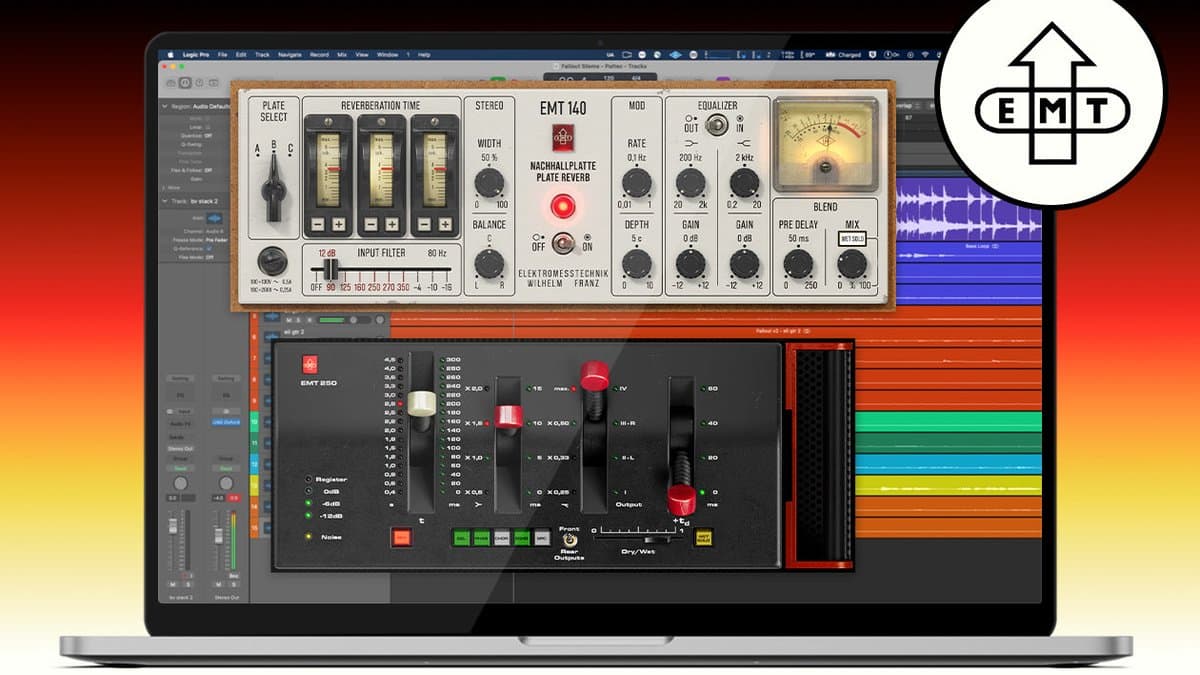
Universal Audio released native versions of UAD EMT 140 Classic Plate Reverberator and UAD EMT 250 Classic Electronic Reverb on August 4, 2026. Both titles now run on a Mac or Windows CPU. An Apollo interface or UAD Accelerator is optional, not required.
A 1957 steel plate and the 1976 digital unit that followed it are no longer locked to UA DSP hardware.
At a glance: $79 intro / $149 regular each (verified on UA product pages, August 19, 2026; intro listed through August 31). VST3, AU, and AAX 64. Included in UAD Spark. 14-day demo. Endorsed by EMT International. No Apollo required.
Why native matters
For years these two titles lived on UAD-2 DSP. No Apollo or Accelerator meant no plug-in. UA has been moving flagship models onto the host CPU — the same path as UAD Explore FREE and Paradise Guitar Studio. These two EMT-endorsed classics now need only a free iLok account and UA Connect.
Native (UADx) plug-ins process on the computer. DSP versions still run on Apollo hardware for near-zero-latency tracking. UA states the models are the same either way. You can mix native on a laptop, then track through the Apollo DSP version if you own one.
Current owners of the Apollo DSP versions get upgrade SKUs on the product pages. On August 19 the EMT 250 Upgrade variant listed at $149 — the regular price, not the $79 intro — so check the cart before assuming a discount.
This is a first look from Universal Audio's official pages, not a hands-on session. We have not loaded either plug-in on a mix. What follows is the verified feature set, live pricing, and where each title sits against a modern algorithmic alternative.
What the EMT 140 actually is
The EMT 140 Classic Plate Reverberator models three physical EMT 140 plates captured at The Plant Studios in Sausalito, California. UA and EMT International present it as the only fully endorsed software EMT 140.
A plate is not a room. A steel sheet hangs under tension; a voice coil drives it; pickups read the vibration. The decay is dense and bright, with a fast onset UA calls a "whip-like attack." Plates sit on vocals and snare because they add sustain without placing the source in a hallway.
The three plate models are not EQ presets on one algorithm:
- Plates A and B use original EMT electronics that, per UA, had not been tuned in some time. UA frames them as looser, worn-in textures for vocals and acoustic sources.
- Plate C uses serviced Martech electronics. UA calls it the more full-frequency, open, and bright option — the one it points at drums.
Hardware plates did not offer stereo width, left/right balance, or LFO modulation. The UAD plug-in adds Width, Balance, Modulation, onboard EQ (low and high shelves), predelay (0–250 ms on the official GUI), and a wet/dry mix.
UA's published tips: use Width to park a snare plate narrow and a vocal plate wide; Balance to keep a snare return centered; Modulation so the tail does not ring as a static metal note; Predelay so the dry attack speaks before the bloom.
Three captured units in one insert is the pitch if you already keep a plate on vocals and another on snare. It is not a hall, chamber, or shimmer engine. For those jobs, start with our best reverb plugins in 2026 rather than forcing the 140 to impersonate a room.
What the EMT 250 actually is
The EMT 250 Classic Electronic Reverb is a different machine. EMT shipped the hardware in 1976 as the first commercially available digital reverb and modulation unit. Only a few hundred were built. UA's plug-in uses the algorithm from a "golden unit" at Ocean Way Recording and is the only emulation EMT International has endorsed.
Official copy is consistent on the hardware split: the 140 is a mechanical plate; the 250 is early digital, with extra programs the plate never had.
Those programs are why you would buy the 250 instead of a second plate: Reverb, Delay, Echo, Phase, Chorus, and Space (Space / BIN on the official GUI). That is the original hardware set, not a modern multi-FX rack. UA adds Dry/Wet Mix, Wet Solo, and hard bypass. The company also says it modeled the A/D conversion, so driving the input changes the tone — UA's modeling note, not something we have verified in a session.
Use the 140 for plate density on a lead or snare. Use the 250 for that early-digital program sound, or when you need chorus, phase, echo, or delay in the same color as the reverb.
Official Universal Audio tutorial, verified via YouTube oEmbed on the Universal Audio channel.
EMT 140 and EMT 250 specifications
Verified August 19, 2026 from UA product pages, the August 4 press post, and UA's UAD Native (UADx) system-requirements article.
| Spec | EMT 140 Classic Plate Reverberator | EMT 250 Classic Electronic Reverb |
|---|---|---|
| Type | Modeled steel plate (3 physical units) | Modeled 1976 digital reverb / modulation |
| Source | Three EMT 140s at The Plant, Sausalito | Algorithm from an Ocean Way "golden unit" |
| Endorsement | EMT International | EMT International |
| Extra programs | Plate A / B / C | Reverb, Delay, Echo, Phase, Chorus, Space |
| Plug-in-only extras | Width, Balance, Modulation, EQ, predelay | Dry/Wet, Wet Solo, hard bypass |
| Formats | VST3, AU, AAX 64 | VST3, AU, AAX 64 |
| OS | macOS Big Sur 11–Tahoe 26; Windows 10/11 64-bit | Same |
| CPU | Intel, AMD, or Apple silicon (native on Apple silicon) | Same |
| Auth | Free iLok account; UA Connect; iLok USB optional | Same |
| Hardware | None required; optional Apollo / UAD-2 DSP | Same |
| Demo | 14-day fully functional | 14-day UAD Native demo |
| Spark | Included | Included |
| SKU (full) | UADX-EMT140 | UADX-EMT250 |
| Live price | $79 intro / $149 regular | $79 intro / $149 regular |
| Intro window | Listed through August 31, 2026 | Listed through August 31, 2026 |
UA's tested DAW list for UADx includes LUNA, Logic Pro 11.2, Ableton Live 12.2, Cubase 15, Pro Tools 2025, Studio One Pro 7, and FL Studio 2025. Reaper is noted as limited testing with no known issues. Plug-ins are 64-bit only.
UAD EMT vs Valhalla FutureVerb
Valhalla FutureVerb is the comparison that matters if you are shopping a new reverb in 2026. It is $50 from Valhalla DSP, with eight reverb modes (Room, Chamber, Plate, Hall, Cathedral, Space, Frozen, Nonlin) and twelve echo modes. Valhalla designed those algorithms for transparency — the opposite brief from UA's EMT pair.
| UAD EMT 140 + 250 | Valhalla FutureVerb | |
|---|---|---|
| Price (live) | $79 / $149 each, or both via Spark | $50 (Valhalla store) |
| What it models | Specific EMT hardware, EMT-endorsed | Original algorithms, not a hardware clone |
| Plate | Three captured EMT 140 units | One Plate mode in an 8-mode set |
| Other spaces | None (140) / early-digital programs (250) | Room, Chamber, Hall, Cathedral, Space, Frozen, Nonlin |
| Delay / echo | 250: Delay, Echo, Phase, Chorus, Space | 12 echo modes, including tape, digital, shimmer, Swarm |
| Formats | VST3, AU, AAX 64 | VST2.4, VST3, AAX; AU on Mac |
| Auth | iLok + UA Connect | Valhalla license (no iLok) |
| Subscription | Included in UAD Spark ($19.99/mo or $149.99/yr) | Perpetual only |
| Hardware lock | None for native; DSP version optional | None |
Which to pick. Buy the UAD pair if the job is that plate or that 1976 digital box — the endorsed models of the machines UA cites on records from The Beatles and Pink Floyd (140) to Prince and Elvis Costello (250). Buy FutureVerb if you want one plug-in that covers rooms, halls, plates, gated nonlinear, freeze, and a full echo section for $50. The FutureVerb plugin page is the spec card.
They do not replace each other. FutureVerb Plate is an algorithm; the UAD 140 is three specific machines. If FutureVerb is already on a send, treat the UAD titles as character inserts.
Who it's for — and who should skip
Buy the 140 if you mix vocals and snare and want a dedicated plate with three captured units plus Width, Balance, and Mod. Buy the 250 if you want the early-digital program box — reverb plus the five extra modes — and you care that the algorithm is the Ocean Way unit EMT signed off on. Buy both if you already subscribe to UAD Spark, or if $119 for UAD Mix Tape Pro (both EMT titles plus eight other UAD titles, August pricing) beats two separate intros.
Skip both if you need halls, chambers, freeze, or shimmer from one window. FutureVerb, or the picks in our 2026 reverb guide, cover that ground for less. Skip the perpetual licenses if you only want to try UA's native catalog — Spark is $19.99 a month and already includes these two. Skip if you refuse iLok; a free iLok account is required even though a USB dongle is optional.
Apollo owners who already have the DSP versions should price the Upgrade SKU against the $79 Full Version sale. The sale can be cheaper. Native also does not give you Apollo's near-zero-latency DSP monitoring. If you track through reverb in headphones and own an Apollo, the DSP build still has a job.
How much the EMT 140 and 250 cost
Live prices on uaudio.com/products/emt-140 and uaudio.com/products/emt-250 on August 19, 2026:
- Full Version: $79 each (intro). Regular / compare-at: $149 each.
- Intro window: listed through August 31, 2026 (
priceValidUntilin page schema). - UAD Spark: both included. $19.99/month or $149.99/year on UA's Spark page.
- UAD Mix Tape Pro: $119 in August — EMT 140, EMT 250, and eight additional titles (product page).
- Upgrade SKUs: listed for DSP owners; EMT 250 Upgrade was $149 the day we checked.
- Demo: 14 days, started from the plug-in GUI.
A stale FAQ line on the EMT 140 page still mentions $29. The live offer, Open Graph price, and schema.org offer are $79 / $149. We used the live offer.
EMT 140 on Universal Audio EMT 250 on Universal AudioUA sells these direct. Spark is the subscription path: UAD Spark.
On August 19, two affiliate storefronts also listed live SKUs we could verify:
- EMT 140 Classic Plate Native at Thomann — £67, Software Deals until 2026/08/31. The UK page did not publish a 30-day best price or RRP.
- UAD Mix Tape Pro at Plugin Boutique — $119 from $149, 20% off until August 31. That bundle lets you pick 10 titles from 45. Plugin Boutique still lists the hardware EMT 140 and EMT 250 as non-native options inside the Mix Tape Pro picker, so it is not a substitute for the native EMT SKUs above.
We did not find a Plugin Boutique or Best Service listing for the native EMT 140 or EMT 250 SKUs on August 19. Official UA links stay the source for those two intros.
FAQ
Do the UAD EMT 140 or EMT 250 require an Apollo?
No. The native (UADx) versions run on the host CPU on macOS or Windows. Apollo or a UAD-2 Accelerator is required only for the DSP build and low-latency tracking.
How much do UAD EMT 140 and EMT 250 cost?
$79 each introductory, $149 each regular, verified on the official product pages on August 19, 2026, with the intro listed through August 31. Both are included in UAD Spark. Mix Tape Pro is $119 in August and includes both plus eight other titles.
What is the difference between the EMT 140 and the EMT 250?
The 140 is a modeled steel plate with three captured units (A and B, original EMT electronics; C, Martech). The 250 is a modeled 1976 digital reverb with Delay, Echo, Phase, Chorus, and Space programs. UA presents them as complementary, not alternatives.
Are they included in UAD Spark?
Yes. Both product pages and the Spark catalog list EMT 140 and EMT 250 as included UAD Native titles. Spark is $19.99/month or $149.99/year.
What are the system requirements?
macOS Big Sur 11 through Tahoe 26, or 64-bit Windows 10/11; Intel, AMD, or Apple silicon; a DAW that hosts VST3, AU, or AAX 64; a free iLok account; UA Connect; and an internet connection to authorize. Apple silicon runs native. Boot Camp Windows on Mac and Hackintosh systems are unsupported. Full list: UAD Native system requirements.
Sources
- UA press: native EMT 140 and EMT 250 (August 4, 2026)
- EMT 140 product page and EMT 250 product page (prices and formats checked August 19, 2026)
- UAD Spark, Mix Tape Pro
- EMT 140 & 250: Classic UAD Reverbs Explained
- UAD Native (UADx) system requirements
- Valhalla FutureVerb (comparison specs)