Some links on this page are affiliate links. If you buy through them, Dubspot may earn a commission at no extra cost to you. It never affects our scores or what we recommend — read our policy.
Universal Audio Paradise Guitar Studio: The End of the Hardware Requirement
UA's Paradise Guitar Studio brings Golden Unit amp modeling to native plugins. We analyze the Dumble, Showman, and Plexi emulations that make this a studio essential.
M
Marcus Feld
Updated July 10, 2026 · 9 min read
Black Friday 2026Universal Audio Black Friday 2026: dates and deals →
See full specs, price, and alternatives in the plugin database →
For over a decade, the "UA sound" came with a catch. You needed their hardware. Apollo interfaces with onboard DSP chips were the gatekeepers to Universal Audio's acclaimed amp simulations. That era is over.
Paradise Guitar Studio represents UA's most significant strategic shift since the company pivoted from hardware manufacturing to plugin development. It's a comprehensive guitar production suite that runs natively on any Mac or Windows machine—no Apollo required.
The Container Philosophy
Most guitarists build their digital signal chains from components. A noise gate here. An overdrive there. An amp sim. A separate IR loader. Maybe some post-processing compression. Each plugin introduces its own buffer latency. Gain staging becomes a nightmare.
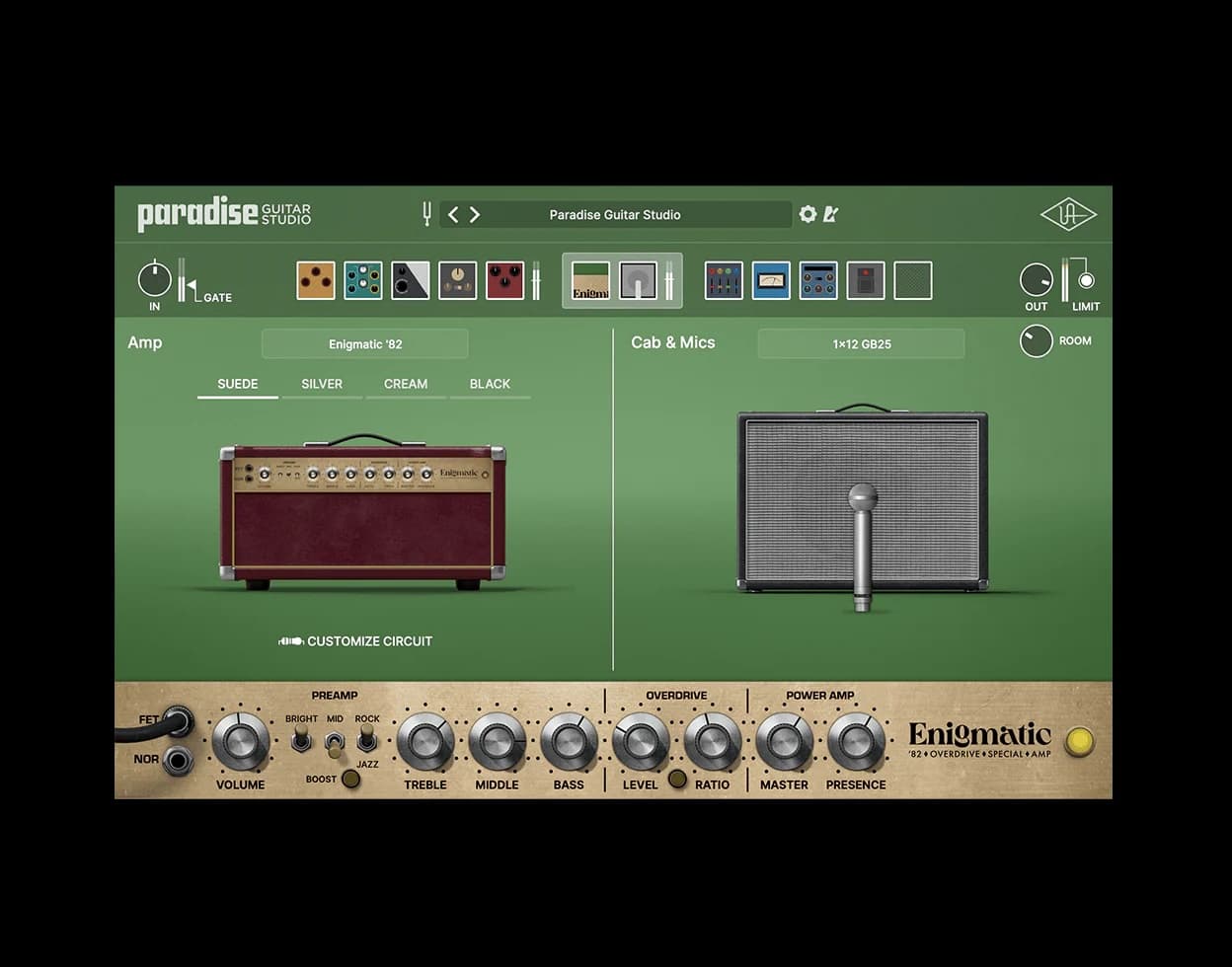
Paradise takes a different approach. It encapsulates everything—stompboxes, amplifiers, cabinets, microphones, and studio outboard gear—within a single plugin window. The internal gain structure is mathematically preserved. When you push a virtual Tube Screamer into the Showtime '64 amp model, the voltage transfer mimics the physical hardware interaction. You can see how it stacks up against the field on our scored Paradise Guitar Studio entry.
This matters more than you might think. Tube amp models are extraordinarily sensitive to input levels. Hit them 3dB too hot and you've ruined the dynamic response. Paradise eliminates this variable entirely.
Golden Unit Modeling: The UA Difference
Universal Audio doesn't model schematics. They model specific physical amplifiers.
The process works like this: UA sources multiple vintage examples of a target amplifier. They service each unit to factory specifications (or desirable modified specs). Then they conduct blind listening tests to identify the unit with the most musical characteristics. That specific amplifier—the "Golden Unit"—gets measured component by component.
This approach captures the non-linearities that make tube amps feel alive:
- Transformer saturation: The magnetic core compresses low end at high volumes
- Power supply sag: Voltage drops create natural compression on note attacks
- Tube rectification: The specific response characteristics of GZ34 rectifiers versus solid-state alternatives
The result? Amp models that don't just sound like the originals. They respond like them under your fingers.
The Amplifier Collection
Paradise launches with 11 amp models. Three stand out as particularly significant.
Enigmatic '82: The $100,000 Amp in Your DAW
Howard Dumble built fewer than 300 Overdrive Special amplifiers. They sell for six figures when they surface on the market. Robben Ford, Stevie Ray Vaughan, and John Mayer have all relied on them.
The Enigmatic '82 captures why these amps command such prices. It's the touch sensitivity. The way notes bloom into controllable feedback. The specific midrange harmonic structure that sits perfectly in a mix without EQ intervention.
UA's emulation includes the critical mode switching from the original hardware:
Jazz Mode offers a flatter EQ response with higher headroom. Pure, hi-fi clean tones.
Rock Mode engages additional gain staging and emphasizes the midrange. This is the singing, violin-like sustain the ODS is famous for.
The plugin goes further than the hardware ever could. A "Custom Mode" allows virtual circuit modifications—swapping tone stacks, adjusting internal HRM trimpots. You can tune the amp to your specific pickups. That's a luxury previously reserved for Dumble's personal clients.
Showtime '64: Clean Headroom That Changed Surf Rock
Dick Dale had a problem. He needed an amplifier that could project his percussive attack over a loud drum kit without distorting. Leo Fender's solution was the Showman—100 watts of clean headroom in a piggyback configuration.
The Showtime '64 captures that massive clean sound. Unlike the Deluxe Reverb, which breaks up relatively early, this amp stays pristine at punishing volumes. It's a transparent platform rather than a colored sound source. Stack your pedals into it and the amp faithfully amplifies whatever you feed it.
The tight, punchy low end comes from modeling the interaction between 6L6 power tubes, the oversized output transformer, and the high-wattage JBL-style speakers in sealed cabinets. Essential for funk, shoegaze, and modern pop production.
The Classic Trinity
The collection includes the three pillars of electric guitar tone, derived from UA's acclaimed UAFX pedals:
Woodrow '55 (Fender Tweed Deluxe) delivers the ragged, exploding distortion of 1950s circuitry. The modeling reproduces how adjusting the volume of the unused channel alters the EQ and gain structure of the active channel—a beautiful quirk of the shared cathode bias design.
Ruby '63 (Vox AC30 Top Boost) captures the Class A operation of EL84 power tubes. The lack of negative feedback creates a sharp, chimey transient response that cuts through any mix.
Lion '68 (Marshall Super Lead Plexi) is the definitive rock amp. The model captures the roar of EL34 tubes at their limit, including support for the channel jumpering technique used by Hendrix and Van Halen.
Beyond Static Impulse Responses
Cabinet emulation is where most amp sims fall apart. Impulse responses capture the frequency response of a speaker perfectly—at a single moment in time. They're static snapshots. They can't account for how speakers change behavior as volume increases.
Paradise employs Dynamic Speaker Modeling derived from UA's OX Amp Top Box. It simulates the physical mechanics of speaker cones:
- Cone cry: The harmonic distortions generated when paper cones approach their power limits
- Impedance interactions: The bidirectional relationship between speaker impedance curves and output transformers
The plugin offers 35 curated cabinet and microphone combinations using classics like the SM57, Royer R-121, and Neumann U67. These aren't random placements. They're phase-aligned positions tested by professional engineers.
The Room fader adds genuine acoustic reflections—not digital reverb added after the fact, but modeled room ambience from the recording space. This adds the three-dimensionality that's typically missing from direct-recorded guitar tones.
Studio-Grade Processing
Here's where Paradise separates itself from the competition. Most guitar suites include stompbox compressors and basic delays. Paradise includes the actual studio hardware models used on professional records.
The UA 1176 Limiting Amplifier is a FET compressor with attack times down to 20 microseconds. In a guitar context, it catches initial transients on clean funk parts, allowing you to push average volume without clipping. It's the aggressive "grab" heard on records from Led Zeppelin to the Red Hot Chili Peppers.
The tape echo module (based on units like the Echoplex EP-3) captures the preamp coloration that made these units magical. The effect improves your tone even with the delay mix at zero.
The plate reverb (likely modeled on the EMT 140) provides dense, metallic ambience that sits beautifully in a mix. This is a sound that's physically impossible to achieve with guitar pedals.
The Neural DSP Question
The obvious comparison is Neural DSP. Their Archetype series has dominated the market with neural network modeling of modern high-gain tones.
The approaches differ fundamentally:
UA's method is "white box" modeling—simulating circuits component by component. It excels at organic feel, dynamic interaction, and the crucial "edge of breakup" zone where amps transition from clean to distorted.
Neural DSP's method is "black box" modeling—capturing the input/output relationship of specific setups. It excels at high-gain precision and mix-ready modern metal tones.
Neither approach is superior. They serve different purposes. If you need pristine djent tones, Neural DSP remains the benchmark. If you want vintage breakup that responds to your volume knob like a real tube amp, Paradise is the new standard. If you're weighing more affordable all-in-one amp suites, our AmpliTube 5 vs Guitar Rig 7 comparison breaks down the two mainstream contenders.
System Requirements and Reality Check
Native processing has tradeoffs. Component-level modeling is computationally expensive.
Paradise demands modern hardware. Apple Silicon (M1/M2/M3) handles it without issue. Older Intel machines or Windows laptops with poor DPC latency may experience dropouts when running multiple instances. Buffer sizes of 128 samples or lower are necessary for acceptable playing feel.
The plugin runs on macOS Big Sur 11+ and Windows 10/11 in VST3, AU, and AAX formats. Authorization requires an iLok account—no physical dongle necessary.
Pricing and Value
Paradise Guitar Studio carries a $199 MSRP with a $149 introductory price. It's also included in the UAD Spark subscription at $20/month, which bundles the LA-2A, 1176, API Vision, and dozens of other plugins.
For producers already invested in the UA ecosystem, the subscription makes sense. For guitarists specifically seeking premium amp modeling, the perpetual license provides excellent value compared to buying individual Neural DSP archetypes.
If you'd rather buy the perpetual license outright, Plugin Boutique stocks it and frequently runs it below the UA store price, and Best Service carries it too.
Check Paradise Guitar Studio price at Plugin BoutiqueThe Verdict
Universal Audio has built something significant here. Paradise Guitar Studio isn't just another amp sim collection. It's a comprehensive production environment that consolidates sixty years of recording technology into a single plugin window.
The Golden Unit modeling approach delivers authenticity that profile-based competitors can't match in the clean-to-crunch dynamic range. The studio rack effects elevate it beyond what any guitar-focused plugin has offered before. The container workflow eliminates gain staging headaches, which is part of why it ranks where it does among our best effect plugins.
Who should buy this: Producers, session guitarists, vintage tone enthusiasts, anyone working in classic rock, blues, indie, or alternative styles.
Who should look elsewhere: Metal producers needing extreme high-gain precision. Users on older hardware that can't handle the CPU demands.
For those with adequate system resources, Paradise Guitar Studio delivers exactly what its name promises. It's as close to guitar recording nirvana as software has achieved.
Paradise Guitar Studio is available now from Universal Audio for $199 ($149 intro) or included in the UAD Spark subscription.