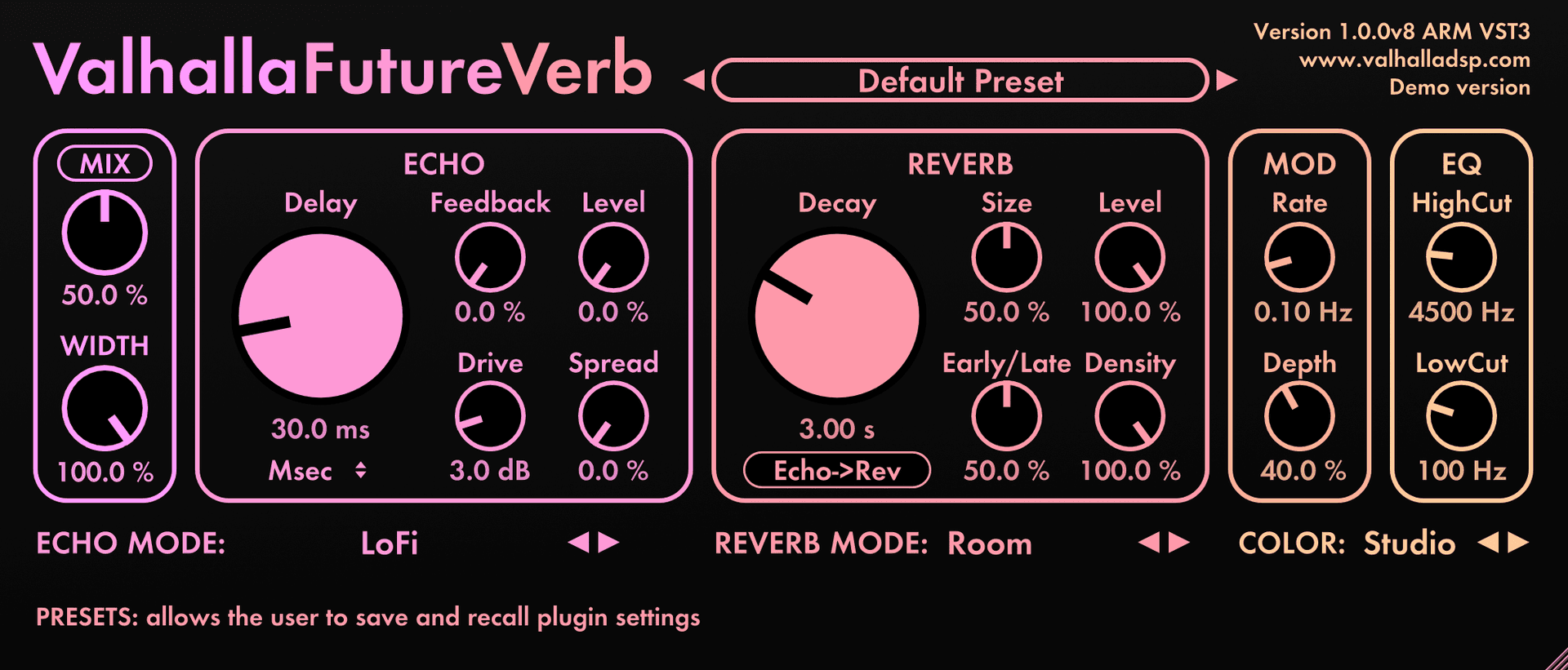
Valhalla FutureVerb is the paid, perfected evolution of the ideas Valhalla DSP first floated in its free Supermassive plugin. It runs two engines side by side — a reverb algorithm and a granular delay — so a single instance can move from a tight, believable room to a shimmering, evolving cloud without leaving the interface. That dual architecture, at $50, is the core of its appeal.
It excels at ambient and cinematic work. Frozen mode spins incoming audio into slowly evolving sonic clouds, while Nonlin delivers the kind of modern gated reverb that flatters drums and synths. Because the algorithms lean on smart DSP rather than long convolution tails, the plugin stays CPU-light even across many tracks — a genuine advantage on large sessions or older machines. The interface follows the Valhalla house style: minimal, fast, and built for turning knobs rather than hunting through menus.
The trade-offs are real. This is an algorithmic effect, not a convolution reverb, so if your work depends on captured impulse responses of specific real-world spaces, FutureVerb won't cover that need. Its mode-driven depth also rewards experimentation over presets — the most striking sounds often live a few tweaks past the default, which asks a little patience from newcomers.
On value it is hard to beat. Against Valhalla's own free Supermassive, FutureVerb offers more realistic algorithms and the added granular-delay engine, justifying the modest upgrade. Compared with premium convolution and multi-effect suites, it is far cheaper and lighter, though those tools go deeper on realism and routing. For producers who want lush, characterful space and texture from one affordable, efficient plugin — and who don't specifically need IR-based reverb — FutureVerb is an easy recommendation, backed by Valhalla's free-updates-forever policy.
For the full breakdown, see our complete Valhalla FutureVerb review.