Some links on this page are affiliate links. If you buy through them, Dubspot may earn a commission at no extra cost to you. It never affects our scores or what we recommend (read our policy).
UAD Capitol Studios: Two Rooms and Four Echo Chambers (2026)
UAD Capitol Studios models Capitol's Studios A and B, 18 mics and four echo chambers in one native plug-in. $249 at Plugin Boutique. Specs, modes, rivals.
E
Elena Marsh
November 5, 2026 · 11 min read
Dubspot's best Black Friday dealDrum Programming and Groove Production Course: $19, was $99 ↗
Black Friday 2026Universal Audio Black Friday 2026: dates and deals →
Universal Audio released UAD Capitol Studios on 4 November 2026, a native plug-in that puts Capitol Studios A and B in Hollywood inside your DAW, along with a mic locker, the rooms' consoles and outboard, and four of Capitol's underground echo chambers. UA says those chambers have never been available in a plug-in before. It costs $249 at Plugin Boutique and UA's own store, with no launch discount, and runs on your computer's CPU with no Apollo or UAD-2 hardware.
At a glance: two studio rooms, five source families, Close, Room and Decca mic positions, 18 microphone types, Re-Mic and Reverb modes, console EQ, six dynamics types and Chambers 1, 3, 5 and 8. VST3, AU and AAX on macOS 11 or later and Windows 10 or later. $249 at Plugin Boutique, 14-day demo, also in UAD Spark Studio. The most detailed studio room in UA's native range, but pricey this week next to Ocean Way Studios Deluxe at $99.
What is UAD Capitol Studios?
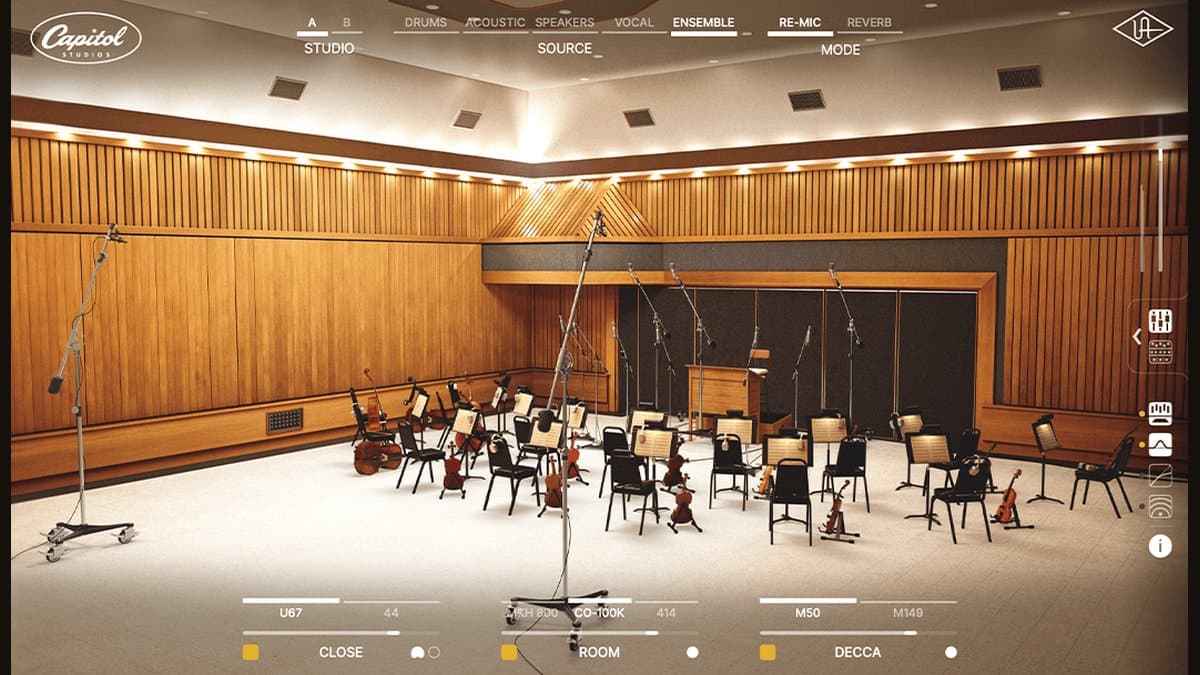
Capitol Studios is UA's second full-studio plug-in after Ocean Way Studios Deluxe. Instead of a reverb algorithm with a room label on it, it is built on UA's Dynamic Room Modeling, a "re-miking" approach that models how specific sources, such as a drum kit or a piano, radiate energy into the room. You pick a source, place it in Studio A or Studio B, choose the mics and drag them around the room in real time.
It is a Native-only title. It does not need an Apollo interface or UAD-2 accelerator, and it does not appear in UAD Console. It licenses through UA Connect, which also offers a free, fully functional 14-day demo.
The rooms: Studio A and Studio B
Studio A is Capitol's largest room, known for orchestral scoring. The plug-in offers both "live" and "tight" sounds there, so the same room can sound open and expansive or more controlled.
Studio B is the band room, known for punch and drums. It has switchable acoustic panels, which change how much the room contributes to the sound.
Sources: what you put in the room
Because Dynamic Room Modeling depends on how a source radiates sound, you start by telling the plug-in what you are feeding it:
- Drums: Wall position in Studio A, Corner in Studio B.
- Acoustic: Solo and Piano.
- Speakers: Studio PA, plus Cab 1 and Cab 2 guitar cabinets.
- Vocal: Solo, Group Live and Group Tight.
- Ensemble: Horns Live and Tight, Strings Live and Tight.
The source list tells you where this plug-in shines: acoustic instruments, drums, vocals and ensembles. Studios A and B are rooms, so a synth pad gets a room around it rather than a long ambient wash.
Mics: three positions and 18 microphone types
Every source has three mic positions: Close, Room and Decca. The Decca position is a three-mic Decca tree with separate left, right and centre faders, the classic orchestral recording setup. The 18 microphone types are the 4038, 44, 414, C-37A, C12, C12A, C800, CO-100K, M50, M149, M160, M251, MD421, MKH 800, R88, SM57, U48 (Sinatra's) and U67.
Setups are curated by Capitol alum Steve Genewick. Some mics switch between cardioid and omni, and close mics on the guitar cabs can be on or off axis. Each channel has distance, align (which removes mic delay), cut filters, polarity, mute and balance.
Re-Mic or Reverb: two modes
Choosing the wrong mode is the easiest mistake to make.
Re-Mic replaces your recording with the room, the mics and the direct path from source to mic. Output is louder, Predelay and Mix are unavailable, and Wet Solo is locked on. Put it on the track as an insert and do not blend it with the dry track, or you will get phasing.
Reverb removes the direct path and gives you only the early reflections and decay. Predelay (0 to 125 ms), Mix and Wet Solo are available, so it works as a send and return, like a conventional reverb.
| Situation | Mode | Why |
|---|---|---|
| Making a close, dry recording sound tracked in Studio A or B | Re-Mic | Replaces the source with the room and mics |
| Adding Capitol space to several tracks on one bus | Reverb | Early reflections and decay only, with Mix and Wet Solo |
| Tracking or monitoring through the plug-in | Reverb on a send | Latency is higher than other UAD plug-ins |
| Keeping the dry track in the mix | Reverb | Re-Mic phases against the dry signal |
Master effects and the four echo chambers
After the room, a reorderable master section runs EQ, Dynamics and Chamber by default.
- EQ: "88", from Studio A's 88 Series console, or "80", from Studio B's vintage 80 Series.
- Dynamics: six types: 1176LN, Air, LA-2A, Ch-88, CMC (Capitol Mastering Compressor) and Bus-80.
- Chambers: Capitol's Chambers 1, 3, 5 and 8, each with five decay settings. Long is the true captured decay; the other four are shorter "beyond reality" settings. Predelay runs from 0 to 250 ms and width from 0 to 100%.
You can bypass the room entirely and use the plug-in as a fully wet chamber reverb on a send. Presets come from past and present Capitol engineers, producers and musicians.
Working notes: latency and automation
Latency is higher than on other UAD plug-ins, so for tracking, use Reverb mode on a send rather than Re-Mic on an insert. And avoid continuous automation of mic align, filters, phase, mute, balance and levels: the plug-in recalculates and can produce artifacts. Change those settings with snapshot automation between phrases instead.
UAD Capitol Studios specifications
| Spec | Detail |
|---|---|
| Type | Native room-modelling and reverb plug-in (Dynamic Room Modeling) |
| Rooms | Capitol Studio A (live and tight) and Studio B (switchable acoustic panels) |
| Sources | Drums, Acoustic (Solo, Piano), Speakers (Studio PA, Cab 1, Cab 2), Vocal (Solo, Group Live, Group Tight), Ensemble (Horns and Strings, Live and Tight) |
| Mic positions | Close, Room, Decca (three-mic tree with L/R and centre faders) |
| Microphones | 18 types, setups curated by Steve Genewick |
| Modes | Re-Mic (insert, no dry blend) and Reverb (Predelay 0 to 125 ms, Mix, Wet Solo) |
| EQ | 88 (Studio A console) or 80 (Studio B console) |
| Dynamics | 1176LN, Air, LA-2A, Ch-88, CMC, Bus-80 |
| Chambers | 1, 3, 5 and 8; five decay settings; predelay 0 to 250 ms; width 0 to 100% |
| Formats | VST3, AU, AAX |
| Systems | macOS 11 or later, Windows 10 or later; native on Apple silicon, Intel and Windows |
| Hardware | None required; not shown in UAD Console |
| Licensing | UA Connect; free 14-day demo |
| Bundles | UAD Spark Studio, UAD Ultimate 15, UAD Complete 5; eligible for Custom Premium bundles |
Capitol Studios vs Ocean Way Studios Deluxe vs Capitol Chambers
| UAD Capitol Studios | UAD Ocean Way Studios Deluxe | UAD Capitol Chambers | |
|---|---|---|---|
| Plugin Boutique price today | $249 (no discount) | $99 until 10 Nov ($249 list) | $149 until 10 Nov ($199 list) |
| What it models | Capitol Studios A and B, 18 mics, consoles and outboard, four echo chambers | Rooms, reverb chambers and microphones from Ocean Way | Capitol's echo chambers only |
| Modes | Re-Mic and Reverb, plus fully wet chamber | Full-studio room modelling (UA's first) | Chamber reverb only |
| Best for | Orchestral, band, drum and vocal rooms with Capitol's console and dynamics | A full studio room plug-in at the lowest price this week | Chamber reverb on a send |
Which to pick: if you want a studio room plug-in and price matters most, Ocean Way Studios Deluxe at $99 until 10 November is the cheaper route into UA's full-studio approach. Capitol Studios is the one to choose if you want Capitol's specific rooms, the Decca tree for orchestral and ensemble work, the console EQ and dynamics, or all four chambers alongside the rooms. Capitol Chambers, the older chamber-only plug-in, makes sense only if a chamber on a send is all you need. And if your real need is a plate, the UAD EMT 140 at $149 does a different job; our native EMT 140 and 250 first look compares UA's plate and early digital reverb.
Who UAD Capitol Studios is for
Buy it if you record or produce acoustic instruments, drums, vocals or ensembles and want them to sound tracked in a real studio; if you work with orchestral or horn and string parts and want a Decca tree without booking a scoring stage; or if you already love UA's chamber sounds and want the rooms, consoles and dynamics in the same plug-in.
Skip it if you mostly make synth-based music and want long, evolving ambient tails: these are rooms and chambers, not an algorithmic hall. Skip it too if you need low-latency tracking through the room, or if you are not prepared to manage Re-Mic routing carefully. And if you want a studio room plug-in this week on a budget, Ocean Way Studios Deluxe costs $150 less until 10 November.
How much does UAD Capitol Studios cost?
- $249 at Plugin Boutique, the same as UA's own store. There is no launch discount.
- $179 for the UAD Custom 2 Premium Bundle at Plugin Boutique (from $299) until 10 November. UA lists Capitol Studios as eligible for its Custom Premium bundles, so this is the cheapest way to own it this week, with a second premium plug-in included.
- $799 for the UAD Ultimate 15 Bundle or $1,999 for the UAD Complete 5 Bundle at Plugin Boutique, both of which include Capitol Studios.
- UAD Spark Studio subscription, which includes it.
- Free 14-day demo in UA Connect, fully functional.
Best Service does not sell Capitol Studios. Our UAD Capitol Studios database entry tracks the price.
Buy now or wait? Capitol Studios itself is not discounted, so there is no deadline on it. The deadline that matters is 10 November: Ocean Way Studios Deluxe at $99, Capitol Chambers at $149 and the Custom 2 Premium Bundle at $179 all end then, along with the rest of the Universal Audio Black Friday sale at Plugin Boutique. If you want Capitol Studios specifically, the Custom 2 Premium route saves $70 on the plug-in alone before you count the second pick.
FAQ
Does UAD Capitol Studios need an Apollo or UAD-2?
No. It is a Native-only plug-in that runs on your computer's CPU on macOS 11 or later and Windows 10 or later, in VST3, AU and AAX hosts. It does not appear in UAD Console.
What is the difference between Re-Mic and Reverb mode?
Re-Mic replaces your recording with the room, mics and direct path, so you use it on an insert without the dry track. Reverb removes the direct path and gives you early reflections and decay, with Predelay, Mix and Wet Solo for send and return use.
Capitol Studios vs Ocean Way Studios Deluxe: which should I buy?
Ocean Way Studios Deluxe is $99 at Plugin Boutique until 10 November and is the cheaper studio room plug-in. Capitol Studios is $249 and adds Capitol's two rooms, the Decca tree, console EQ, six dynamics types and four echo chambers. Choose Capitol for orchestral and ensemble work or the chambers, Ocean Way for value.
Is UAD Capitol Studios included in UAD Spark?
Yes, it is part of the UAD Spark Studio subscription. It is also included in UAD Ultimate 15 and UAD Complete 5.
Verdict
Capitol Studios is UA's most detailed native room so far. Two famous rooms, a Decca tree, 18 mics, Capitol's console EQ and dynamics, and four echo chambers that double as a standalone chamber reverb add up to a lot of plug-in, and the source-based modelling suits real instruments, drums, vocals and ensembles. The catches are practical: $249 with no launch offer, higher latency, careful routing in Re-Mic mode, and artifacts if you automate mic settings continuously. This week, Ocean Way Studios Deluxe at $99 is the value pick, and the Custom 2 Premium Bundle at $179 is the cheapest way into Capitol Studios itself. Try the demo before 10 November and decide while both are on the table.