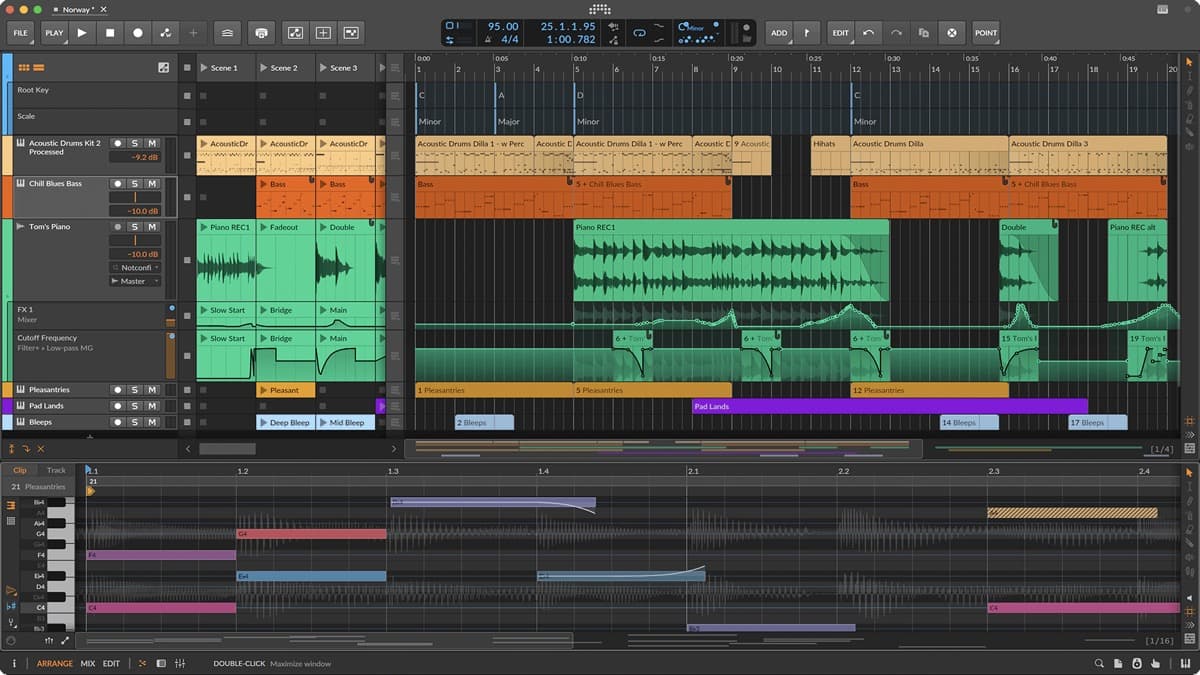
Bitwig Studio is a cross-platform digital audio workstation built by former Ableton engineers around one central idea: modulation. Where most DAWs treat modulation as an afterthought, Bitwig makes it the organizing principle. Almost any parameter can be modulated by almost any source — LFOs, envelopes, macros, step sequencers — and those modulators stack and interact in ways that feel closer to a modular synth than a linear timeline. That philosophy reaches its peak in The Grid, a patchable environment for building synths, effects, and generative devices from scratch inside the project.
It excels at sound design and experimental production. The unified modulation system, MPE-ready note editing, and a nested device chain that behaves like a virtual rack make it a natural home for producers who think in signal flow rather than fixed presets. It is also one of the very few professional DAWs with genuine native Linux support, which alone earns it loyalty from a segment the competition ignores. Version 6 sharpens the fundamentals — automation clips, clip aliases, project-wide key signature, and layered editing — so the everyday timeline work now keeps pace with the sound-design engine.
The trade-off is depth over convenience. The modulation model and The Grid carry a real learning curve, and the €399 Studio tier is a demanding ask when Producer (€199) already covers most needs. Its stock instruments, notation, and included content still trail more mature ecosystems. Against its alternatives that gap is clearest: Ableton Live is stronger for clip-based live performance and has a larger sound library, while Cubase and Studio One outclass it on scoring, notation, and traditional mixing. Bitwig's edge is modulation and openness, not breadth of content.
Choose Bitwig if you want a DAW that treats modulation and modular patching as first-class, and you value cross-platform freedom over the deepest preset library. Our full Bitwig Studio 6 review goes deeper on the version 6 changes.