Some links on this page are affiliate links. If you buy through them, Dubspot may earn a commission at no extra cost to you. It never affects our scores or what we recommend — read our policy.
Oddment ODD-1V Review: The ODD-1 Granular Synth as a Plugin
Oddment ODD-1V brings the ODD-1 hardware granular synthesizer into your DAW as a VST3, AU and standalone plugin. Full review of features, specs and price.
M
Marcus Feld
September 17, 2026 · 9 min read
See full specs, price, and alternatives in the plugin database →
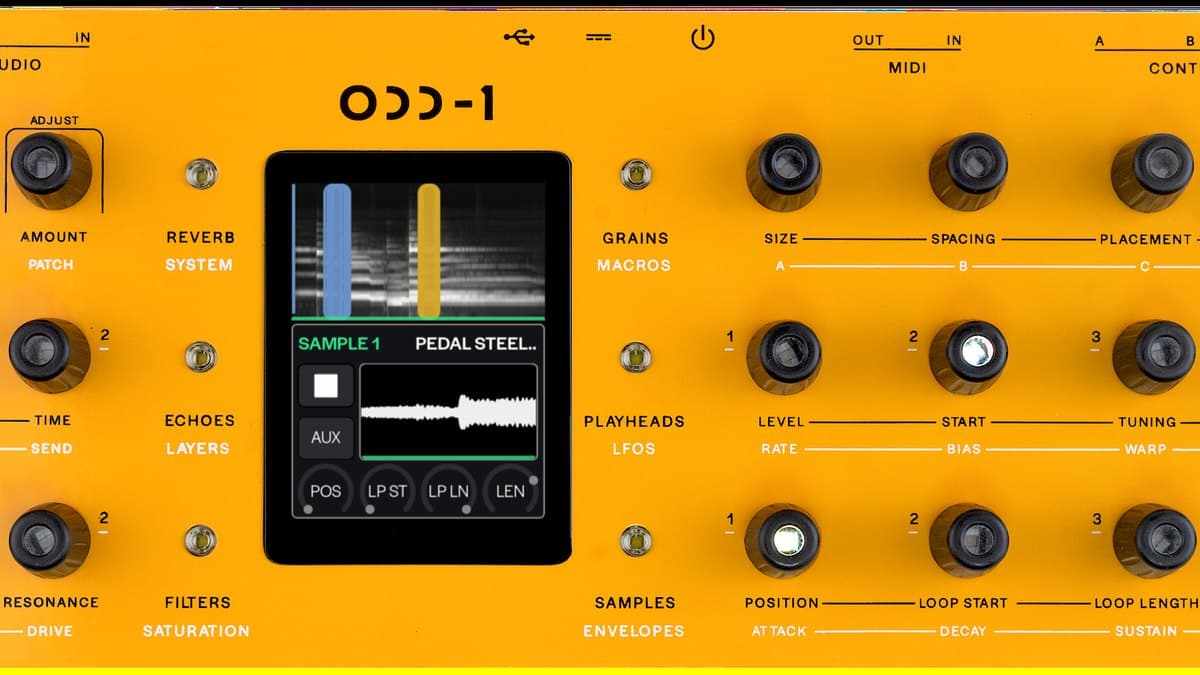
Oddment Audio built its name on the ODD-1, a desktop granular synthesizer that turned heads at Superbooth and Knobcon 2026. In September 2026 the company shipped the plugin version, ODD-1V, so you no longer need the hardware to use the engine. It is not a slimmed-down companion. ODD-1V is a 1:1 port of the ODD-1, with the same granular core, the same 2 GB library and full patch interchange with the unit.
At a glance: 149 dollars in early access, 199 dollars at full price, and free for ODD-1 hardware owners. ODD-1V runs as a VST3, AU and standalone on macOS, native on Apple Silicon and Intel, and on Windows. It is a two-layer granular instrument with four playheads per layer, binaural grains and a per-grain filter. This is a granular synth, not a granular effect.
What is Oddment ODD-1V?
Granular synthesis chops audio into tiny fragments called grains, then replays them at new speeds, pitches and positions. Most producers meet the idea through effects that smear whatever audio you feed them. ODD-1V works the other way around. It is a full instrument built on sample playback and granular processing, closer to a sampler than to an insert effect.
The engine runs two polyphonic layers. Each layer holds a 60-second stereo sample buffer and reads it with four independent playheads, so a single note can spray grains from four places in a sound at once. Pitch and time are fully independent, which means you can freeze a sound in place and still transpose it, or race through it without changing the note. Every grain gets placed in the stereo field with binaural spatialization and passed through its own auditory-inspired bandpass filter. That per-grain detail is what gives ODD-1V its unusually three-dimensional, living textures.
It arrives as the plugin form of a real instrument. The ODD-1 hardware is a touch-screen desktop unit with a 4-core processor, designed in Michigan, and ODD-1V carries the identical feature set into software. Patches you build in the plugin load on the unit, and vice versa, so the two are genuinely one instrument in two bodies.
What ODD-1V does, feature by feature
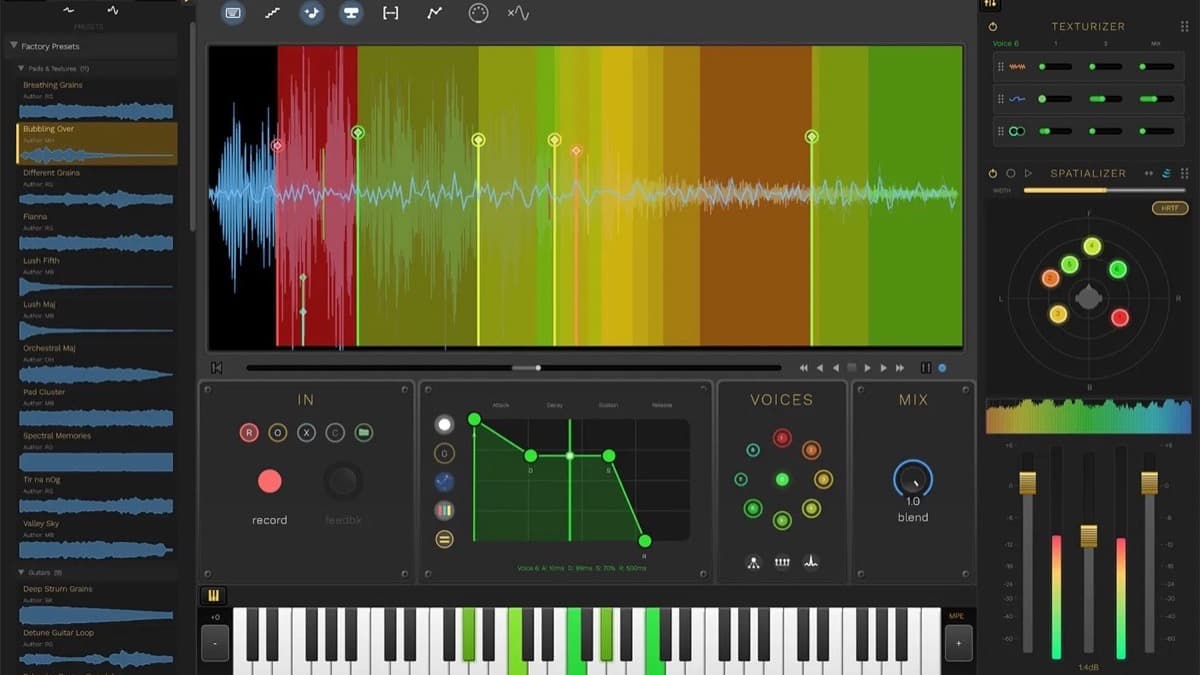
The interface looks busy, but it breaks into a few clear sections. Here is what each one gives you.
- Two layers, four playheads each. The heart of the synth. Two polyphonic layers, each with a 60-second stereo buffer, and four independent playheads per layer that scatter grains from different points in the sound. That is where a single sample becomes a moving cloud rather than a static loop.
- Independent pitch and time. Because pitch and time are decoupled, you can hold a grain cloud in place and still play it as an instrument, or scrub through a sample at any speed without detuning it. This is the core trick that makes granular feel musical.
- Per-grain spatial filtering. Each grain is spatialized binaurally and filtered through its own bandpass, modeled on how we hear. Textures spread across the stereo image and gain depth rather than sitting flat in the center.
- A large sample engine. ODD-1V ships with 2 GB of factory content and gives you more than 3 GB for your own samples. It reads WAV, FLAC and MP3, mono or stereo, at 44.1, 48 or 96 kHz, so your own field recordings and loops sit next to the factory material.
- Two filters and two saturators per voice. Each voice has two multimode filters, covering low-pass, high-pass, band-pass and band-reject, plus two saturators offering distortion, bit crushing and compression. You shape and dirty the grains without leaving the synth.
- Echoes and reverb. Each layer runs two echo units, and a reverb module sits over the top. As with a good granular rig, you can build a finished ambient part inside the one instrument.
- Deep, fully patchable modulation. ODD-1V provides three envelopes, four LFOs, four macros and four control inputs, and every parameter can be modulated. MIDI runs deep too, with key, velocity, pitch bend, mod wheel, aftertouch and CC learning, so a controller maps onto the engine quickly.
- Three performance modes. SYNTH builds sounds from samples, LIVE transforms real-time audio input, and LOOPS captures and modifies material hands-free. The same engine covers designed patches, live processing and looping capture.
Put together, ODD-1V is a granular workstation. It records, plays, spatializes, filters, saturates and finishes a sound in one window, with far more per-grain control than a typical granular effect exposes.
Oddment ODD-1V specifications
| Spec | Detail |
|---|---|
| Type | Granular sample synthesizer (plugin version of the ODD-1 hardware) |
| Layers | 2 polyphonic layers, each with a 60-second stereo buffer |
| Playheads | 4 independent playheads per layer, independent pitch and time |
| Voices | 8-plus voices, depending on settings |
| Grain detail | Binaural spatialization and a per-grain bandpass filter |
| Factory content | 2 GB library, plus 3-plus GB for user samples |
| Sample import | WAV, FLAC, MP3; mono or stereo; 44.1, 48 or 96 kHz |
| Filters | 2 per voice (LP, HP, BP, BR) |
| Saturation | 2 per voice (distortion, bit crush, compression) |
| Effects | 2 echo units per layer, plus a reverb module |
| Modulation | 3 envelopes, 4 LFOs, 4 macros, 4 control inputs; every parameter modulatable |
| Performance modes | SYNTH, LIVE, LOOPS |
| Formats | VST3, AU, standalone; macOS (Apple Silicon and Intel), Windows |
| Price | 149 dollars early access, 199 dollars full; free with the ODD-1 hardware |
Oddment ODD-1V vs Output Portal
The granular tool most producers already own is Output Portal, so it is the natural comparison. They are not the same kind of plugin, though.
| Oddment ODD-1V | Output Portal | |
|---|---|---|
| Type | Granular synthesizer and sampler | Granular effect on input audio |
| Sound source | Loaded samples plus 2 GB library | Whatever audio you route in |
| Grain control | Four playheads per layer, per-grain filter and spatialization | Macro-driven grain cloud |
| Layers | Two independent layers | Single processing path |
| Depth | Full modulation, filters, saturation, echoes | XY macro with built-in FX |
| Formats | VST3, AU, standalone | VST, VST3, AU, AAX |
| Price | 149 dollars early access | Around 149 dollars |
Portal is faster and simpler. It sits on a channel, you turn a big XY control, and you get instant granular motion on the audio already playing. ODD-1V asks more of you and gives more back. It is an instrument you load samples into and play, with per-grain filtering, two layers and a full modulation section. Reach for Portal when you want quick granular color on a track. Reach for ODD-1V when you want to build patches and perform granular sound from the ground up. For other deep granular tools, see the Dillon Bastan Iota II review and the Sugar Bytes Graindad review.
Who Oddment ODD-1V is for
Consider it if you design textures, drones and evolving pads, you already like granular sound, or you want hardware-grade depth without buying the hardware. The four playheads, binaural grains and per-grain filter reward patient sound designers, and the sample engine makes your own recordings the raw material.
Skip it if you only need occasional granular color on existing audio, where a lighter effect like Portal is quicker, or if you prefer to wait for a fully finished build. ODD-1V is in early access, so a few features are still on the way.
How much does Oddment ODD-1V cost?
ODD-1V is 149 dollars during its early-access period and 199 dollars at full price. Owners of the ODD-1 hardware, which is 999 dollars and began shipping in the United States in September 2026, get the plugin for free. It is sold direct through the official Oddment Audio ODD-1 page rather than through a partner retailer, and the company has said further features will arrive over the coming months.
FAQ
Is Oddment ODD-1V a granular effect or a synth?
It is a granular synthesizer and sampler, not an effect. You load samples into two layers and play them as an instrument, with four playheads per layer, a per-grain filter, and full modulation. Its LIVE mode can also transform real-time input, but the core is a playable instrument.
What is the difference between ODD-1V and the ODD-1 hardware?
ODD-1V is a 1:1 software port of the ODD-1. It has the same engine, the same 2 GB library and full patch interchange, so sounds move both ways. The hardware adds a touch screen, physical controls and CV connectivity, while the plugin runs inside your DAW as a VST3, AU or standalone.
What are the system requirements for ODD-1V?
ODD-1V runs on macOS, native on Apple Silicon and Intel, and on Windows, in VST3, AU and standalone formats. It reads WAV, FLAC and MP3 samples in mono or stereo at 44.1, 48 or 96 kHz, and ships with a 2 GB factory library plus room for your own content.
Verdict
ODD-1V is one of the more ambitious granular releases of the year because it does not water down its hardware roots. Two layers, four playheads each, binaural grains and a per-grain filter make it a real instrument for building texture, not a one-knob effect. The 2 GB library and generous user space mean your own sounds become the raw material, and patch interchange with the ODD-1 keeps the plugin and the unit in sync. The catch is timing: this is an early-access build, so a handful of features are still to come, and it is sold direct only. If you want granular depth with hardware pedigree inside your DAW, it is well worth a place on the shortlist. For more texture-first tools, see our Chopgrid review and the best free synth VSTs in 2026.