Parish Audio DGR 2026: Bitcrusher With Jitter and Alias, $23.97
Parish Audio DGR Digital Degrader is a bitcrusher with six Character modes, jitter, alias, drive and three quantize styles. $23.97 to 19 Nov, then $39.95.
Dubspot's best Black Friday dealsDubspot Tracker Pro: $15, was $24.99 ↗Drum Programming and Groove Production Course: $19, was $99 ↗
Black Friday 2026Parish Audio Black Friday 2026: dates and deals →
DGR Digital Degrader is Parish Audio's new bitcrusher and lo-fi processor, released in November 2026 for macOS and Windows. It goes further than the usual bits-and-rate pair: six Character modes change how the degradation behaves, and separate Jitter and Alias controls let you shape the flaws of digital conversion, not just its resolution. It is $23.97 in Parish Audio's 40% flash sale until 19 November 2026, from a regular $39.95.
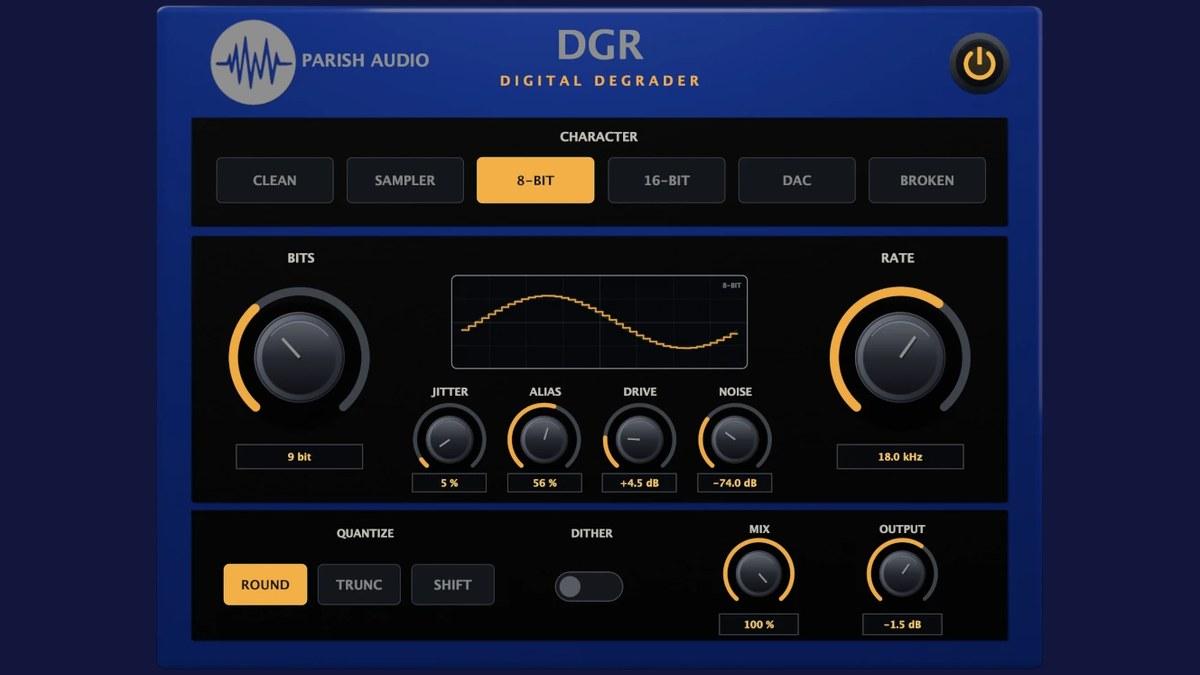
At a glance: digital degradation effect; six Character modes (Clean, Sampler, 8-Bit, 16-Bit, DAC, Broken); Bits, Rate, Jitter and Alias; pre-degradation Drive; hardware-style Noise; optional Dither; Round, Trunc and Shift quantize modes; Mix and Output; waveform display. VST3 on Windows, VST3 and AU on macOS. $23.97 to 19 Nov, $39.95 regular, or in Parish Audio's $9.95 a month subscription with a 7-day trial. A deeper bitcrusher than the free classics at an impulse price.
What is Parish Audio DGR?
Lo-fi is not one sound. It is the crunch of a low-bit sampler, the rough edges of an early converter, a sample clock that will not sit still, metallic aliasing and the hiss of tired hardware. Most bitcrushers give you two knobs and one flavour of that. DGR breaks the conversion process into its parts and lets you set each one, from a hint of early-digital texture on a full mix to drums that sound like the hardware is failing.
It is the third creative processor from Parish Audio this autumn, after the granular Aethon and the time-manipulation effect Warpfield. Where those reshape audio in time, DGR is about resolution and conversion artefacts.
DGR features, explained
Six Character modes
The Character selector changes more than a preset would. Each mode alters how DGR responds to the signal, including filtering, converter colour, clock behaviour, distortion and noise.
- Clean is a direct bit and rate reduction with little extra colour.
- Sampler adds the filtered, slightly coloured feel of older sampling hardware, the obvious start for drums and loops.
- 8-Bit is rougher and narrower, for crunchy percussion and retro game textures.
- 16-Bit is a cleaner early-digital character for subtle vintage texture.
- DAC focuses on converter and reconstruction colour, smoother than a bitcrusher and closer to audio through an imperfect converter.
- Broken adds stronger clock irregularity and signal-dependent roughness, for glitched drums and destroyed loops.
Bits, Rate, Jitter and Alias
Bits sets the quantization depth from 24-bit down to extreme low resolution, so the signal becomes progressively stepped and distorted. Rate lowers the effective sample rate. Jitter adds instability to the reduced sample clock: a little gives movement, a lot gives unpredictable digital timing, and its behaviour changes with the Character mode. Alias sets how much high-frequency content bypasses the anti-alias filter before rate reduction, which is where the metallic, inharmonic fold-back of aggressive downsampling comes from. Keep Alias low for a filtered, polite reduction; open it with a low Rate for raw crunch.
Drive, Noise, Dither and Quantize
Drive pushes the signal before the degradation stage, so it changes the texture of the distortion rather than simply adding level. Noise is an audible hardware-style noise floor that stays present even with no input, which is useful for glueing a loop into a lo-fi bed. Dither adds low-level noise before quantization, subtle at high bit depths and much more audible at low ones.
Three Quantize modes change how samples snap to the reduced bit depth. Round is conventional nearest-level quantization. Trunc rounds toward zero for a more abrupt, differently weighted harmonic structure. Shift offsets the quantization for an unusual texture while keeping a true zero region around silence. The differences become obvious at low Bits settings, so that is where to compare them.
Mix, Output and the display
Mix blends the degraded signal with the dry one for parallel crunch that keeps the original attack, and Output compensates for level changes when you A/B. The centre display draws the waveform as Bits and Rate reduce it: fewer vertical steps as bit depth drops, wider horizontal steps as the rate falls, and irregular timing when Jitter is up.
Parish Audio DGR specifications
| Spec | Detail |
|---|---|
| Type | Digital degradation, bitcrusher and lo-fi effect |
| Character modes | Clean, Sampler, 8-Bit, 16-Bit, DAC, Broken |
| Resolution controls | Bits (24-bit down), Rate, Jitter, Alias |
| Tone controls | Drive (pre-degradation), Noise, Dither |
| Quantize | Round, Trunc, Shift |
| Utility | Mix, Output, waveform display |
| Controls | 18 |
| Formats | VST3 on Windows; VST3 and AU on macOS |
| Licence | One-time purchase, or Parish Audio all-access subscription |
| Activation | Sign in with your Parish Audio account inside the plugin |
Which DGR Character mode to use
A quick guide to where each mode earns its place in a session:
| Source | Mode | Starting move |
|---|---|---|
| Drum loop that needs vintage sampler grit | Sampler | Moderate Rate, Bits around 12, Mix below 100% |
| Chiptune leads and crunchy percussion | 8-Bit | Low Bits, Alias up, Round quantize |
| Full mix or bus, subtle early-digital tone | 16-Bit | High Bits, a little Noise, Mix to taste |
| Pads and keys through a tired converter | DAC | Light Jitter, Alias low |
| Glitch drums and transitions | Broken | Jitter and Alias high, automate Rate |
Parish Audio DGR vs Decimort 2, TAL-Bitcrusher and RC-20
| DGR | Decimort 2 | TAL-Bitcrusher | RC-20 Retro Color | |
|---|---|---|---|---|
| Price | $23.97 to 19 Nov ($39.95 regular) | €59 regular, €29 in D16's current sale | Free | $99 intro to 12 Jan 2027 ($129 list) |
| Focus | Conversion flaws: bits, rate, jitter, alias | Vintage sampler emulation with filter | Basic bits, rate and noise | Multi-effect colour: noise, wobble, distortion, space |
| Character options | Six modes | Sampler-flavoured engine | Single mode | Six effect modules |
| Formats | VST3; AU on macOS | VST3, AU, AAX | VST2, VST3, AU, AAX, CLAP | VST3, AU, AAX |
| Pick it if | You want control over how the conversion breaks | You want vintage sampler colour first | You want a free basic crusher | You want all-round lo-fi colour in one box |
Which to pick: if you already have the free TAL-Bitcrusher, DGR is the step up, adding jitter, alias, quantize styles and six characters. Decimort 2 is the closer rival for sampler-flavoured crunch, while RC-20 Retro Color is a broader colour box that does tape wobble and space as well. DGR is the most specific of the four about digital failure, and at its flash-sale price it is the cheapest paid option here. The lack of AAX means Pro Tools users should look at the other three.
Who Parish Audio DGR is for
Buy it if you make lo-fi hip-hop, breaks, electronic or game music and want degradation you can tune, from converter colour to full destruction. It also suits sound designers who need glitch and failure textures with repeatable settings.
Skip it if you work in Pro Tools, because there is no AAX version. Skip it too if you want tape wobble, vinyl noise and reverb in the same plugin; a multi-effect like RC-20 covers more ground.
How much does Parish Audio DGR cost?
- $23.97 in Parish Audio's 40% sitewide flash sale until 19 November 2026.
- $39.95 regular, one-time purchase you own permanently.
- Included in Parish Audio's all-access subscription at $9.95 a month, with a 7-day free trial.
Get DGR Digital Degrader at Parish Audio
Price-timing note: the flash sale ends on 19 November and covers the rest of the Parish Audio catalogue too, so it is the moment to add Warpfield or Aethon. Our Parish Audio Black Friday page tracks the brand's offers.
FAQ
What is Parish Audio DGR?
DGR Digital Degrader is a lo-fi and bitcrusher plugin with six Character modes, Bits, Rate, Jitter and Alias controls, Drive, Noise, Dither and three quantize styles.
How much does DGR cost?
$23.97 in Parish Audio's flash sale until 19 November 2026, then $39.95. It is also part of the $9.95 a month all-access subscription.
What is the difference between Jitter and Alias in DGR?
Jitter makes the timing of the reduced sample clock unstable. Alias controls how much high-frequency content folds back into the audible range when the sample rate is reduced.
Does DGR work in Pro Tools?
No. DGR is VST3 on Windows and VST3 and AU on macOS, with no AAX version.
Is DGR better than a free bitcrusher?
It does much more. Free crushers usually offer bits, rate and noise; DGR adds six Character modes, jitter, alias, drive, dither and three quantization styles.
Verdict
DGR treats lo-fi as a set of specific flaws rather than one effect, and that is what makes it useful. The Character modes give each source a sensible starting colour, Jitter and Alias reach textures a basic crusher cannot, and Mix keeps the attack of drums intact. The missing AAX build is the one real gap. At $23.97 until 19 November it is an easy recommendation for anyone who reaches for a bitcrusher every week. The DGR plugin page keeps the price current once the sale ends.