Some links on this page are affiliate links. If you buy through them, Dubspot may earn a commission at no extra cost to you. It never affects our scores or what we recommend — read our policy.
Iota II Review: Drawing Sound on a Spectrogram
Dillon Bastan Iota II is a visual multi-sampling spectral and granular synth you play by drawing on a spectrogram. Full specs, how it compares to Portal, and price.
T
Theo Nakamura
September 13, 2026 · 9 min read
See full specs, price, and alternatives in the plugin database →
Dillon Bastan released Iota II on September 10, 2026. It's a visual multi-sampling instrument you play by drawing on a spectrogram, and it revives an idea many producers thought was gone for good: the sample-as-canvas workflow of iZotope Iris 2. Iota II pushes that concept further, with granular and spectral playback, twelve independent playback Paths, and a physics engine that can animate the whole thing on its own. Everything below draws on the official Dillon Bastan specifications.
At a glance: $60 with a free trial. VST3, AU, LV2, and a standalone application on macOS (Apple Silicon and Intel), Windows, and Linux. You load up to six samples, draw playback sequences onto a zoomable spectrogram, then shape them with granular, spectral, or resynthesis playback across as many as twelve Paths. Think sound-design workstation for textures, drones, and cinematic beds, not a quick preset rompler.
What is Iota II?
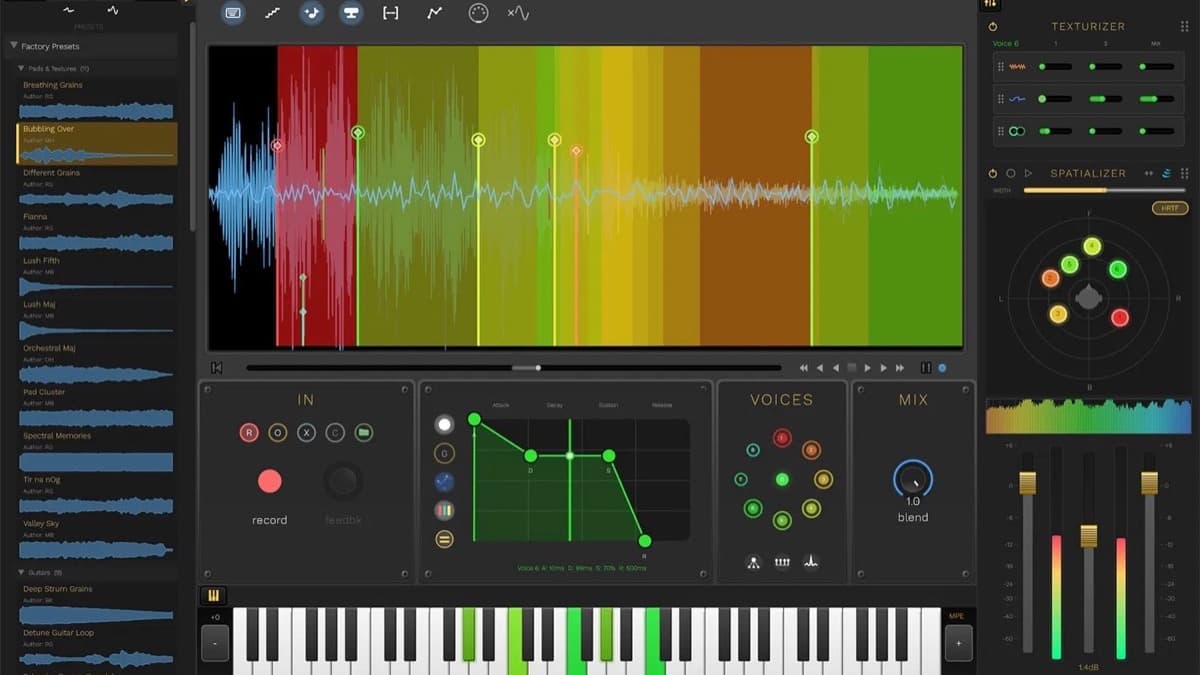
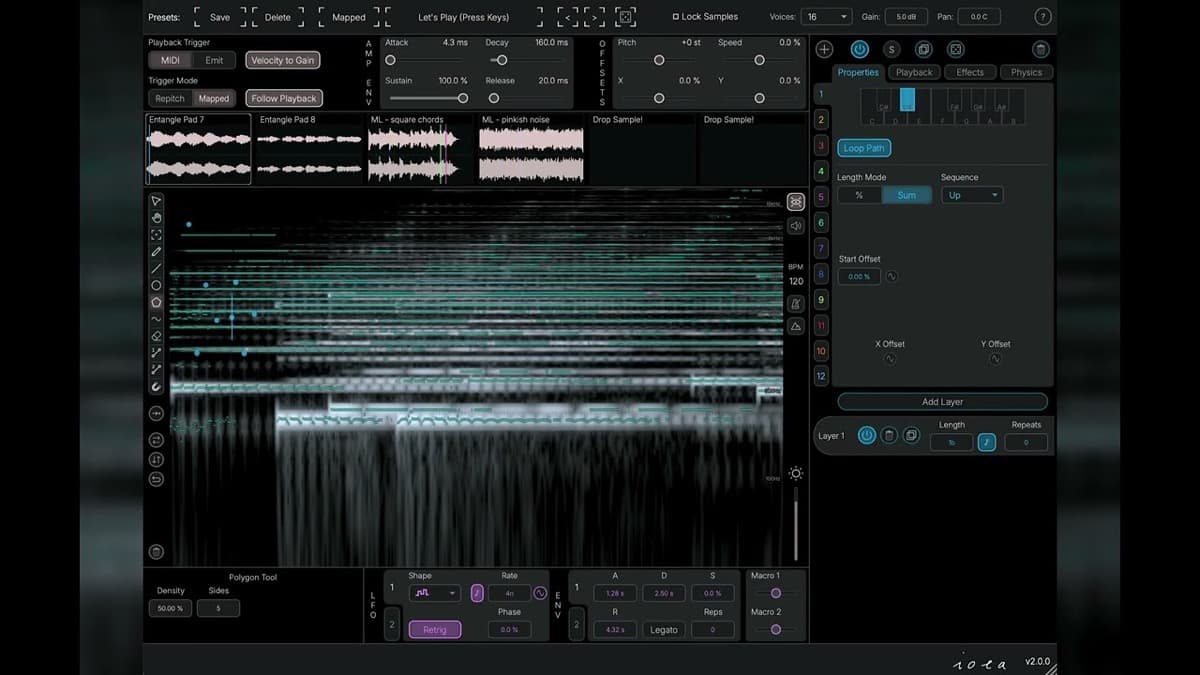
Iota II is a sampler you interact with by drawing. At its center sits a spectrogram, a visual map of a sound where the horizontal axis is time and the vertical axis is frequency. Rather than set a start point and hit play, you sketch the path your playback takes across that image, and the instrument follows the line you drew.
That will feel familiar to anyone who used iZotope Iris 2, the spectral sampler iZotope discontinued years ago and never replaced. Producers have missed it ever since. Dillon Bastan, known for a long run of inventive Max for Live devices including the original Iota, rebuilt the idea as a full cross-platform plugin and pushed it well past where Iris 2 stopped. Where Iris 2 mostly let you paint a spectral selection to filter a sample, Iota II lets you draw motion, layer it, and let physics move it for you.
What Iota II does, feature by feature
A spectrogram you draw on
You can load up to six samples, either from the factory library or your own files, each with its own gain and tuning. The spectrogram shows them so you can see exactly where the energy sits in a sound, and you can zoom in to work on fine detail. Drawing on that image is the core gesture in Iota II. You're not scrubbing a waveform. You're tracing where and how playback moves through the sound.
Up to twelve Paths
The canvas holds up to twelve Paths, and each Path is effectively its own voice with independent settings. A Path chooses one of three playback algorithms. Normal plays the sample back conventionally, spectral reads the sound through a built-in spectral filter so you can isolate and reshape frequency content, and resynthesis rebuilds the audio from its spectral data for smooth, synthetic textures. Running several Paths at once lets you stack a clean layer, a spectral wash, and a resynthesized drone from the same source material.
Layers and image-to-sequence
Inside every Path you can create an unlimited number of Layers. A Layer is a freeform playback sequence drawn on the spectrogram, with its own length, repeat rate, and ordering. You can also convert an image into a sequence, so a picture becomes the map that drives playback. Layers are where Iota II stops being a sampler and starts being a composition tool, because you're drawing rhythm and movement, not just tone.
Granular and scrub playback
Each Layer can play back in a granular or classic mode, or scrub through the material by hand. Granular playback breaks the sound into tiny grains you can stretch, smear, and freeze, which is how you get the evolving pads and clouds that this kind of instrument is loved for. Scrubbing gives you direct, tactile control for sound design and performance.
Effects, modulation, and physics
Every Path carries its own effects section: a multimode filter with spectral FFT, biquad, and ladder types, plus delay, overdrive, and sample-rate reduction with ring modulation for grit. Modulation is generous. You get two multi-wave LFOs with a Perlin noise option for organic drift, two looping envelopes, two path-following sequencers, two random spray values, and two macros, all bipolar, plus a voice amp ADSR. MPE slide and pressure are supported for expressive control.
The feature that sets Iota II apart is Auto Emit. Instead of triggering notes, you let a physics engine fire playback using gravity attractors, with controls for interval, delay, skip, and variance. Set it running and Iota II generates evolving, self-playing textures that never repeat the same way twice. That's the line between a sampler and a generative instrument.
Iota II specifications
| Spec | Detail |
|---|---|
| Product | Iota II |
| Developer | Dillon Bastan |
| Type | Visual multi-sampling spectral and granular synthesizer |
| Samples | Up to 6 (factory library or user samples), per-sample gain and tuning |
| Interface | Zoomable spectrogram you draw playback onto |
| Paths | Up to 12, each with normal, spectral, or resynthesis playback |
| Layers | Unlimited per Path, freeform sequences with length, repeat, ordering |
| Playback modes | Granular, classic, and scrub; image-to-sequence conversion |
| Effects | Multimode filter (spectral FFT, biquad, ladder), delay, overdrive, sample-rate reduction, ring modulation |
| Modulation | 2 LFOs (Perlin option), 2 looping envelopes, 2 path sequencers, 2 random sprays, 2 macros, amp ADSR, MPE |
| Triggering | MIDI keyboard (repitch) and physics-based Auto Emit with gravity attractors |
| Formats | VST3, AU, LV2, standalone |
| System | macOS (Apple Silicon and Intel), Windows, Linux |
| Price | $60 (free trial available) |
Iota II vs Output Portal
The nearest household name in this corner is Output Portal, the granular effect a lot of producers already own. They overlap in texture but work in opposite directions.
| Iota II | Output Portal | |
|---|---|---|
| Developer | Dillon Bastan | Output |
| Type | Visual sampling instrument | Granular effect plugin |
| Sound source | Up to 6 loaded samples or factory content | The audio already on your track |
| Core gesture | Draw playback paths on a spectrogram | Dial in a grain cloud over incoming audio |
| Depth | 12 Paths, layers, physics, resynthesis | One grain engine with presets and macros |
| Formats | VST3, AU, LV2, standalone (mac/win/linux) | VST, AU, AAX (mac/win) |
| Price | $60 | $49 |
Which to pick. Choose Iota II if you want to build new sounds from scratch, sculpt them by hand, and let generative motion carry them somewhere unexpected. Choose Output Portal if you want to glitch and granularize audio that's already in your mix with a couple of knobs. Portal is faster to a result, while Iota II is a deeper studio you sit inside. If your taste runs to grain-level design, Sugar Bytes Graindad and Output Arcade round out the field.
Who Iota II is for
Consider it if you make ambient, cinematic, or experimental music, if you design textures and drones for film and games, or if you spent years wishing someone would bring back Iris 2. Sound designers who like to build a sound rather than pick one will feel at home immediately, and the Auto Emit engine is a gift for anyone who scores to picture.
Skip it if you want finished sounds fast. Iota II rewards patience and exploration, so a producer who needs a quick, preset-driven rompler for a pop session will find it slow going. This is a tool for making sounds nobody else has, which is exactly why it takes time.
How much does Iota II cost?
Iota II is $60 as a one-time purchase directly from Dillon Bastan, with no subscription. A free trial is available, so you can test the workflow on your own material before buying, which is worth doing given how different this is from a normal sampler. It installs as VST3, AU, LV2, and a standalone app, so it fits Ableton Live, Logic, Bitwig, Reaper, and Linux hosts alike.
FAQ
Is Iota II a replacement for iZotope Iris 2?
In spirit, yes. Iris 2 was the spectral sampler many producers relied on before iZotope discontinued it, and nothing filled the gap. Iota II revives the draw-on-a-spectrogram idea and goes further, adding granular and resynthesis playback, twelve Paths, deep modulation, and a physics-driven Auto Emit mode Iris never had.
What is the difference between Iota II and a granular effect like Portal?
Output Portal processes whatever audio is already on your track through one grain engine. Iota II is a full instrument: you load up to six samples, draw how playback moves through them, and layer twelve Paths with spectral and resynthesis modes. Portal reshapes existing audio, Iota II builds new sounds.
What formats and systems does Iota II support?
Iota II runs as VST3, AU, LV2, and a standalone application on macOS (Apple Silicon and Intel), Windows, and Linux. That Linux and LV2 support is unusual for a commercial instrument and makes it friendly to Bitwig and Reaper users on any platform.
The bottom line
Iota II is the most convincing answer yet to a question producers have asked for years: what replaced Iris 2? It keeps the beautiful, direct idea of drawing sound onto a spectrogram, then surrounds it with granular and spectral playback, twelve layered Paths, rich modulation, and a physics engine that plays the instrument for you. It asks for patience and it can lean on your CPU, but at $60 with a free trial, it's one of the most creative sound-design tools released this year. For texture builders and cinematic sound designers, it's close to essential.