FRCTL GRNi: A Granular Sampler You Can Play
FRCTL GRNi is a $34.99 launch granular sampler you play over MIDI. Two layers, MPE, 52 presets, and Linux. Specs, real prices, and who should buy v1.0.0.
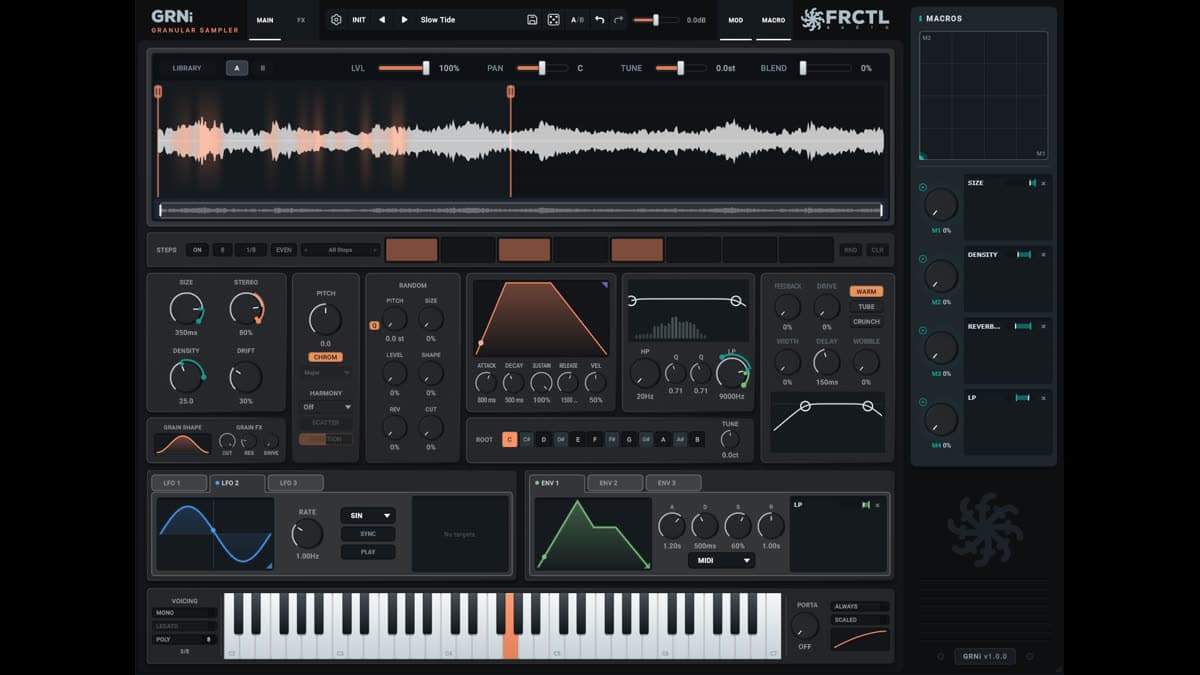
FRCTL Audio shipped GRNi as version 1.0.0 in September 2026. It is a granular sampler instrument: drop a file on the waveform, draw a selection, and play that slice over MIDI. Each held note grows its own grain stream, so a chord gets thicker instead of thinner. Launch price is $34.99 against a $44.99 list for the first two weeks.
At a glance: $34.99 launch / $44.99 list for the first two weeks. VST3, AU, CLAP, and standalone. Windows, macOS, and Linux. 14-day trial. 52 factory presets. Two blendable layers. MPE. 10-slot FX rack. Sold direct by FRCTL Audio.
This is a first look at the shipping 1.0.0 instrument and the specs FRCTL publishes. We have not had GRNi open in a session yet.
What GRNi is
GRNi is not a real-time granular effect. FRCTL already makes that plugin; it is called GRN. GRNi grew out of the same grain engine, then turned it into something you load a sample into and play from a keyboard. Serials are not interchangeable. If you want to granulate audio already on the track, that is still GRN. If you want to turn a recording into keys, that is GRNi.
The useful split is density per voice. A lot of granular instruments share one cloud across the whole chord, so extra notes steal grains from each other. GRNi gives every sounding note its own stream and its own window into the selection. A four-note chord is four times the texture, not the same texture spread thinner. The waveform glow shows where each note is reading.
That puts it next to Novum as a sample-to-instrument play, and next to Portal and Aethon as a granular cousin that is not an insert effect. Portal and Aethon sit on a track you already recorded. GRNi is the track.
Drop a sample, play the grains
Load is the whole point. Drop a WAV, AIFF, FLAC, OGG, or MP3 on the waveform from the file browser, or click LOAD. On Windows, drags from Splice or the Ableton browser land too. Each layer keeps 60 seconds at 48 kHz (65 seconds at 44.1 kHz, 30 seconds at 96 kHz). Draw the slice you want, then play.
Presets carry engine settings only. Your sample, selection, layer levels, and blend survive preset switching, so you can walk the factory bank against your own material instead of losing the file every time you audition a pad.
A buffer library saves captured buffers as .grnbuf files per layer. Build a sound once, then recall that buffer in another project without hunting the original recording.
Two layers, blended grain by grain
Layer B is a second sample, not a copy of layer A. Each layer keeps its own selection, level, pan, and tune. BLEND does not crossfade two static mixers. It decides, for every new grain, which layer that grain reads from. The mix breathes. A pad can lean on a vocal in layer A and a room tone in layer B without a static 50/50 sitting in the middle.
That is the sound-design half of the instrument. The performance half is voicing. GRNi runs mono, legato, or poly up to 16 voices, with portamento in ALWAYS and SCALED modes. An on-screen keyboard from C2 to C7 uses the same voice engine as your controller. MPE adds per-note bend (it survives into release tails), per-note pressure into level, and slide that moves each note's read position through the sample. A regular MIDI keyboard still works.
SCALE mode tunes the pitch knob and the grain jitter to one of ten scales, so scattered grains land on notes that belong together. A Q toggle on the random page keeps pitch jitter in key the same way. Harmony adds scatter and direction when you want intervals instead of a single pitch.
Grain cards, modulation, and the step sequencer
The main page is six cards plus the keyboard. Grain handles SIZE, DENSITY (tempo-syncable), DRIFT, and STEREO, plus a grain shape editor and per-grain CUT / RES / DRIVE. Pitch sits next to it with FREE / CHROM / SCALE. Random covers pitch, size, level, shape, reverse, and cut per grain. Voice is an ADSR with velocity. A resonant high-pass / low-pass filter shows a live spectrum. Feedback runs WARM / TUBE / CRUNCH.
Modulation is one click away: 3 LFOs, 3 envelopes, and 4 macro knobs on an XY pad, all drag-and-drop. A step sequencer writes rhythmic grain patterns when you want the cloud to pulse instead of bloom. The GUI resizes from 75% to 150%.
Polyphony is 16 voices and 64 grains. That is the published ceiling. Dense chords with high density will spend it.
The 10-slot FX rack
The FX page is a reorderable rack after the grain engine, so every effect hears the whole cloud. Ten slots: bitcrusher, chorus, reverb, delay, phaser, flanger, distortion, tremolo, utility, and filter. Each slot has six knobs and a mix, plus bypass. Order is saved with the preset. The current first look is Orra Pump Pro.
This is a finishing rack, not a modular playground. You will not replace a dedicated delay suite with it. You will print a playable granular patch with space and motion already on it, which is the point of putting the rack inside the instrument.
Factory content is 52 presets in seven categories: keys, pads, plucks, drones, textures, motion, and weird.
GRNi specifications
| Spec | Detail |
|---|---|
| Type | Granular sampler instrument |
| Version | 1.0.0, September 2026 |
| Layers | 2, with per-layer selection, level, pan, tune, and grain-by-grain BLEND |
| Sample import | WAV, AIFF, FLAC, OGG, MP3; 60 s/layer at 48 kHz (65 s at 44.1 kHz, 30 s at 96 kHz) |
| Voices / grains | 16 voices, 64 grains |
| Voicing | Mono, legato, poly; portamento ALWAYS / SCALED |
| Modulation | 3 LFOs, 3 envelopes, 4 macros on an XY pad, step sequencer |
| FX | 10-slot reorderable rack after the grain engine |
| MPE | Per-note bend, pressure, slide |
| Presets | 52 factory, 7 categories; presets keep your sample |
| Formats | VST3, AU, CLAP, standalone |
| Platforms | Windows 10 / 11; macOS Intel and Apple Silicon; Linux |
| License | 3 computers; lifetime free updates |
| Trial | 14 days, full-featured, no card |
| Price | $34.99 launch / $44.99 list, first two weeks |
GRNi vs Novum, Portal, and Aethon
| GRNi | Dawesome Novum | Output Portal | Parish Audio Aethon | |
|---|---|---|---|---|
| Job | Playable granular sampler | Spectral + granular instrument | Granular insert effect | Granular transform insert |
| Layers / source | 2 sample layers, MIDI | Single-sample spectral import | Live audio input | Capture buffer from the track |
| MPE | Yes | No published MPE focus | Effect, not an instrument | Effect, not an instrument |
| Formats | VST3, AU, CLAP, standalone | VST3, AU, AAX | VST, VST3, AU, AAX | VST3, AU |
| Linux | Yes | No | No | No |
| Price | $34.99 launch / $44.99 | $179 | $149 ($75 on the current sale) | $34.97 intro / $69.95 |
Pick GRNi when you want to load your own file and play it as keys, especially if you need Linux, CLAP, or MPE. Pick Novum when the spectral import is the instrument and you will pay for that workflow. Pick Portal or Aethon when the source is already on the track and you want an insert, not a sampler. Lucid is the other current granular insert on this desk, built around scale-locked grains on live audio.
The Granular Duo on the FRCTL shop pairs GRN and GRNi at $59.99. The Everything bundle is $114.99. Those prices apply at checkout against what is already in the cart.
Who GRNi is for
GRNi suits producers who collect recordings and want them playable: ambient and score work, beatmakers flipping a one-shot into keys, and MPE players who want per-finger grain streams. The 14-day trial is full-featured and does not ask for a card. When it ends, the editor freezes but audio still passes, so old projects keep opening.
Skip it if you need AAX or a spectral instrument like Novum. Skip it if you only want to granulate a live track; that is GRN or Aethon. And skip it if 60 seconds per layer at 48 kHz is too short for the files you work with. This is a playable grain instrument, not a long-form sampler.
How much does GRNi cost?
GRNi is $34.99 for the first two weeks, then $44.99, direct from FRCTL Audio. The license is perpetual, with lifetime free updates and a 14-day money-back guarantee. Three computers. Formats are VST3, AU, CLAP, and standalone on Windows, macOS, and Linux. You will not find it on Plugin Boutique, Thomann, or Best Service.
FAQ
Is GRNi the same as GRN?
No. GRN is an effect that granulates audio already on the track. GRNi is an instrument that granulates a sample you load and plays it over MIDI. Serials are not interchangeable.
How much does GRNi cost?
$34.99 launch / $44.99 list for the first two weeks, one-time, from FRCTL Audio.
Does GRNi support MPE?
Yes. Per-note pitch bend survives into release tails, pressure maps to level, and slide moves each note's read position through the sample.
What are the GRNi system requirements?
Windows 10 or 11, macOS on Intel or Apple Silicon, and Linux. Plugin formats are VST3, AU, and CLAP, plus a standalone app.
Do presets replace my sample?
No. Presets store engine settings. Your samples, selections, layer levels, and blend stay put while you browse.
Verdict
GRNi is the FRCTL grain engine turned into a keyboard instrument. Two layers that blend grain by grain, a stream per note, MPE, and a ten-slot rack sit at a launch price that is closer to a preset pack than a sampler suite. Linux and CLAP are uncommon extras at this price. It will not replace Novum's spectral import or an insert granular like Portal or Aethon, and there is no AAX. Browse our granular coverage to see where a $35 playable grain sampler sits next to the $179 spectral instrument and the insert effects.