Some links on this page are affiliate links. If you buy through them, Dubspot may earn a commission at no extra cost to you. It never affects our scores or what we recommend — read our policy.
Blinksonic HOLODRIFT: Granular Sampler Meets Spectral Synth
HOLODRIFT pairs eight granular slots with a real-time spectral engine that rebuilds any sound partial by partial. €119 launch price to Oct 30. Specs, rivals, verdict.
P
Priya Raman
October 21, 2026 · 9 min read
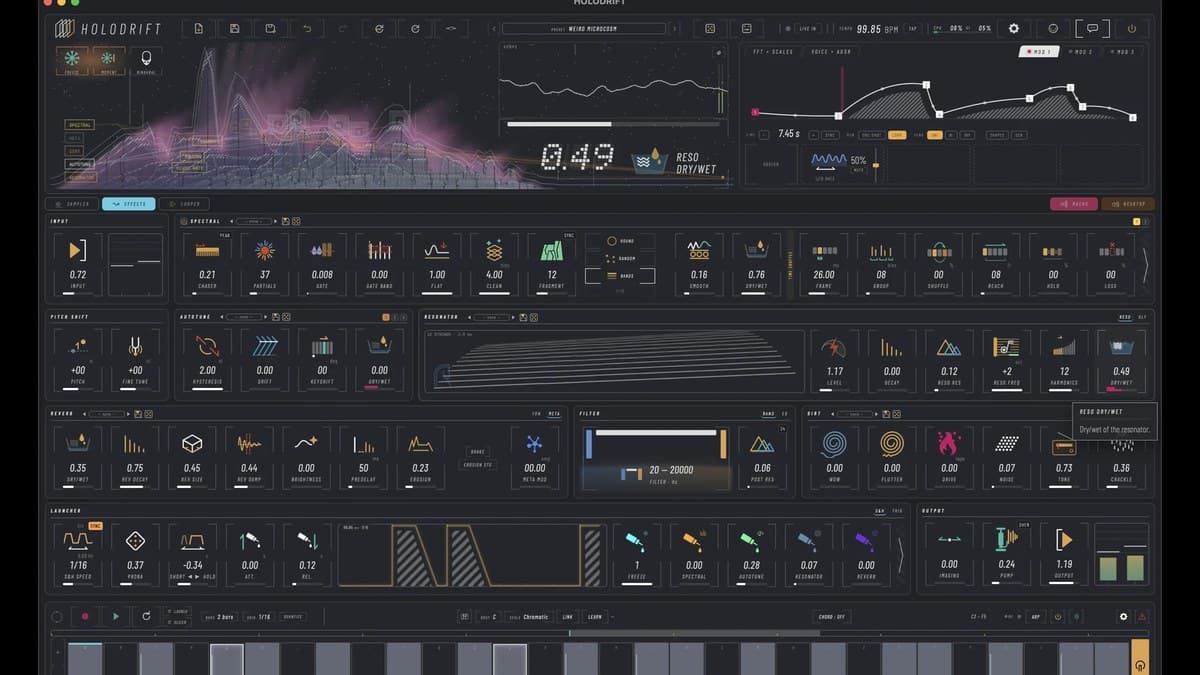
Blinksonic has released HOLODRIFT, its first standalone instrument after a decade of REAKTOR ensembles. It is a granular sampler and a real-time spectral engine in one plugin. Eight granular slots hold your sounds, a "journey" glides from one to the next, and everything the sampler plays is analysed into partials and rebuilt as you play. The launch price is €119 with code L4UNCH until October 30, 2026, against a regular €159.
At a glance: HOLODRIFT costs €119 at launch (regular €159), VAT included, direct from Blinksonic. It runs as AU, VST3, CLAP and standalone on macOS 13 or later (universal), and as VST3, CLAP and standalone on Windows 10 and 11. There is no AAX. You get an instrument and a HOLODRIFT FX version for audio tracks, 1,360 library sounds in 16 collections, 240 presets in 13 banks, and 265 automatable parameters. The demo runs nine days with everything unlocked.
What is HOLODRIFT?
Most granular instruments stop at grains. Most spectral tools stop at analysis and effects. HOLODRIFT chains the two. The granular sampler makes the raw material, and the spectral engine listens to it continuously, splits it into partials, then rebuilds it. Between the two sits the JOURNEY, a single position that travels along the line of eight slots and crossfades one sound into the next.
The result is aimed at evolving textures, pads, soundscapes and odd beats rather than clean emulations. It comes from Blinksonic, the one-person studio of French sound designer Sylvain Stoppani, best known for REAKTOR ensembles such as LIQUIFI+IGNITA. HOLODRIFT takes the same idea, a sampler feeding a resynthesis engine, much further.
How the sound is built
Eight granular slots
Each slot is a complete granular engine with four voices. Load a whole sample, a slice of a loop, a recording or live input, then control grain speed, size, overlap, jitter, spray, pan and density. Grains run from a few milliseconds to a second long. You can stretch a sound without changing its pitch, freeze it, run it backwards, or scatter it into a cloud.
Each slot also chooses how the journey reads it. LOCK ties the playhead to the journey, so eight slices of one loop behave like a single instrument. FREE lets each sound run at its own pace. HOLD freezes the playhead in place. You can also shrink the line to fewer, wider slots.
AUTOFILL is the fast start: one click fills all eight slots from a chosen category of the library. The library itself is laid out as a map by timbre, and you can draw a lasso around a region to fill the slots with neighbouring sounds.
The journey
The journey is what makes HOLODRIFT play like an instrument instead of a sample browser. You drive it by hand from a position strip, the mod wheel or the XY pad, with a recorder that loops your gesture over one to 16 bars. Or let it move by itself: AUTO holds each slot for a share of time you set with a weight bar, LFO sweeps it with seven shapes, and STEP moves one slot per note, in order or at random.
On the XY pad, X drives the journey and Y can control any setting. An INERTIA control sets how slowly the cursor follows your finger, from 80 ms to a full minute. That last option is useful for slow ambient beds.
The spectral engine
Everything the sampler plays goes through an FFT engine (256 to 4,096 points, 2x to 8x overlap) with 15 spectral processes. Several are straightforward: a spectral gate, a partial count filter, freeze, and smoothing of pitch and level. Others are stranger. TIME SHUFFLE reorders analysis frames in time, LOSS drops them at random, DISPERSE pushes partials into their neighbours, and SCRAMBLER swaps the pitch of two partials. Blinksonic is candid that real-time resynthesis adds roughness, and it leans into that "grit" as a feature.
WAVE mode is the headline. Instead of rebuilding each partial with a sine, HOLODRIFT replays it with a wavetable: one of 21 waveforms, or any sample you drop in, measured over 128 harmonics. Your notes and gestures stay, but the material changes. IMPRINT then lays a file's formants and resonances over the result.
The rest of the chain
After the spectral engine come eight more sections: pitch shift (plus or minus 24 semitones), a polyphonic AUTOTUNE that snaps each partial to one of 24 scales without pitch detection, a 16-comb RESONATOR tuned to the scale, a spectral DELAY with shimmer that delays partials rather than audio, two reverbs (FDN and a drifting META type with EROSION), a filter or three-band EQ, a DIRT section with tape, wow, flutter and nine saturation models, and an output stage with width, PUMP and a limiter.
Performance tools
A looper records what HOLODRIFT plays and slices it back into the eight slots. A SLICER with 16 pads remixes the output with random slice, pitch, scratch, reverse and stutter tools, and an always-on CAPTURE buffer grabs the last 1 to 32 bars. There is a 30-key computer keyboard mode, a scale map that folds any MIDI keyboard onto the chosen scale, a LEARN function that guesses root and scale, eight chord types, an 11-pattern arpeggiator, three drawn modulators with 23 shapes, and MIDI learn.
HOLODRIFT specifications
| Spec | HOLODRIFT |
|---|---|
| Type | Granular sampler plus real-time spectral resynthesis synth |
| Granular | 8 slots, 4 voices each, LOCK/FREE/HOLD/LOOP modes |
| Journey | Manual with 1 to 16 bar gesture recorder, AUTO, LFO (7 shapes), STEP |
| Spectral engine | FFT 256 to 4,096, overlap 2x to 8x, 15 spectral processes |
| WAVE mode | 21 waveforms or any sample, 128 harmonics, IMPRINT |
| Effects | Pitch shift, polyphonic AUTOTUNE (24 scales), 16-comb resonator, spectral delay, FDN and META reverbs, filter/EQ, DIRT, output |
| Library | 1,360 sounds, 16 collections, 28 editable tags |
| Presets | 240 in 13 banks |
| Automation | 265 parameters, MIDI learn, MIDI clock, host sync |
| Versions | HOLODRIFT (instrument) and HOLODRIFT FX (effect) |
| macOS | 13 or later, Intel and Apple Silicon: AU, VST3, CLAP, standalone |
| Windows | 10 or 11, 64-bit, WebView2: VST3, CLAP, standalone |
| Recommended | Apple M2 or M1 Pro, Intel Core i7 12th gen or Ryzen 7 5800X, 16 GB RAM |
| Disk | About 1 GB with the library |
| Licence | 2 computers; Studio licence up to 10 |
| Price | €119 launch with code L4UNCH to Oct 30, 2026, then €159 |
HOLODRIFT vs Pigments 7 vs Materia
| HOLODRIFT | Arturia Pigments 7 | AudioThing Materia | |
|---|---|---|---|
| Price | €119 launch, €159 regular | $199 at Plugin Boutique | $39 at Plugin Boutique to Oct 31, from $69 |
| Core idea | Granular slots feeding spectral resynthesis | Multi-engine synth with granular and harmonic engines | Additive re-synthesis of a sample |
| Sample morphing | Journey across 8 slots | Per-engine, two engines at once | One sample at a time |
| Spectral processing | 15 real-time processes, WAVE mode | Harmonic (additive) engine | Per-partial editing with 128-point envelopes |
| Formats | AU, VST3, CLAP, standalone | Standalone, VST, VST3, AU, AAX | VST2, VST3, AU, AAX, CLAP |
Arturia Pigments 7 is the safer all-rounder. It covers wavetable, virtual analog, sample, granular, harmonic and modal sounds in one synth with a deep modulation system, and it runs in Pro Tools. What it does not do is glide one sound through eight sampled materials, or rebuild everything it plays through a real-time spectral engine the way HOLODRIFT does. See our Pigments page for the full rundown.
AudioThing Materia is the precise, editable option. It turns one sample into partials you can redraw one by one, and it is $39 at Plugin Boutique until October 31. HOLODRIFT is the more performative tool: less surgery, more movement and texture.
Who it's for
HOLODRIFT is for sound designers, ambient and experimental producers, and film and game composers who build beds and textures from their own recordings. If you like to feed a field recording or a guitar into something and play the result, the live input and the FX version make it unusually flexible. The scale tools and chord modes help keyboard players who do not want to think about theory.
Skip it if you use Pro Tools, since there is no AAX. Skip it, too, on an older laptop: Blinksonic recommends a 2022-or-newer machine and a 1920 x 1080 screen at minimum. And if you want precise, repeatable sounds rather than drifting ones, a classic synth or Materia will suit you better.
Pricing and availability
HOLODRIFT is available now from the official Blinksonic store for €119 with code L4UNCH until October 30, 2026. The regular price is €159. Prices include VAT. A licence covers two computers at a time, and a Studio licence covers up to ten. A nine-day demo has every feature unlocked, with a short pause every 15 minutes.
FAQ
Is HOLODRIFT an instrument or an effect?
Both. HOLODRIFT is the MIDI instrument, and HOLODRIFT FX goes on an audio track and runs the track through the same chain via its live input.
Does HOLODRIFT work in Pro Tools?
No. It runs as AU, VST3 and CLAP plugins and as a standalone app. There is no AAX version, and no Linux or iPad version.
What audio files can I load?
WAV, AIFF, FLAC, MP3 and OGG at any sample rate. The recorder saves 32-bit float WAV files.
How heavy is it on the CPU?
The engine analyses and rebuilds sound in real time, so Blinksonic recommends a 2022-or-newer computer and 16 GB of RAM. On integrated graphics, lowering the visualizer frame rate helps.
HOLODRIFT vs Pigments?
Pigments is a broader multi-engine synth that also runs in Pro Tools. HOLODRIFT is narrower but goes much further with granular morphing and real-time spectral processing of any sound, including live input.
Verdict
HOLODRIFT is one of the most original synth concepts of the year: a granular sampler that feeds a spectral engine, with a journey control that turns eight sounds into one moving texture. The feature list is deep enough for months of exploration, and the €119 launch price is fair for that scope. The missing AAX, unsigned installers and steep system recommendations are the trade-offs. This is a first look based on Blinksonic's official materials, not a hands-on test.