AudioThing Materia Turns Any Sample Into an Additive Synth
AudioThing Materia is an additive re-synthesizer that rebuilds any sample from 96 harmonic partials, with 10 filter types and four FX, from 39 euros.
AudioThing has released Materia, an additive re-synthesizer that breaks any sample into harmonic partials and rebuilds it as a playable instrument. It arrived on 12 October 2026 as version 1.0, and it's on sale at 39 euros during the launch, down from 69. This is a first look based on the official product page, not a hands-on review.
At a glance: Materia loads a sample, analyses it into up to 96 individual partials, and lets you reshape each one before playing the result across the keyboard. Every partial carries its own frequency, amplitude, phase and envelope, so you can thin a sound out, stretch it, retune it or turn a one-shot into an evolving pad. It runs as VST2, VST3, AU, AAX and CLAP across macOS, Windows and Linux.
What is AudioThing Materia?
Materia sits in a corner of synthesis that most producers rarely touch directly: additive resynthesis. Where a wavetable synth like Serum 2 scans through stored waveforms and a subtractive synth carves a bright tone down with filters, an additive engine builds sound from the ground up out of individual sine partials. Materia's twist is that you don't draw those partials by hand. You feed it a sample, it analyses the spectrum, and it hands you back the raw ingredients as editable harmonics.
That makes it a resynthesis tool first and a synth second. The classic reference point is Image-Line Harmor, the additive-resynthesis synth that producers reach for when they want to freeze, blur or re-pitch a sound at the spectral level. Camel Audio's Alchemy did something similar before Apple absorbed it. Materia is a more focused and far cheaper take on the same idea, aimed at sound designers who want spectral control without a modular-sized learning curve.
What Materia does, feature by feature
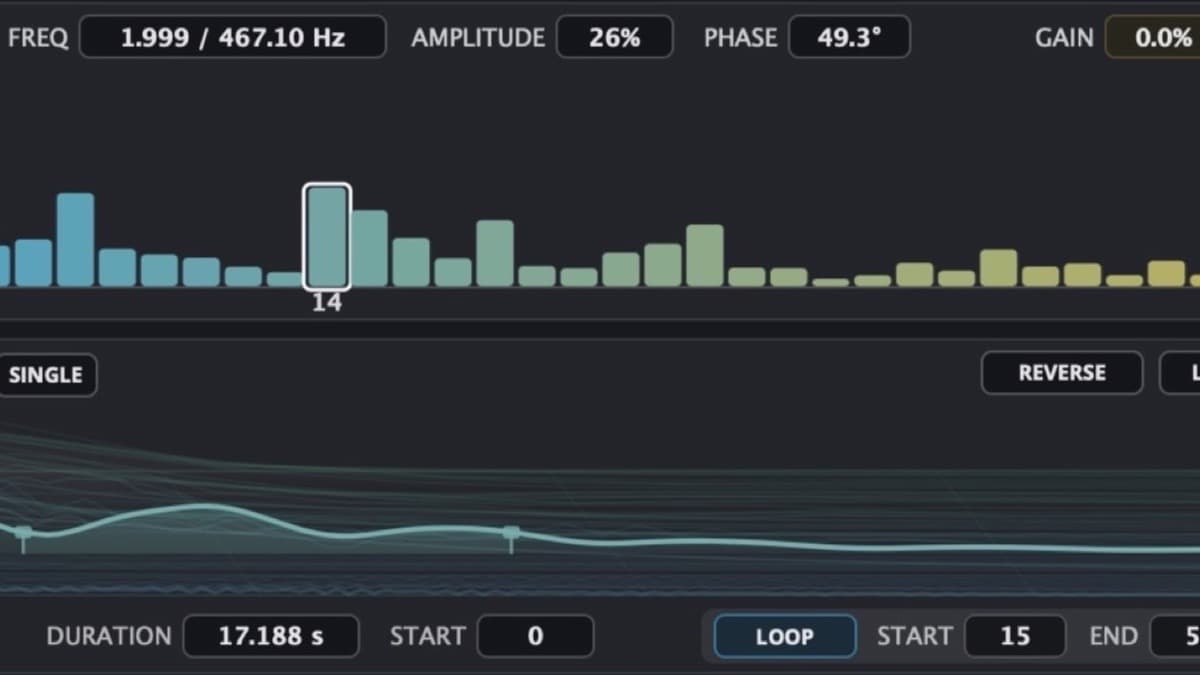
Spectral analysis into 96 partials. Drop in a sample and Materia decomposes it into as many as 96 harmonic partials, each with its own frequency, amplitude, phase and envelope. This is the heart of the instrument. Because the sound is now a stack of editable sine components rather than a fixed recording, you can mute partials to hollow it out, boost others to emphasise a formant, or detune the stack to turn a clean tone into something metallic and strange.
A 128-point envelope on every partial. Each partial gets its own 128-point amplitude envelope, with editable duration and sustain loop points. That's an unusually deep level of control for a plugin at this price. It means a single analysed note can be re-timed partial by partial, so the low harmonics can sustain while the upper ones decay, or the whole spectrum can be reshaped into a slow swell that never existed in the source. Sync Partial Edits lets you apply a change across many partials at once so you're not editing 96 curves one at a time.
Advanced Analysis and empty partials. Beyond the standard analysis, Materia adds an Advanced Analysis mode for tighter spectral tracking and an Add Empty Partials function, which lets you introduce new harmonics that weren't in the original sample. That turns resynthesis into genuine synthesis: you can graft new overtones onto a voice, a drum or a field recording and build a hybrid tone from a real-world starting point.
A filter with 10 types. On top of the partial engine sits a filter offering 10 modes, including low-pass, high-pass, band-pass, notch and formant. The formant option is the interesting one here, because layering vocal-style formant shaping over an already additive tone is exactly the kind of move that makes resynthesis sound organic rather than clinical.
Four effects, including a physical-modelling resonator. Materia ships with four built-in effects: a resonator that models the response of materials such as pipes, plates and springs, plus echo, a phaser and a waveshaper. The resonator looks like the standout on paper, since feeding additive partials through a modelled physical body is a fast route to bell tones, plucked strings and haunted-room textures.
Modulation and workflow. Two envelopes and two LFOs, both with drawable custom shapes, handle modulation. A preset browser with a randomiser gives you quick starting points, and Brightness and Contrast controls tune the look of the interface. Usefully, the analysed model is stored inside the plugin state, so a project reopens with its sound intact even if the original sample is long gone.
Materia specifications
| Spec | Detail |
|---|---|
| Type | Additive re-synthesizer |
| Developer | AudioThing |
| Engine | Spectral analysis into up to 96 harmonic partials |
| Per-partial control | Frequency, amplitude, phase and a 128-point envelope each |
| Analysis tools | Advanced Analysis, Sync Partial Edits, Add Empty Partials |
| Filter | 10 types (low-pass, high-pass, band-pass, notch, formant and more) |
| Effects | Resonator, echo, phaser, waveshaper |
| Modulation | 2 envelopes, 2 LFOs with drawable shapes |
| Desktop formats | VST2, VST3, AU, AAX, CLAP (64-bit) |
| Platforms | macOS 10.13+, Windows 7+, Ubuntu 20.04+ |
| Price | 39 euros launch, from 69 |
Materia vs Arturia Pigments
The nearest mainstream reference most producers already own is Arturia Pigments, a multi-engine synth that can import samples and includes an additive-style harmonic mode alongside wavetable and granular engines. The two overlap, but their scope is very different, and the comparison shows what Materia is for.
| AudioThing Materia | Arturia Pigments | |
|---|---|---|
| Core idea | Dedicated additive resynthesis of samples | Multi-engine synth (wavetable, virtual analog, granular, harmonic) |
| Partials | Up to 96, individually editable | Harmonic engine, less granular per-partial editing |
| Per-partial envelopes | 128-point envelope on each partial | No equivalent per-partial depth |
| Sample resynthesis | The whole point of the plugin | One feature among many |
| Platforms | macOS, Windows, Linux | macOS, Windows |
| Price | 39 euros launch, from 69 | Around 199 full price |
Which to pick. If you want one synth that covers wavetable, analog-style and granular sounds in a single, polished instrument, Pigments is the broader buy and will do more jobs. If your goal is specifically to take a recording apart at the harmonic level and rebuild it, Materia goes far deeper for a fraction of the price, and its per-partial envelopes do something Pigments doesn't. A granular tool like Output Portal covers a different flavour of sample mangling again, smearing audio into clouds rather than resynthesising it.
Who Materia is for
It suits you if you're a sound designer who likes to start from real recordings: a vocal snippet, a cymbal, a creaking door, a synth one-shot. Materia's partial editing and the physical-modelling resonator reward that kind of spectral curiosity, and it can produce evolving textures, bells and formant pads that are hard to reach any other way.
Skip it if you want a conventional play-and-go synth with big presets and immediate bass and lead sounds. That's the job of a wavetable instrument like Vital or Serum 2. Materia is a specialist, and its strength is depth in one area rather than breadth.
How much does Materia cost?
Materia is 39 euros during the launch sale, down from its regular 69 euros. There is a free demo that inserts three seconds of silence every 45 seconds and disables saving, so you can test the workflow before buying, and a single licence covers up to three computers. You can buy it from the official AudioThing product page, and browse the rest of the maker's catalogue on AudioThing at Plugin Boutique.
For more from the same developer, our plugin coverage includes AudioThing The Orb 2 and AudioThing Orbita, and if you're hunting for no-cost options, our guide to the best free synth VSTs of 2026 is a good next stop.
FAQ
What is additive resynthesis?
Additive synthesis builds sound from many individual sine waves, called partials. Resynthesis means analysing an existing recording into those partials so you can edit them. Materia does both: it breaks a sample into up to 96 partials and lets you reshape each one, then plays the rebuilt sound across the keyboard.
What formats and systems does Materia support?
Materia runs as VST2, VST3, AU, AAX and CLAP in 64-bit hosts. It is available for macOS 10.13 or newer, Windows 7 or newer, and Ubuntu 20.04 or newer, so it covers Linux as well as Mac and Windows.
How much does Materia cost and is there a demo?
It launched at 39 euros, down from 69, and a free demo is available. The demo adds three seconds of silence every 45 seconds and disables saving, which is enough to audition the sound and workflow before you commit.
Is Materia a synth or a sampler?
It is a hybrid. You start from a sample like a sampler, but Materia does not simply play the recording back. It resynthesises it from harmonic partials, so you are shaping a true additive synth engine that happens to be seeded by your audio.