AudioThing Orbita Spreads Hits Across Eight Circles
AudioThing Orbita is a $39 intro Euclidean drum machine with eight circular tracks, 36 banks, and per-sample filters. Specs, price, and who should buy it.
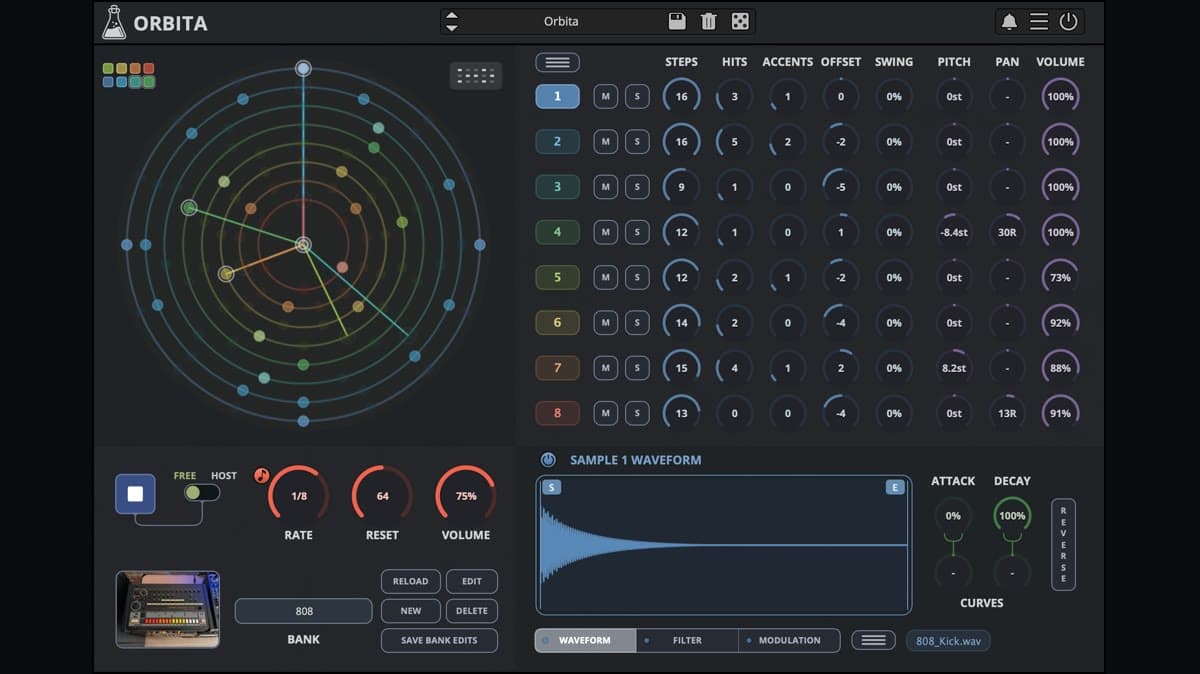
AudioThing shipped Orbita on 28 August 2026, an eight-track sample drum machine that places hits by Euclidean math instead of a classic XOX grid. Desktop intro pricing is $39 against a $69 regular, and Plugin Boutique matches that window through 30 September 2026. This is a first look at the shipping feature set. We have not used it in a session.
At a glance: $39 intro / $69 regular. VST2, VST3, AU, AAX, and CLAP on macOS 10.13 through macOS 26 (Universal 2), Windows 7 or later, and Ubuntu 20.04 or later. iOS and iPadOS ship as AUv3 plus standalone. One license covers three computers. No iLok. Buy it at Plugin Boutique or audiothing.net.
What Orbita is
Most drum plugins ask you to click every step. Orbita asks two numbers per track: how long the cycle is, and how many hits to drop into it. The engine then spaces those hits as evenly as it can around a circle. Change Hits from 3 to 5 and the pattern redraws itself. Change Steps from 16 to 13 and the circle no longer lines up with the bar, which is the whole point.
That idea is old news in hardware and modular land. AudioThing's version is a sample player with eight of those circles running at once, plus a filter and an LFO on every sample. AudioThing traces the first sketch back more than a decade, to a small experimental sequencer it rebuilt several times before this 1.0. You can see that patience in the layout. The circles are the instrument, and the rest of the panel exists to make them useful.
Orbita isn't a synthesis drum machine. It doesn't grow kicks from oscillators. You load samples, either from the 36 factory banks or from your own folder, and the sequencer does the rhythmic work. If you want a chance-first grid that fills cells from a folder, see Chopgrid. If you want hardware analog voices plus digital tracks in one box, see Polyend Drums. Orbita sits between those two: software, sample-based, and Euclidean first.
For a wider map of current boxes, start with the best drum machines of 2026.
How the Euclidean sequencer works
Each of the eight tracks owns its own cycle. You pick a track, set Steps from 0 to 16, then raise Hits. The hits land as evenly as the math allows. That's the Euclidean part, the same even-spacing rule that turns "5 hits in 16" into a pattern you'd have taken a lot longer to click by hand.
Accents mark a subset of those hits as louder. Use them when a 4-on-the-floor kick needs one beat to lean forward, or when a shaker pattern needs a downbeat you can feel.
Offset rotates the whole pattern around the circle without changing step count or hit count. A 3-hit clave that feels late becomes early by a few ticks. This is the cheapest way to find a new interlocking feel between two tracks that already share a length.
Swing pulls the timing off the grid. Euclidean spacing is mechanically even. Swing is how you stop the loop from sounding like a metronome.
Reset decides how many beats pass before the sequencer jumps back to the start. When a 16-step kick runs against an 11-step perc, the two parts can take a long time to meet again. Reset is the leash. Set it short and the groove realigns every bar or two. Set it long, or leave it open, and the pattern keeps walking.
AudioThing's own walkthrough builds the smallest useful demo: a 16-step kick with 4 hits, a 16-step snare with 2 hits, then the hats dropped from 16 steps to 15. One number changes and the hats start to drift. That's the whole product in ten seconds.
Transport can follow the host or run free, and Rate sets how fast the circles move when you aren't locked to the DAW. Two of the sequencing controls live on the circles themselves: drag to change Offset, scroll to change Hits. There's a pattern menu of ready-made cycles, plus a randomizer for when you want a new idea without rebuilding all eight tracks. Once a pattern is worth keeping, you can drag it out as MIDI.
Banks, samples, and the eight-pad mode
Orbita ships 36 factory banks. They cover acoustic kits, 808, CR-78, DD-10, DR-220A, Elsita, LELL UDS, SR-LP-88, Super Drums, Super Percussions, Ult-Sound DS-2, VL-1, Hybrid Grooves, TX101, Mixed Percussions, and more. That's a useful starter set if you want a vintage box tonight and a found-sound kit tomorrow.
The Bank Editor is the long-term reason to keep the plugin. Load your own samples, drag them into the eight slots, save the bank. Combine recordings, one-shots, and odd textures. Orbita doesn't pretend to be a full sampler workstation. It's eight files and a circle per file, which is plenty for a kit and nowhere near enough if you need mapping, round robins, and a piano roll.
Eight-pad drum machine mode is the other way in. Trigger each sound by hand, assign custom MIDI notes to match a pad controller, and play against the Euclidean patterns or instead of them. Use this when you already have a groove in your hands and you only wanted Orbita's samples and filters.
Filter and LFO per sample
Every sample has its own filter: low-pass, high-pass, band-pass, and notch, each in 2-pole and 4-pole versions. Soften a noisy hat, scoop a body out of a tom, or push resonance until a click becomes a tone. Because the filter is per sample, the kick can stay fat while the perc gets thin.
Every sample also has its own LFO. Pick a waveform, set the rate, and send it to Pitch, Pan, Volume, Cutoff, or Resonance. A little pan on a shaker is movement. A lot of pitch on a found sound is a different instrument. Per-sound attack and decay live on their own tab, and that pair is the difference between a tight kit and a smeared one.
The window is resizable. Brightness and contrast controls sit on the panel, a small AudioThing habit that earns its keep if you work in a dark room.
Orbita specifications
| Spec | Detail |
|---|---|
| Developer | AudioThing |
| Type | 8-track sample Euclidean drum machine |
| Sequencer | Per-track Steps (0-16), Hits, Accents, Offset, Swing, Reset |
| Sound | 8 samples per bank, factory plus user via Bank Editor |
| Filter | Per-sample LP / HP / BP / Notch, 2-pole and 4-pole |
| Modulation | Per-sample LFO to Pitch, Pan, Volume, Cutoff, Resonance |
| Banks | 36 factory banks plus Bank Editor |
| Performance | Eight-pad mode with custom MIDI notes |
| Other | Preset browser with randomizer, resizable UI, brightness / contrast |
| Formats | VST2, VST3, AU, AAX, CLAP (64-bit). Linux: VST2, VST3, CLAP |
| macOS | 10.13 through macOS 26, Universal 2, 2 GHz CPU, 4 GB RAM |
| Windows | Windows 7 or later, 2 GHz CPU, 4 GB RAM |
| Linux | Ubuntu 20.04 or newer, 2 GHz CPU, 4 GB RAM |
| iOS | AUv3 and standalone on iPhone and iPad |
| Auth | Online or offline, 1 license / 3 computers, no iLok |
| Demo | Limited banks, 3 seconds of silence every 2 minutes, saving disabled |
| Intro price | $39 through 30 September 2026 |
| Regular price | $69 |
| Buy | Plugin Boutique or AudioThing |
Orbita vs Polyend Drums vs Chopgrid
| Orbita | Polyend Drums | Chopgrid | |
|---|---|---|---|
| Job | Euclidean sample drum machine | Flagship hybrid hardware drum box | Chance-fill 16-cell sampler |
| Street / list | $39 intro / $69 | $2,699 / €2,699 on our Polyend Drums review | $29 intro / $49 on our Chopgrid card |
| Formats | VST2, VST3, AU, AAX, CLAP, iOS AUv3 | Standalone hardware | VST3, AU, standalone |
| Engine | 8 sample tracks, Euclidean circles | 4 analog SSI voices + 4 digital / sample tracks | 16 cells, synthesis + drum modules |
| Best for | Fast interlocking software grooves | A desk instrument you play without a computer | Surprise kits from a folder |
Which to pick. Orbita earns the money when you want Euclidean polyrhythms in the DAW tonight and you already have samples, or you're happy to load them. Polyend Drums is a different purchase entirely: analog voices, a deep 64-step sequencer, and flagship hardware money. Chopgrid is closer in price. Choose Chopgrid when the fun is many files and chance, and Orbita when the fun is eight circles that refuse to resolve on the same bar.
VRAC+ is the other software cousin if you want one source sliced into a 16-pad kit rather than a Euclidean engine. WHORL analyzes one file into attacks, bodies, and textures on a 16-step grid. Different job, similar "make a rhythm from a file" instinct.
Who Orbita is for
Consider it if you like grooves that drift and you'd rather not draw every step by hand.
Consider it if $39 is weekend-instrument money and you'll actually finish a beat with eight samples.
Consider it if you want Linux CLAP and VST3, or an iOS AUv3, from the same developer as the desktop build.
Consider it if three activations and no iLok is how you like to work.
Skip it if you need analog synthesis voices, because Orbita only plays samples.
Skip it if you want a 64-step hardware sequencer with parameter locks. That's Polyend Drums, not this plugin.
Skip it if you need deep sampling with mapping, round robins, and a piano roll. Eight slots is the kit.
Skip it if you already live in a Euclidean modular setup and you only wanted another circle. Try the demo first, because the silence every two minutes will tell you fast whether the idea is yours.
How much Orbita costs
$39 intro through 30 September 2026, then $69. That's the price at Plugin Boutique and on audiothing.net. AudioThing's own store runs the same intro in euros at EUR 39 against EUR 69.
The demo is free with a limited bank selection. It drops in 3 seconds of silence every 2 minutes, it won't save, and you can't authorize it. The full installer lands in your user area after purchase.
Activation is online or offline. Create an account, log in from the plugin, or download a license file. After that, Orbita doesn't need the internet. One license covers three computers, and there's no iLok.
iOS and iPadOS are a separate App Store build (AUv3 and standalone). Check that price on Apple's listing before you buy for a phone or iPad.
The plugin card lives at /plugins/audiothing-orbita.
FAQ
Is Orbita a synth or a sampler?
It's a sample drum machine with a Euclidean sequencer. Each track plays one sample, and there's no oscillator engine.
Orbita vs Chopgrid?
Chopgrid fills 16 cells from random files and adds synthesis modules. Orbita loads eight samples and spaces hits around independent circles. Same-ish price, different rhythm job.
Does Orbita run on Linux and Apple Silicon?
Yes. Ubuntu 20.04 or newer for VST2, VST3, and CLAP. macOS 10.13 through macOS 26 as a Universal 2 binary (AU, VST2, VST3, AAX, CLAP).
Is there an AAX build?
Yes, on macOS and Windows. Linux doesn't get AAX.
How long does the intro last?
Through 30 September 2026, at Plugin Boutique and on the AudioThing store. After that it's $69.
The bottom line
Orbita is an eight-circle sample drum machine that turns Steps, Hits, and Offset into grooves that refuse to sit still. $39 intro through 30 September 2026, then $69. We have not scored it.
Load a kick on 16, put hats on 15, and listen for a bar. If that drift is the idea you've been clicking in by hand, pay the intro. The storefronts are Plugin Boutique and audiothing.net/instruments/orbita.