Parish Audio Aethon: Granular Transform From Any Track
Parish Audio Aethon is a $34.97 intro granular transform with Freeze, a full grain engine, and finishing FX. Specs, real prices, and who should buy v1.0.0.
Parish Audio shipped Aethon as version 1.0.0, a granular transform you drop on a track you already have. It pulls incoming audio into a capture buffer, breaks that buffer into grains, and lets those grains drift, reverse, pulse, and smear into something else. Intro pricing is $34.97 against a $69.95 regular price, and the launch discount runs through 14 September 2026. This is a first look at the live Parish shop and the 1.0.0 installers. We have not used it in a session.
At a glance: $34.97 intro / $69.95 regular through 14 September 2026. Windows and Mac installers for v1.0.0. Windows VST3; macOS VST3 and AU. No AAX. Buy it from Parish Audio.
This is a new plugin, not an update to Parametric Compressor. Same shop, same intro math, different job.
What Aethon is
Most granular plugins ask you to think like a synthesist. You set grain size, spray, and density, then you hunt for a musical result. Aethon puts one control, Transform, at the center and treats the rest of the panel as the way you aim that transformation. Keep Transform low and the source stays recognizable, with extra motion around it. Push it up and the plugin stops being a sweetener and starts being the instrument.
Parish's own examples are mix jobs, not modular slogans: turn a synth into a slow atmosphere, dissolve a chord into a cloud, break a vocal into jittery stereo fragments, or lock a melodic line to a tempo-synced pulse. The audio is whatever is already moving through the track. You do not load a sample library.
If you want a preset-first granular playground with a big XY macro, Portal is the usual expensive reference. If you want a hands-on grain sandbox with Sugar Bytes attitude, Graindad is the other named alternative. Aethon is cheaper and more linear: one buffer, one Transform knob, a grain engine, and a finishing rack.
The Transform control and the capture buffer
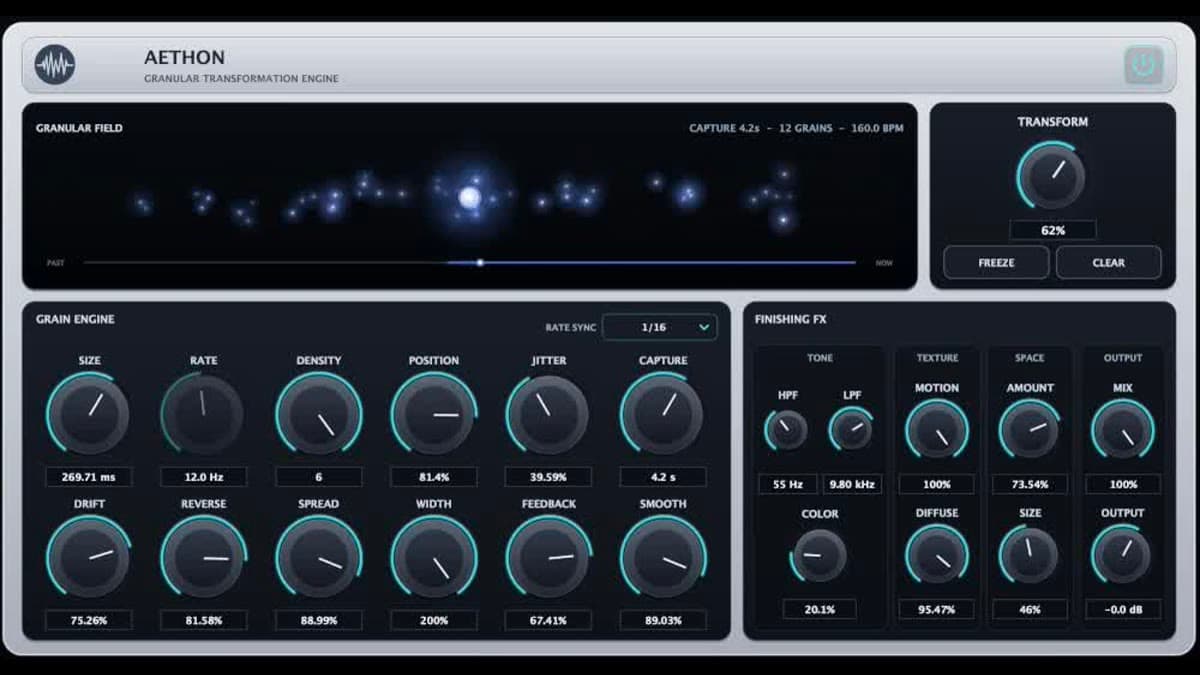
Transform sets how far the plugin leans into the granular engine and the sound-shaping stages around it. Low settings keep more of the source. High settings emphasize the grains and the finishing FX. It is the one control you can ride in a chorus without opening the rest of the panel.
Under that sit Freeze and Clear. Freeze stops the buffer from taking new audio. The last captured moment stays in memory while Aethon keeps turning it into new textures. Incoming audio drops out of the equation. Clear wipes the history so Position, Jitter, and Drift have nothing left to read.
Capture sets how much recent audio the plugin keeps. A short buffer stays close to the present. A longer buffer gives Position more past to walk through. The GUI shows that history as a field of grains, with a past-to-now timeline and a live grain count.
This is the difference between a granular delay and a granular freeze. Delay wants new audio forever. Freeze wants one instant to become a pad. Aethon does both from the same buffer.
The grain engine
The Grain Engine is twelve controls plus a Rate Sync menu. Parish publishes a description for each one on the product page. Here is what they do for a producer.
Size is grain length. Short grains get rhythmic and fragmented. Long grains smear into sustained layers. This is the first decision: pulse or cloud.
Rate sets how often new grains appear when Rate Sync is Free. Faster rates feel denser even before you touch Density.
Rate Sync locks grain timing to the host or lets it run free. Synced divisions are how you get a 1/16 pulse that stays with the session. Free is how you get a wash that ignores the grid.
Density is how many grains build the output. Sparse settings leave individual events. High settings blur those events into a continuous layer.
Position chooses where the engine reads inside the captured history. Move it back to revisit older audio. Leave it forward to stay near what just arrived.
Jitter randomizes grain positions around that Position. A little jitter keeps the texture alive. A lot of jitter scatters the grains across a wider stretch of the buffer.
Drift walks through the captured material on its own, so the texture evolves without you riding Position.
Reverse sets how many grains play backward. A little reverse is a flicker. A lot of reverse is an abstract, backward cloud.
Spread groups grains tightly or lets their positions and behavior fan out.
Width is stereo image, from near-mono to a field that opens past normal stereo.
Feedback returns processed grains into the capture system. That is how a texture starts repeating and reshaping itself instead of dying with the input.
Smooth softens the joins between grains. High Smooth is blended and atmospheric. Low Smooth keeps edges and rhythm.
Those twelve knobs are the whole granular argument. None of them hide behind extra pages. Short Size, high Density, high Reverse, and Feedback up will leave the source behind in a hurry.
Finishing FX
The right-hand rack is the polish after the grains. Parish calls it Finishing FX, and it is a complete small chain.
HPF and LPF carve the processed sound. Raise the high-pass to lose rumble the grains picked up. Drop the low-pass to darken a harsh cloud.
Color adds harmonic character. Use it when the grains feel thin and you want them to sit like a layer, not like a special effect.
Motion animates a texture that has gone still. Pair it with Drift when Freeze is on and the buffer would otherwise loop in place.
Diffuse is a short diffusion stage. It softens transients and individual grain hits so events blend into atmosphere.
Space Amount and Space Size are the ambience after the grains. Amount is how much space. Size is how large and how long that space feels.
Mix blends processed and dry. Pull it back for parallel transformation. Leave it at 100% when Aethon is the sound.
Output is the final level after grains, finishing FX, and Mix.
Power bypasses processing and leaves the plugin in the chain.
This rack is why Aethon can stay on a vocal or a synth without a second reverb after it. It is also why it will not replace a dedicated hall. Space here is a finisher, not a convolution engine.
Parish Audio Aethon specifications
| Spec | Detail |
|---|---|
| Developer | Parish Audio |
| Full name | Aethon Granular Transformation Engine |
| Version | 1.0.0 |
| Type | Granular transform / buffer effect |
| Intro price | $34.97 through 14 September 2026 |
| Regular price | $69.95 |
| Headline control | Transform |
| Grain engine | Size, Rate, Rate Sync, Density, Position, Jitter, Drift, Reverse, Spread, Width, Feedback, Smooth, Capture |
| Buffer | Capture length, Freeze, Clear |
| Finishing FX | HPF, LPF, Color, Motion, Diffuse, Space Amount, Space Size, Mix, Output |
| Display | Grain visualization with capture time, grain count, and tempo |
| Formats | Windows VST3; macOS VST3 and AU |
| AAX | No |
| Installers | Windows .exe and Mac .pkg, both v1.0.0 |
| Also available | Parish Full Access Pass, $9.95 per month after a 7-day trial |
| Buy | Parish Audio |
Aethon vs Portal vs Graindad
Portal is the playable granular effect most producers already know. Graindad is the deeper hands-on sandbox. Prices in those columns come from those plugin cards.
| Parish Audio Aethon | Output Portal | Sugar Bytes Graindad | |
|---|---|---|---|
| Price | $34.97 intro / $69.95 | $149 on our Portal card | €99 on our Graindad card |
| Job | Transform a live buffer with one intensity control | Preset-led granular FX with an XY macro | Performance granular sandbox |
| Buffer | Capture history plus Freeze and Clear | Time-manipulation engine, tempo-synced grain delay | Freeze and stutter modes |
| Deep controls | Full grain engine plus finishing FX | Scale-based pitch, stretch, humanize, seven FX | Multiple granular modes and performance tools |
| Presets | Factory presets on the product | 250+ finished presets | Sugar Bytes-style preset and performance sets |
| Formats | VST3, AU | VST, VST3, AU, AAX | VST3, AU, AAX |
| Pro Tools | No AAX | AAX | AAX |
| Reach for it when | You want a cheap, literal grain transform on a track | You want instant cinematic grains from presets | You want to perform the grains |
Which to pick. Choose Aethon when the picture in your head is "take this synth, freeze a bar, and turn it into a moving layer," and you do not want to pay flagship money for that move. Choose Portal when you want a huge preset library and a macro you can play. Choose Graindad when you want to perform stutter, freeze, and spray from the plugin itself.
If you want a recent Parish dynamics plugin instead of grains, that is Parametric Compressor.
Who Aethon is for
Consider it if you already record synths, vocals, and guitars and you want a cheap way to grow a second layer from those tracks.
Consider it if Freeze-plus-Transform is a move you keep building with a delay, a reverb, and a grain plugin. Aethon is that chain in one insert.
Consider it if $34.97 is the budget and you would not have bought Portal at $149.
Skip it if you work in Pro Tools and need AAX. This release is VST3 and AU.
Skip it if you want a granular synthesizer with its own oscillators. Aethon is an effect. No incoming audio, no grains.
Skip it if you need a preset browser that finishes cues for you. Portal still wins that job.
How much does Parish Audio Aethon cost?
$34.97 intro, $69.95 regular at Parish Audio. The launch discount is 50% off and runs through 14 September 2026. After that, the shop price is $69.95.
Windows and Mac installers are version 1.0.0. Parish also sells a Full Access Pass at $9.95 a month after a 7-day trial, which covers the current plugin lineup including Aethon. Cancel anytime.
Parish sells direct. Plugin Boutique and Thomann do not list Aethon.
The plugin card lives at /plugins/parish-audio-aethon.
FAQ
Is Aethon a granular synth?
No. It is an effect. It transforms audio that is already moving through the track. There is no oscillator bank and no factory sample library.
How long does the $34.97 intro last?
Through 14 September 2026. After that, Aethon is $69.95.
Aethon vs Portal, which one?
Portal is the preset-led granular effect with an XY macro and a $149 street price. Aethon is a cheaper transform with a visible buffer, a Freeze switch, and a full grain engine on one page. Buy Portal for finished cinematic grains. Buy Aethon when you want to shape a specific track you already have. Detail is on the Portal card.
Does Aethon run in Pro Tools?
No AAX build. Windows is VST3. macOS is VST3 and AU.
Is this the same plugin as Parish Parametric Compressor?
No. Parametric Compressor places dynamics bands like an EQ. Aethon is a granular transform. They share a shop and an intro price shape. They do not share a processor. See the Parametric Compressor first look.
Verdict
Aethon is Parish Audio's cheap answer to a common session problem: you like the part, and you want a second version of it that moves. $34.97 is the intro through 14 September 2026. $69.95 is the regular price. Transform, Freeze, a full grain engine, and a finishing rack are the whole product.
It will not replace Portal's preset library, and it will not run in Pro Tools. For a first 1.0.0 on a new granular effect, the control list is complete and the price is the reason to try it. Install the Windows or Mac build, freeze two bars of a synth, and ride Transform until the source becomes a layer. The live storefront is parishaudio.com/products/aethon.