Minimal Audio Lucid: Granular FX That Stay in Key
Minimal Audio Lucid is a $79 intro granular FX plugin with scale-locked grains, timeline sync, and 350 presets. Specs, Portal comparison, and who it is for.
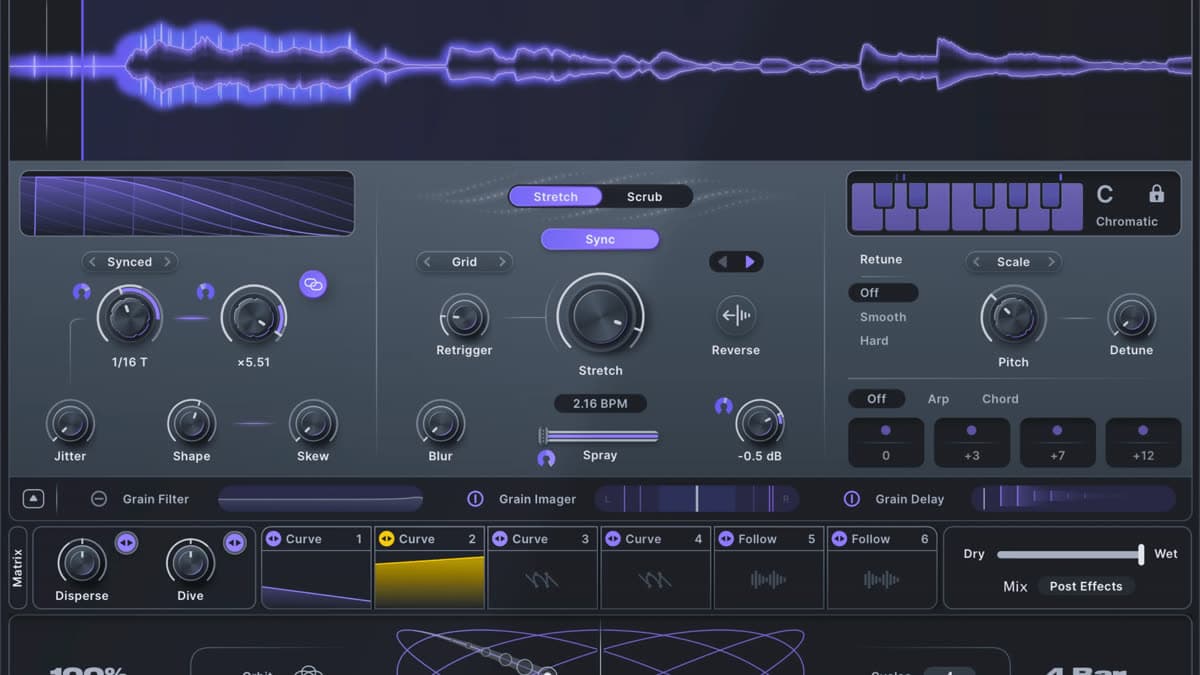
Minimal Audio has released Lucid, a real-time granular effect that retunes every grain to a key and scale you choose. Granular processing chops audio into tiny slices, or grains, then replays them to stretch, smear, and re-pitch the source. The official store and Plugin Boutique both list $79 intro / $129 regular, and Plugin Boutique dates that intro through 30 September 2026. This is a first look at published specs and official demos. We have not printed Lucid on a mix.
At a glance: $79 intro, $129 regular through 30 September 2026. 64-bit VST2, VST3, AU, and AAX. macOS 10.11 or later including Apple Silicon, Windows 10 or later. 350 presets across 13 packs. Official trial installers are listed as v1.0.0. Buy it from Minimal Audio or Plugin Boutique.
What Lucid is, and what it is not
Lucid is an insert effect, not a granular synth. You feed it a vocal, a loop, a pad, or a pluck, and it rebuilds that audio grain by grain. Minimal Audio's pitch is musical control: stay in key, stay on the timeline, then push as far as you want.
That is a different job from Current 2, the same company's flagship instrument. Current builds sounds from oscillators and samples, while Lucid only processes what is already on the track. It also sits close to Output Portal in the catalog, since both are granular effects with scale tools and a performance pad. Lucid's published hook is per-grain scale-lock plus timeline sync rather than a circular visualizer.
If you still want the vocabulary behind delay, reverb, pitch, and why grains smear time, start with our audio effects overview. Lucid assumes you already know why you reached for a granulator.
Minimal Audio's own walkthrough is the most useful demo right now. It is official material, not an independent verdict:
Grain scale-lock and timeline sync
Two controls define the product page.
Grain scale-lock retunes every grain to the key and scale you set, in real time. Minimal Audio calls this an industry first, so treat the label as their claim rather than a settled fact. The behavior is what matters: a vocal fragment or a drum hit can move in pitch without leaving the song's notes. Compare that to a granulator that sprays microtonal debris unless you babysit every transposition.
Granular timeline sync keeps stretch, freeze, snap, and scrub locked to the session. Stretch changes duration, freeze holds a slice, snap quantizes motion, and scrub drags you through the buffer. Those moves stay on the grid instead of drifting away from the arrangement.
Official pack demos name both engines directly, Stretch and Scrub, and the factory library treats them as two doors into one grain engine. Pitch stays musical. Time stays on the clock. Everything after that is shaping.
Per-grain tools after the retune
Scale-lock is not the whole engine. Official feature copy lists four more grain-level processors.
Harmonic grain delay is the shimmer and arpeggio path. Delay hits grains that are already tuned, so echoes stay in the scale instead of stacking out-of-key ghosts.
Multi-mode grain filter shapes each grain with filtering, drive, and modulation. This is not one master EQ parked after the cloud; the filter sits on the grain itself.
Dynamic grain imager builds stereo width from the grains rather than from a widener further down the chain. Official language describes wide, controlled stereo movement directly from the grains.
Grain chord and arp modes turn incoming audio into chords, stacked harmonies, and evolving arpeggios. The Plugin Boutique page posts dry and wet clips on arps, drums, plucks, and vocals. Those are manufacturer demos, not our session.
If you would rather have granular inside a sampler than in an FX slot, Bitwig's 6.1 Sampler adds a Fragments mode, covered in our Bitwig Studio 6.1 Sampler first look. Lucid is the insert-lane version of the same idea.
Animator pad, presets, and the shared modulation rack
Animator pad is the performance control, an animated XY that moves several parameters at once. Official copy frames it as playable macros rather than a hidden modulation matrix.
The library ships 350 presets across 13 packs, with searchable tags and performance-ready macros. Official pack-demo titles map the factory folders: Ambient, Arps, Core, Delay, Harmony, Motion, Scrub, Stretch, Stutter, Sweep, Tone, Transform, and Tuned. That is a starting map, not a verdict on every patch.
After the grain engine, Lucid adds a separate rack of eight swappable effects, including multi-band compression, frequency shifting, reverb, and distortion.
Modulation reuses the system found in Current and Rift: sequencers, envelope followers, and LFOs assignable to any parameter. If you already live in those plugins, the assignment habit transfers immediately. If you do not, budget time for that layer, because the grain engine runs without it but the deep patches will not.
Minimal Audio's short product film works as the overview if you want the pitch before the walkthrough:
The official quickstart and preset-demo films sit on the same channel, and the product manual is the written spec.
Lucid specifications
| Spec | Detail |
|---|---|
| Developer | Minimal Audio |
| Type | Real-time granular effect (insert), listed as a flagship |
| Intro price | $79 on minimal.audio/products/lucid and Plugin Boutique |
| Regular price | $129 |
| Intro window | Through 30 September 2026 |
| Formats | 64-bit VST2, VST3, AU, AAX |
| macOS | 10.11+, native Apple Silicon |
| Windows | 10+ |
| Presets | 350, searchable tags, macros |
| Factory packs | 13 (Ambient, Arps, Core, Delay, Harmony, Motion, Scrub, Stretch, Stutter, Sweep, Tone, Transform, Tuned) |
| Grain pitch | Scale-lock: every grain retuned to chosen key and scale |
| Time | Timeline sync: stretch, freeze, snap, scrub |
| Per-grain FX | Harmonic delay, multi-mode filter, dynamic imager, chord and arp modes |
| Extra rack | Eight swappable effects (multi-band compression, frequency shifter, reverb, distortion, and more) |
| Modulation | Sequencers, envelope followers, LFOs (shared with Current and Rift) |
| Performance | Animated XY Animator pad |
| Trial | Official product page lists v1.0.0 Mac and Windows trial installers |
| License | Minimal Audio account login (Plugin Boutique redemption uses the same account) |
| Subscription path | All Access: $15/month or $120/year, official copy says 9 months to own |
| Buy from | Minimal Audio or Plugin Boutique |
| Manual | manual.minimal.audio/lucid-manual |
Lucid vs Portal vs FutureVerb
Portal is the granular effect already documented in the Dubspot plugin database. Valhalla FutureVerb is the cheap space-and-grain alternative, and it is not a scale-locked granulator. The Portal price below is from our plugin card.
| Lucid | Output Portal | Valhalla FutureVerb | |
|---|---|---|---|
| Job | Scale-locked granular insert | Playable granular FX | Dual-engine reverb + granular delay |
| Street / list | $79 intro / $129 | $149 on our Portal card | $50 from Valhalla DSP |
| Presets | 350 across 13 packs | 250+ | Mode-driven, not a 350-preset FX lab |
| Pitch tools | Per-grain scale-lock | Scale-based pitch modulation | Not a scale-lock granulator |
| Time tools | Stretch, freeze, snap, scrub on the timeline | Time stretch, tempo-synced grain delay | Echo and grain delay inside a reverb |
| Performance | Animated XY Animator pad | Circular XY linked to grain params | Knobs, no XY pad |
| Extra FX | Eight swappable effects | Seven FX plus master compressor and filter | Reverb + echo engines |
| Formats | VST2, VST3, AU, AAX | VST, VST3, AU, AAX | VST3, AU, AAX |
| Reach for it when | You want grains that stay in key and on the grid | You want a finished, playable granular color | You want space and texture for $50 |
Which to pick. Choose Lucid if the reason you avoid granular is pitch chaos and timeline drift. Choose Portal if you already like Output's preset-first XY workflow and do not need per-grain scale-lock as the headline. Choose FutureVerb if the job is rooms, plates, freeze, and a granular echo rather than chord-locked grain clouds. Lucid and Portal can happily coexist, and FutureVerb solves a different problem.
Glitch sequencing is a third lane entirely. Superlunar GX-8600 corrupts and stutters on purpose, while Lucid works to keep the result musical.
Who Lucid is for
Consider it if you want granular texture that follows the song's key and you will actually set that scale. Vocals, plucks, and loops are the official demo sources, and the $79 intro is the cheap moment to decide. Official trial installers exist, so use them first.
Consider it if you already run Current or Rift and want the same modulation habit on an insert. The shared sequencer, envelope follower, and LFO system is the continuity pitch.
Skip it if you need a granular instrument built from oscillators or a sample map. That is Current, a sampler, or Bitwig's Fragments mode.
Skip it if you only want a one-knob smear and already own Portal. Lucid's published surface is deeper than a single XY, and we have not tested whether that depth is faster in practice.
Skip it if you need a Thomann or Best Service basket. Buy Lucid from Minimal Audio or Plugin Boutique.
What Lucid costs
$79 intro, $129 regular through 30 September 2026, at Plugin Boutique and the official Lucid store.
All Access is Minimal Audio's subscription alternative: $15 per month or $120 per year, with official copy stating nine months to own the toolkit. That is a catalog plan, not a Lucid-only discount, so confirm what it includes before treating it as the cheaper route.
Activation runs through a Minimal Audio account. Plugin Boutique's installer notes cover redeeming a serial, then logging into that account inside the plugin. There is no iLok. The spec card lives at /plugins/minimal-audio-lucid.
FAQ
Is Lucid a synth or an effect?
An effect. It granulates incoming audio, and Current 2 is the instrument in Minimal Audio's lineup. Do not buy Lucid expecting a playable granular oscillator.
How long does the $79 intro last?
The $79 intro runs through 30 September 2026. After that the regular price is $129.
Does Lucid lock grains to a scale?
Yes, according to official copy. Grain scale-lock retunes every grain to the key and scale you choose, in real time, and it is the product's headline feature rather than a buried switch.
Lucid vs Portal, which one?
Portal is the playable Output granulator documented at /plugins/portal. Lucid's published differentiators are per-grain scale-lock, timeline-synced stretch, freeze, snap, and scrub, chord and arp grain modes, and the Current and Rift modulation rack. We have not A/B'd them on the same vocal, so run both demos if you can.
What are the system requirements?
macOS 10.11 or later, including native Apple Silicon, and Windows 10 or later. You need a 64-bit host supporting AAX, AU, VST2, or VST3. Confirm any RAM or CPU floor in the manual.
The bottom line
Lucid is Minimal Audio's granular insert with a clear brief: keep grains in key and on the timeline. The $79 intro through Plugin Boutique's 30 September window is the figure that matters this month, and $129 is the number after that.
This is a first look, not a scored review. We have not lived with the Animator pad or the eight-effect rack. Download the official v1.0.0 trial, set a scale, and put it on a vocal and a drum loop. If the retune is what finally keeps a granulator in your session, the official page and the Plugin Boutique listing are the two live storefronts.