Sugar Bytes Graindad Review: Granular Sound Design
Sugar Bytes Graindad is a real-time granular effect that freezes, slices and re-textures any audio, triggered by transients, clock or MIDI. Full review.
Black Friday 2026Sugar Bytes Black Friday 2026: dates and deals →
See full specs, price, and alternatives in the plugin database →
Sugar Bytes released Graindad on September 3, 2026, with an iPadOS version following a day later. It is a real-time granular effect that records whatever you feed it and rebuilds that audio out of grains. You can freeze a moment, stutter it, stretch it, pitch it or slice it, and the whole thing responds to transients, the host clock or incoming MIDI notes.
At a glance: €99; AU, VST2, VST3, AAX and standalone on macOS and Windows, plus AUv3 on iPadOS; up to 64 simultaneous grains; Harvester modulation and a full onboard effects rack; hundreds of presets. It is a deep sound-design tool, not a set-and-forget utility.
What is Sugar Bytes Graindad?
Granular processing chops audio into tiny fragments, called grains, then plays them back in new orders, speeds and pitches. It is how you turn a two-second vocal into a shimmering pad, a drum loop into a cloud of texture, or a single note into an evolving drone. The technique is powerful and, in the wrong hands, chaotic.
Graindad is Sugar Bytes' take on that idea, built around live audio rather than a loaded sample. The plugin listens to its input, records into a buffer, and then reorganizes what it hears. That real-time recording is the key difference from many granular tools that only work on a pre-loaded file. You can drop Graindad on a bus, play, and let it grab and mangle the performance as it happens.
It sits in the same family as the studio's other creative effects. If you know Effectrix or Turnado, the hands-on, performance-first attitude will feel familiar. Graindad points that same energy at a single discipline and goes deep.
What Graindad does, feature by feature
Graindad is deep, but the design breaks into a few clear blocks. Here is what each one does for you.
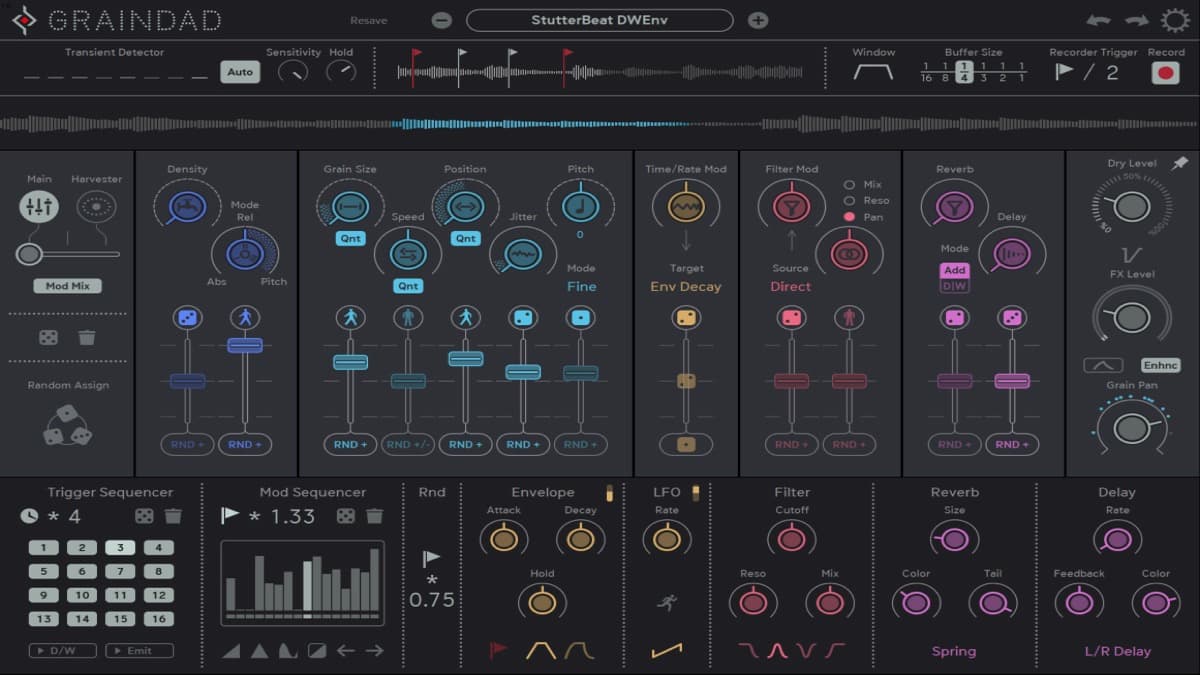
- A live grain engine, up to 64 grains. The core plays back as many as 64 grains at once, drawn from the audio it just recorded. Twelve main controllers shape that cloud, and the engine can loop, stutter, time-stretch, pitch-shift, reverse and harmonize the material. This is where a plain loop becomes a texture.
- Three ways to capture audio. Recording can sync to the host clock, fire from an incoming MIDI note, or trigger off transients in the signal. Transient capture is the clever one. Feed Graindad a drum loop and it can grab each hit and grain it in time, without you drawing a single automation lane.
- The Harvester modulation system. Alongside classic step sequencers, an LFO and an envelope, Graindad adds Harvester, a visual system that drives several parameters at once. Instead of wiring one LFO to one knob, you shape movement across the whole grain cloud from a single panel. It is the feature that keeps textures alive rather than static.
- A 16-step trigger sequencer. A dedicated sequencer fires grains and effects on a grid, so you can build rhythmic glitch patterns that lock to your track rather than wandering freely.
- A multiband transient detector. The transient clock reads your audio across frequency bands, which is why Graindad can react musically to real material instead of a fixed metronome.
- A full onboard effects rack. After the grains, you get filters (low-pass, band-pass, high-pass and band-reject), three reverbs (a high-quality algorithm, a spring and a shimmer), plus delay, chorus and flanger. A complex dry/wet envelope rides the balance. You can finish an entire ambient texture inside the one plugin.
- Randomization almost everywhere. Nearly every parameter can be randomized, which turns Graindad into an idea generator. Roll the dice, keep the happy accidents, and refine from there.
Put those blocks together and Graindad stops being a simple freeze effect. It works more like a small granular workstation that records, mangles, modulates and finishes the sound in a single window.
Sugar Bytes Graindad specifications
| Spec | Detail |
|---|---|
| Type | Real-time granular effect |
| Grain engine | Up to 64 simultaneous grains, 12 main controllers |
| Grain actions | Loop, stutter, time-stretch, pitch-shift, reverse, harmonize |
| Triggering | Host clock, MIDI note, or transient detection |
| Modulation | Harvester system, step sequencers, LFO, envelope, wide randomization |
| Sequencer | 16-step trigger sequencer |
| Effects | Filters (LP/BP/HP/band-reject), reverbs (HQ, spring, shimmer), delay, chorus, flanger |
| macOS formats | AU, VST2, VST3, AAX, standalone (64-bit, Intel and Apple Silicon) |
| Windows formats | VST2, VST3, AAX, standalone (64-bit) |
| iPadOS | AUv3 (released September 4, 2026) |
| System | macOS 10.13 or later, Windows 7 or later |
| Presets | Hundreds, from the Sugar Bytes sound-design team |
| Price | €99 |
Graindad vs Output Portal
The obvious point of comparison is Output Portal, the other well-known granular effect that producers reach for. They share a goal, real-time granular texture, but they get there differently.
| Sugar Bytes Graindad | Output Portal | |
|---|---|---|
| Core idea | Records live audio, then grains it | Grid-based granular effect on input audio |
| Triggering | Transient, host clock or MIDI | Rhythmic grid and gates |
| Grain count | Up to 64 grains | Dense granular cloud |
| Modulation | Harvester, step sequencers, LFO, envelope | LFOs and envelopes on core parameters |
| Onboard effects | Filters, three reverbs, delay, chorus, flanger | Filter, delay, reverb |
| Formats | AU, VST2, VST3, AAX, standalone, AUv3 | VST, AU, AAX |
| Price | €99 | Around $99 |
Portal is fast and rhythmic, and it is arguably quicker to a usable result. Graindad trades some of that immediacy for depth. The Harvester modulation, the transient-aware recording and the larger effects rack give you more to sculpt once you are past the first few presets. If you want a granular effect that reacts to a live performance and then lets you finish the sound in one place, Graindad is the deeper tool. For a comparison of texture-first spaces, our best reverb plugins guide and the Output Portal entry in the plugin database are good next stops.
Who Graindad is for
Graindad suits sound designers, ambient and cinematic producers, and anyone who builds tracks from texture rather than presets. If you like grabbing a field recording, a vocal take or a drum loop and turning it into something unrecognizable, this is a natural fit. Electronic and experimental producers who already enjoy the Sugar Bytes workflow will feel at home immediately.
It is less essential if your needs are simple. If you only ever want an occasional frozen pad, a stock granular reverb or a free freeze plugin may cover it. Graindad rewards people who want to go deep, and its depth is wasted on a single trick.
How much does Sugar Bytes Graindad cost?
Graindad is €99 for the full version, covering the desktop plugin across macOS and Windows in AU, VST2, VST3, AAX and standalone formats, plus the AUv3 iPadOS build. A demo is available from Sugar Bytes so you can test it on your own material before buying. You can check the current price on Plugin Boutique or on the official Sugar Bytes site.
FAQ
Is Sugar Bytes Graindad worth it?
If you do serious sound design, yes. The real-time recording, transient triggering and Harvester modulation put it ahead of simple freeze plugins, and the onboard effects mean you can build a finished texture in one window. If you only need occasional granular color, a stock tool or free plugin may be enough.
What is the difference between Graindad and Output Portal?
Portal is grid-based and rhythmic, and it gets you to a result quickly. Graindad records live audio, triggers grains from transients, clock or MIDI, and offers deeper modulation through Harvester along with a larger effects rack. Graindad is the more flexible sound-design tool; Portal is the faster groove-based one.
What are the system requirements for Graindad?
Graindad needs macOS 10.13 or later, or Windows 7 or later, both 64-bit. On macOS it runs natively on Intel and Apple Silicon, in AU, VST2, VST3, AAX and standalone formats. There is also an AUv3 version for iPadOS.
Does Graindad work on live audio or only samples?
It works on live audio. Graindad records its input in real time and then grains what it captured, so you can process a performance as it happens rather than loading a file first.
Verdict
Graindad is one of the more complete granular effects on the market, and it earns its place by being an instrument rather than a gimmick. The live recording and transient triggering make it feel responsive, the Harvester modulation keeps textures moving, and the onboard effects mean a single insert can carry a whole ambient part. The trade-off is depth: it is easy to make noise, and there is a learning curve. Push past that and Graindad becomes a reliable, expressive part of a sound-design chain. For related creative processing, see our Grainheads 3.0 coverage and the Arturia Rev OCEAN reverb review.