Some links on this page are affiliate links. If you buy through them, Dubspot may earn a commission at no extra cost to you. It never affects our scores or what we recommend — read our policy.
NIBBI Turns the Open-Source CHOMPI Into a Free Plugin
Temecula DSP NIBBI is a free seven-voice sampler plugin that ports the open-sourced CHOMPI TAPE engine to your DAW, with factory samples, a tape looper and single-knob effects.
M
Marcus Feld
October 2, 2026 · 7 min read
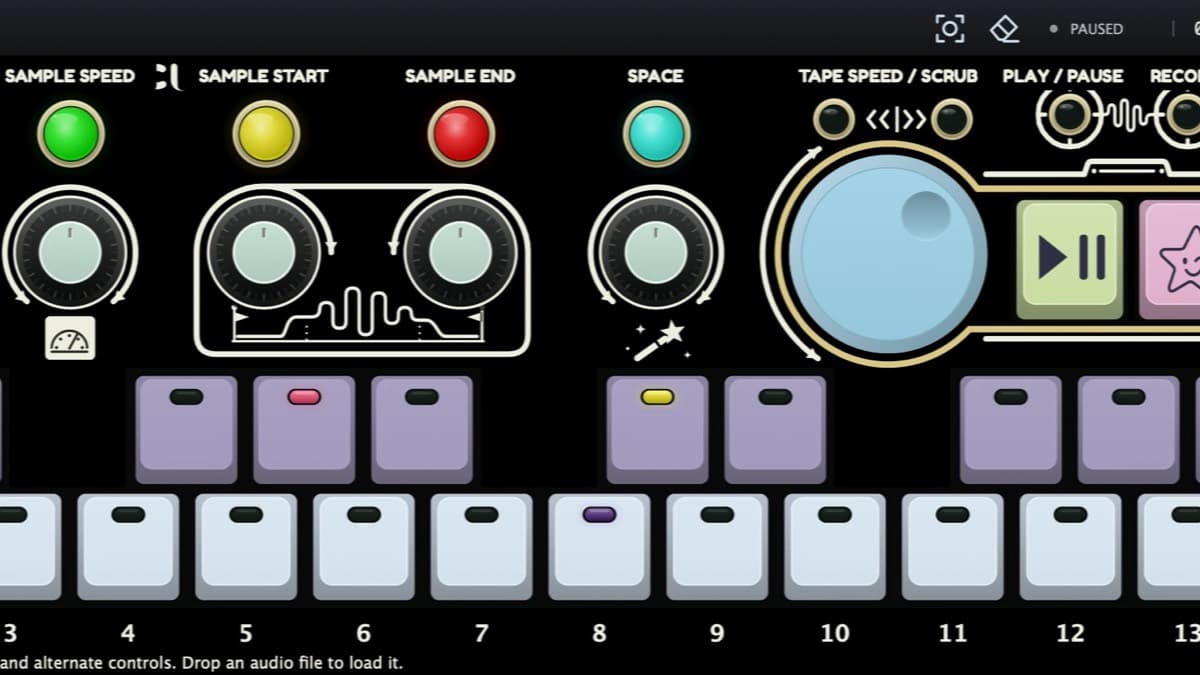
Temecula DSP has released NIBBI, a free sampler plugin that rebuilds the CHOMPI hardware's TAPE engine inside your DAW. It landed on 1 October 2026 for macOS and Windows, only hours after the CHOMPI firmware was open-sourced. This is a first look based on the official product page and source repository, not a hands-on review.
At a glance: NIBBI is a seven-voice sampler you record straight into, play across the keyboard, and smear into a tape-style loop. It ships with the original CHOMPI factory samples in its MELO and HITKIT banks, adds single-knob Space, Saturation and Filter effects, and costs nothing. It runs as VST3, AU and AAX on Mac, and VST3 and AAX on Windows, so it drops into almost any session.
What is NIBBI?
CHOMPI started life as a small, playful hardware sampler with a distinctly lo-fi, tape-flavored voice. When its makers discontinued the unit and released the firmware as open source, the design became fair game for anyone who wanted to carry that sound forward. Temecula DSP, the developer behind faithful recreations of the Alesis MidiVerb II and the Ensoniq DP/4, moved first.
NIBBI is described on the repository as an independent desktop port of the CHOMPI TAPE engine, not an official release from the hardware's makers. In plain terms, it takes the part of CHOMPI that people loved most (the way it records, pitches and degrades a sample) and wraps it in a plugin you can automate and recall inside a project. The hardware's quirks are the point here. This is not a clean, surgical sampler. It is a character box built to make sounds feel worn, bent and a little unstable.
What NIBBI gives you
Sample straight in, then play it. NIBBI's workflow is deliberately simple. You capture a sound into the live buffer, which holds roughly 165 seconds, map it across the keys, and start playing. There is no deep multisample editor to wrestle with. The idea is speed: grab a noise, a vocal phrase or a chord, and have it playable in seconds.
Seven voices with hands-on playback control. Each of the seven voices can be shaped with varispeed, fixed start and end points, forward or reverse playback and an AD envelope. That small set of controls is enough to turn one recording into pads, stabs, basses or glitchy textures without ever leaving the instrument.
The factory banks are included. NIBBI ships with the original hardware's sounds. Banks A to C carry 42 MELO recordings and 42 HITKIT recordings, the melodic and percussive content that defined CHOMPI's personality, while Banks D and E start empty for your own captures. You get the recognizable sound set out of the box, plus room to build your own.
Single-knob effects. Three effects sit on the signal path, each simplified to one main control. Space blends delay and reverb, Saturation adds drive and tape warble, and Filter sweeps a low-pass or high-pass with resonance. None of them ask for much thought, which keeps the focus on performance rather than menu-diving.
Tape looping. The looper is the engine's signature. You can build a tape-style loop from what you play, layering and reprocessing until the sound frays in the way only tape-modeled playback does. This is where NIBBI earns its lo-fi reputation and where it pulls furthest away from a straight, clean sampler.
It stays light. The sample bank works to a 256 MB decoded-audio budget, so NIBBI is built to be a quick, low-overhead tool rather than a giant library host. MIDI Learn lets you map its controls to a hardware surface for live tweaking.
NIBBI specifications
| Spec | Detail |
|---|---|
| Type | Lo-fi character sampler (CHOMPI TAPE engine port) |
| Developer | Temecula DSP |
| Polyphony | Seven voices |
| Factory content | MELO and HITKIT banks (Banks A to C: 42 + 42 recordings), Banks D to E empty |
| Live buffer | Approximately 165 seconds |
| Sample budget | 256 MB decoded audio |
| Effects | Space (delay + reverb), Saturation (drive + tape warble), Filter (low-pass/high-pass + resonance) |
| Playback | Varispeed, fixed start/end, forward/reverse, AD envelope, tape looper |
| Control | MIDI Learn |
| Formats | macOS: AU, VST3, AAX; Windows: VST3, AAX |
| Price | Free |
NIBBI vs Kontakt 8
The obvious reference point for any sampler is Kontakt 8, the industry workhorse. They are built for opposite jobs. Kontakt is a vast, precise sampling platform designed to host enormous multisampled libraries and bespoke instruments. NIBBI is a tiny, opinionated character sampler built around one lo-fi engine and a fast capture-and-play loop.
| Temecula DSP NIBBI | Kontakt 8 | |
|---|---|---|
| Role | Lo-fi character sampler | Full sampling platform |
| Polyphony | Seven voices | Effectively unlimited |
| Library | CHOMPI factory banks, small budget | Massive third-party ecosystem |
| Editing | Fast, minimal, performance-first | Deep scripting and mapping |
| Character | Tape warble, varispeed, grit | Clean and fully controllable |
| Formats | VST3, AU, AAX | VST3, AU, AAX, standalone |
| Price | Free | Paid (full or Player tiers) |
Which to pick. If you need to host sprawling sample libraries, build detailed instruments or edit mappings with precision, Kontakt is the tool. If you want to throw a sound in, warp it and chase a worn, lo-fi feel in seconds, NIBBI does that for nothing and gets out of your way. Many producers will keep both, reaching for NIBBI exactly when they want imperfection.
Who NIBBI is for
Grab it if you make lo-fi, ambient, beats or anything where texture matters more than polish. The tape looper and varispeed are tailor-made for drifting pads, chopped vocals and crunchy one-shots.
It suits you if you already loved the CHOMPI hardware and want that voice back in a recallable plugin, or if you like sampling from field recordings and odd sources and want a quick place to mangle them.
Skip it if you need a precise, large-format sampler for orchestral or heavily multisampled instruments. That is Kontakt territory, or a drum-focused tool like XO, not NIBBI's.
How much does NIBBI cost?
NIBBI is free. You download it directly from the official product page, and the source lives in Temecula DSP's public repository under the licenses of the open-sourced CHOMPI firmware it builds on. There is no paid tier and no account wall.
If you are stocking a free toolkit, NIBBI fits neatly alongside the picks in our roundup of the best free VST plugins of 2026, and it continues a wider trend of discontinued hardware living on as open-source software, the same spirit that keeps boutique makers like Chase Bliss in the conversation long after a product ships.
FAQ
Is NIBBI really free?
Yes. NIBBI is a free download for macOS and Windows, with the original CHOMPI factory samples included. It is built on the open-sourced CHOMPI firmware and is an independent port, not an official release from the hardware's makers.
What formats and systems does NIBBI support?
On macOS it runs as AU, VST3 and AAX. On Windows it runs as VST3 and AAX. It is a seven-voice sampler with a roughly 165-second live buffer and a 256 MB decoded-audio sample budget.
How is NIBBI different from a normal sampler?
NIBBI is a lo-fi character sampler focused on fast capture, varispeed playback and a tape-style looper. It is not built to host large multisample libraries like Kontakt 8. The appeal is its worn, tape-flavored sound and its speed, not surgical precision.