Some links on this page are affiliate links. If you buy through them, Dubspot may earn a commission at no extra cost to you. It never affects our scores or what we recommend — read our policy.
Atavism Makes a Pad From the Track Itself
Atavism by Parallel Minds turns a track into an in-key spectral pad. Launch price is $29, then $39. VST3 and AU on Mac and Windows, about 300 ms latency.
P
Priya Raman
September 30, 2026 · 10 min read
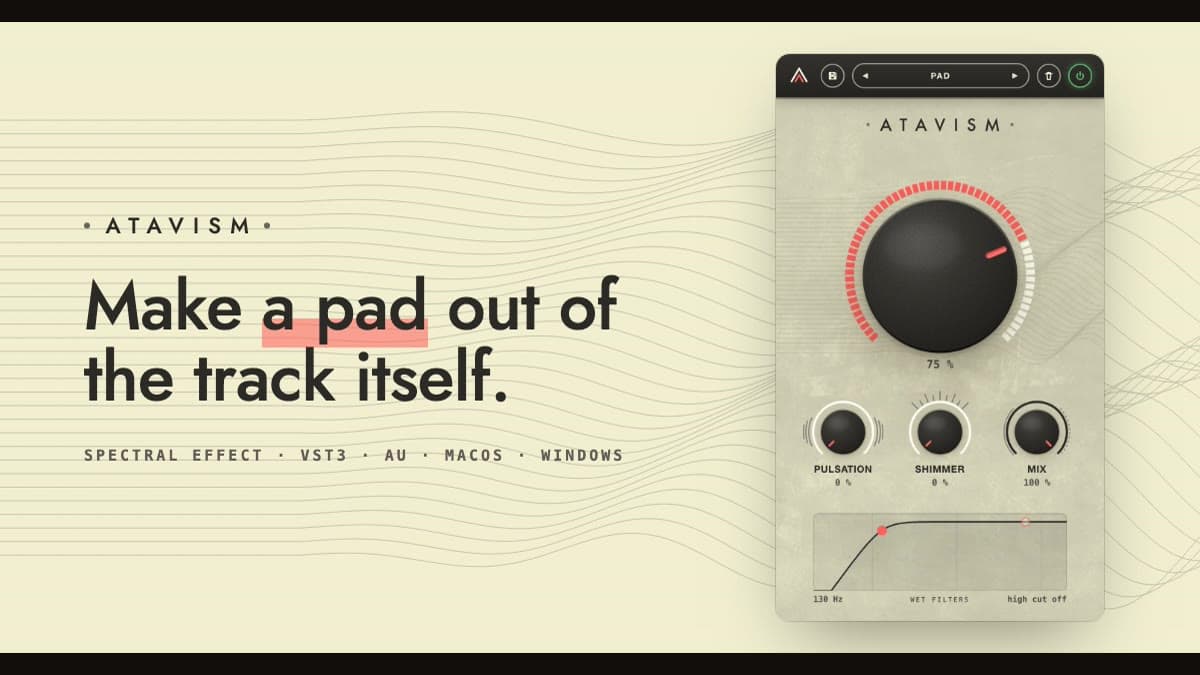
Parallel Minds has released Atavism, a spectral effect that makes a pad out of whatever you put it on. The drums stop hitting. The chord keeps ringing, and it stays in the key of the track. Version 1.0.2 is the current build. The launch price is $29. The regular price after launch is $39. One licence covers both platforms. This is a first look at the shipping plugin and the specs on the Parallel Minds page. We have not run Atavism on a session yet.
At a glance: $29 launch, $39 after. One knob from the dry track to a pad made of its harmony. VST3 and AU on macOS 11 or later, universal. VST3 on Windows 10 and 11. About 300 ms of latency, or about 170 ms in Short mode. No AAX. Eight factory presets. A demo that silences two seconds at the end of every minute.
What Atavism does
Put Atavism on a track, a bus, or the master. Turn the main knob. Attacks fall away. What was a groove becomes the harmony those hits were sitting on. At a quarter of the way up, the attacks are gone and the rhythm is a memory. At the top, only the lines that persist remain. Parallel Minds describes the middle, around 75%, as the harmony of the last few seconds, hovering.
The pad is not a new synth part played on top. It is built from the partials already in the audio, so a chord change in the track becomes a chord change in the pad. That is the practical promise for film and game cues: an instant bed that cannot drift out of key, because it is the track.
Parallel Minds walks the same idea through a few jobs. Under a track, the Wings preset at about 40% sits a pad beneath the mix and follows the chords. On a master, the space between hits fills with the song's own harmony. In place of a track, you automate the knob up over the last bar and the drums dissolve into the chord. Bounce the first phrase and the intro already knows the song. Out of anything that hums, a guitar chord, a vocal, or a field recording at full knob, with Shimmer up, becomes a held cloud an octave wide, made of its own partials. On a send, that cloud can sit behind a live player.
The named starting points on the page include Echoes of the Past, Dust on the Tape, Desert of the Damned, Low Ceiling, and Ticking Wire, plus Wings for the under-the-mix placement. Eight factory presets ship in total. Your own presets save into both VST3 and AU.
One knob, then the shaping
The main knob is the effect. Everything else decides what kind of pad you are left with.
Pulsation is a slow, irregular swell. It is there so a long bed does not sit perfectly still. The same settings bounce identically from one run to the next, Pulsation included, so a print does not change because you rendered it twice.
Shimmer grows the octave above inside the pad. It stays in key, because the octave comes from the pad's own harmony, not from a pitch-shift you then have to tune.
Mix runs from dry to wet, in time with the track. Fully wet is a pad on its own track. Somewhere around 35% to 60% tucks the pad under the source it came from.
Two filters act on the pad only. A low cut keeps it out of the bass. A high cut takes the air off it. The dry track is never filtered. Drag the handles on the graph. The example on the page shows a wet high cut around 130 Hz as one of the illustrated positions. Nine parameters automate, and every knob learns MIDI with a right-click.
How the pad is made
Parallel Minds describes four stages.
First, separate. What rings continues. What hits is let go. An attack does not come through as an attack.
Second, keep the lines. Notes that stand out stay. Noise under them goes. The same move applies to a quiet stem and a loud master.
Third, spread. Each moment smears across the seconds that follow. Parallel Minds calls this a reverb's convolution with no decay. The song keeps its length and its place on the timeline.
Fourth, spread again. From about 75% a second stage spreads the result once more. At the top of the knob, only the persistent lines are left.
The spread only goes forward. A note starts when it is played. Its harmony blooms after it. Stop the music and the pad keeps rising for almost three seconds, then it goes out on its own. There is no frozen slice waiting for you to un-hold it, and there is no room tail decaying on a reverb time. When the chords change, the pad changes with them.
That is the distinction worth keeping if you already own a granular insert or a huge reverb. Portal granulates the input into a playable texture. Valhalla Shimmer and Valhalla Supermassive build space and pitch-shifted tails. Atavism keeps the harmony and lets the time of the sound go. blepfx spectra is the other recent spectral tool on this site, and it does a different job: it hands one track's spectral outline to another track. Atavism has one input.
Atavism specifications
| Spec | Detail |
|---|---|
| Price | $29 launch, $39 regular. One licence, both platforms |
| Version | 1.0.2 |
| Main control | One knob, dry track to pad |
| Shaping | Pulsation, Shimmer, Mix, low cut, high cut |
| Filters | On the pad only. The dry track is not filtered |
| Latency | About 300 ms. About 170 ms in Short mode. Host-compensated |
| Automation | Nine parameters. MIDI learn on every knob |
| Presets | Eight factory presets, plus user presets shared across VST3 and AU |
| macOS | 11 or later, universal binary. VST3 and AU |
| Windows | 10 and 11, 64-bit. VST3. Windows 10 needs Microsoft WebView2 for the window |
| Not included | VST2, AAX |
| Licence | One key. No account. No internet connection required to activate |
| Demo | Full plugin. Two seconds of silence at the end of every minute until you enter a key |
| Bounce | Same settings produce the same bounce, including Pulsation |
Atavism vs a granular effect and a shimmer reverb
| Atavism | Portal | Valhalla Shimmer | |
|---|---|---|---|
| Price | $29 launch / $39 | $149 | $50 |
| Job | Strip attacks, leave an in-key pad from the track | Granular effect on any input | Pitch-shifted reverb and large tails |
| Input | The track itself. Always in key | Any audio, then grains | Any audio, then a reverb |
| Latency | About 300 ms, or 170 ms in Short | Effect processing, preset-driven | Reverb, light controls |
| Formats | VST3, AU. No AAX | VST, VST3, AU, AAX | VST, AU, AAX |
| Live use | Put it on a send so the dry stays direct | Insert or send, as a texture | Insert or send, as space |
Use Atavism when you want the breakdown, the bed, or the ambient version of a part you already recorded, and you want it in key without programming a synth. Use Portal when you want grains, glitch, and an XY macro, and $149 is the budget for that colour. Use Valhalla Shimmer when the missing piece is a tail and an octave of reverb, at $50. Output Movement, at $149, is the rhythmic multi-effect if the track needs tempo-locked motion rather than a pad. Valhalla Supermassive is the free version of the huge-space job.
Who Atavism is for
Film and game composers, and producers who need a bed or a breakdown in a minute. The knob is the whole gesture. Automate it over a bar and the drums leave. Park it under a cue and the harmony follows. Live players can put it on a send, in Short mode, so the dry signal stays direct while the pad blooms behind them.
Skip it if you track in Pro Tools and need AAX. There is no AAX build, and no VST2 build. Skip it if you need to monitor the wet signal with no latency. About 300 ms, or 170 ms in Short, is the cost of hearing a moment of audio before spreading it. The host compensates recorded tracks. A live input should go to a send. Skip it if you wanted a reverb, a delay, or a sampler. Atavism will not give you a room, a repeat, or a note you trigger from a keyboard.
Windows 10 has one extra step. The sound is fine without it, but the plugin window needs Microsoft WebView2, which Windows 11 already includes. The installer adds it when the machine is online. Offline, Parallel Minds points you to the Evergreen Standalone Installer, x64, from Microsoft.
How much Atavism costs
$29 during launch. $39 after. One purchase, one key, both macOS and Windows. Updates inside the major version are included. Activation is offline: open Settings from the logo, enter the email from the order, paste the key. No account.
The demo is the full plugin. It mutes for two seconds at the end of every minute until the key is in. Every control, preset, and format works for as long as you want to try it.
Buy it from parallel-minds.studio/products/atavism. If a key goes missing, Parallel Minds resends it from the order email, and they say that usually happens well inside two working days.
FAQ
How much does Atavism cost?
$29 at the launch price, then $39. One licence covers macOS and Windows.
Does Atavism run in Pro Tools?
No. Formats are VST3 and AU on macOS 11 or later, and VST3 on Windows 10 and 11. There is no AAX build and no VST2 build.
Why is there latency?
The effect has to hear a moment of the track before it can spread it. Parallel Minds lists about 300 ms, or about 170 ms in Short mode. The DAW compensates, so recorded tracks stay in time. For live playing, use a send and Short mode.
Is the pad a reverb or a freeze?
The harmony follows the track. Stop the music and the pad rises for almost three seconds, then ends. Chords change in the pad when they change in the source. Nothing is held as a frozen sample, and nothing decays as a room tail.
What does the demo limit?
Two seconds of silence at the end of every minute. The controls, presets, and formats are the full plugin.
This is a first look, not a scored review. We have not automated the knob across a cue or printed a breakdown with it. Load the demo, put it on a loop that already has chords, and listen to the pad at 40% and at full. The official page is the store.