blepfx Spectra Moves a Spectrum From One Track to Another
blepfx spectra morphs spectral envelopes between two signals and shifts formants by ±24 semitones. Official price starts at $25, on macOS, Windows, and Linux.
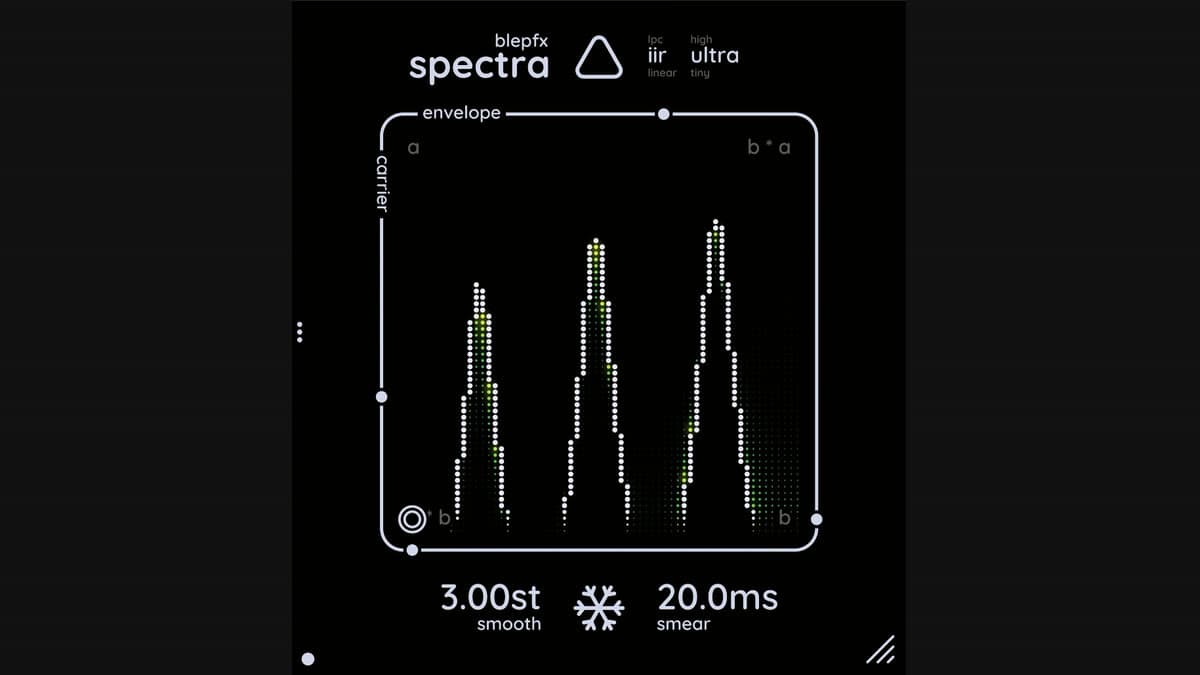
blepfx has released spectra, a spectral morphing plugin that splits two signals into an envelope and a harmonic residual, then lets you recombine them. The product page starts at $25, VAT included, with a free demo. Formats are VST3, AU, and CLAP on macOS, Windows, and Linux. It also shifts formants. That second job is real, and it is not the same job as a dedicated formant insert.
At a glance: $25 to start, VAT included, plus a free demo with limitations. Four envelope algorithms, including a zero-latency IIR vocoder mode. Formant shift from −24 to +24 semitones. Latency from 0 ms in IIR up to about 85 ms at 48 kHz in the FFT modes. This is a first look at the official spectra page and blepfx's own video. We have not used it in a session.
What is spectra?
spectra takes a main input and a sidechain and treats each one as two layers. The envelope is the rough outline of the spectrum. The harmonics are the fine, spectrally flat detail left after that outline is removed. You morph the outlines on one axis and crossfade the whitened detail on the other. The result can be a vocoder, a hybrid texture, or a formant move on a single source.
blepfx describes three uses on the same page, and they are three positions of the same engine.
- Envelope morph. At 0% you keep the main envelope. At 100% you take the sidechain envelope. A mode labelled
b * auses the harmonic content of the main signal with the envelope of the sidechain. That is the classic vocoder relationship, with a continuous crossfade instead of a fixed carrier and modulator. - Spectral vocoder. Four algorithms extract and apply those envelopes. They do not sound like four presets of one filter. Linear, Hilbert, LPC, and IIR are different phase and latency choices.
- Formant shifter. Shift runs from −24 to +24 semitones, four octaves in total. Smooth decides whether that move feels natural or phasey. A Tilt control, in dB, tips the envelope darker or brighter without a separate EQ.
If you came here from our zplane TIMBRE first look, pause on the job title. TIMBRE shifts formants and does not move pitch, on two bands, with a published 23.2 ms latency. spectra can shift formants too. Its main act is handing one track's spectral outline to another track's detail. Read TIMBRE for the mix insert. Read this for the morph.
Four algorithms, and why the latency changes
The Algorithm menu is the sound. Resolution changes meaning depending on which algorithm you picked.
- Linear. Basic FFT envelope transfer, linear phase. Clean, and it can pre-ring. This is the mode you open when you want the transfer to be obvious and you can live with delay.
- Hilbert. blepfx calls it an improved Linear that uses the Hilbert transform to cut pre-ringing. Approximate minimum phase. Same family as Linear, less smear before the transient.
- LPC. Linear predictive coding, the speech-coding method. Less precise, almost no pre-ringing, and a vowel-like character. Minimum phase. This is the mode that sounds like a mouth even when the sidechain is not a voice.
- IIR. A bank of narrow bandpass filters, the classic vocoder technique. Zero latency. blepfx describes it as ringy. If you are printing while a player is in the room, this is the algorithm that does not add a delay line.
Resolution sets FFT size in Linear, Hilbert, and LPC. Larger sizes resolve frequency better and give up time resolution, which is why latency climbs. In IIR mode, Resolution is the band count. More bands, more CPU, still no latency from an FFT. blepfx publishes the span as 0 ms for IIR and around 85 ms at 48 kHz at the heavy end of the FFT settings. That is a tracking decision, not a quality badge. Pick IIR when the vocalist is listening. Pick Linear or Hilbert when the part is already recorded and you want the cleaner transfer.
Morph, freeze, shift, and tilt
The visualizer is an XY pad. X is envelope morph. Y is carrier morph. The white line is the target envelope. The gradient is the filter being applied, from the source outline to the target outline.
- Envelope morph blends main and sidechain outlines. You can ride it with the slider or the pad.
- Carrier morph crossfades the two whitened signals. Whitening strips each envelope first, so you are blending detail, not blending two full sounds and calling it a morph.
- Smooth sets how much fine structure the envelope keeps. Lower values keep more detail. The minimum depends on algorithm and resolution. Shift-click toggles linear (Hz) and logarithmic (semitone) smoothing. Linear and Hilbert accept both. LPC is linear only. IIR is logarithmic only, and lower smoothing means more phase delay.
- Smear smooths the envelope in time. Shift-click splits attack and release. Freeze holds the current envelope so you can shift and morph a captured shape instead of chasing the input.
- Shift moves formants up or down across ±24 semitones. Low smoothing tends toward a phasey, synthetic shift. Higher smoothing tends toward a more natural lowpass or highpass colour. That is the official description of the quality trade, and it is the knob to learn before you decide spectra is "just a vocoder."
- Tilt tips the envelope in dB. Positive values lift lows and cut highs. Negative values do the opposite.
- Extra menu. Input gain for main and sidechain, output gain for the wet signal plus dry main and dry sidechain, a Whiten ceiling so upward expansion does not lift noise, and Normalize. Normalize on copies dynamics from the target. Off, it balances source and target dynamics.
Bypass stops the processing rather than leaving it running at zero. The window resizes, and there is a light theme and a dark theme.
spectra specifications
| Spec | Detail |
|---|---|
| Price | From $25, VAT included, plus a limited free demo |
| Type | Spectral envelope morph, vocoder, and formant shifter |
| Algorithms | Linear (FFT, linear phase), Hilbert (less pre-ringing), LPC (vowel character), IIR (zero latency) |
| Formant shift | −24 to +24 semitones |
| Other tone | Smooth, Smear, Freeze, Tilt, envelope morph, carrier morph |
| Latency | 0 ms in IIR; FFT modes up to about 85 ms at 48 kHz |
| Formats | VST3, AUv2, CLAP. No AAX. No VST2 |
| macOS | 10.13 or later, Intel and Apple Silicon. AU, VST3, CLAP |
| Windows | 8 or later, 64-bit. VST3 and CLAP |
| Linux | glibc 2.30 or later, 64-bit. VST3 and CLAP |
| Graphics | OpenGL 3.3 or later |
| CPU architectures | x86 and ARM |
| Buy | spectra at blepfx |
Those system lines are blepfx's own FAQ for the plugin line, not a guess from a host list. AU installs as an Audio Unit component on macOS. CLAP is available on all three desktops. AAX is absent, so Pro Tools users are out unless they host it somewhere else.
spectra vs zplane TIMBRE vs Little AlterBoy
zplane TIMBRE is a dual-band formant shifter. Soundtoys Little AlterBoy is a monophonic voice processor with pitch, formant, and hard-tune. spectra overlaps both on the word "formant" and then leaves. Use the table for the split, and use the TIMBRE first look if you want the ÉLASTIQUE insert in full. This article is not that review.
| blepfx spectra | zplane TIMBRE | Little AlterBoy | |
|---|---|---|---|
| Price | From $25, VAT included | €53 intro / €79 regular through 30 September 2026 | $99 on the AlterBoy card |
| Main job | Move envelopes and whitened detail between two signals | Shift formants without moving pitch | Pitch, formant, and hard-tune on one voice |
| Formant range | ±24 semitones, one shift | ±36 semitones, High and Low bands | One formant control, mono only |
| Two inputs | Main plus sidechain, with an XY morph | Noise carrier or external sidechain for vocoding | MIDI, not a spectral sidechain morph |
| Latency | 0 ms (IIR) to ~85 ms at 48 kHz | 23.2 ms at 44.1 kHz | Built as a tracking voice effect |
| Formats | VST3, AU, CLAP | AAX, AU, VST3 | AAX, AU, VST 2, VST 3 |
| Systems | macOS, Windows, Linux | Windows 10/11, macOS 13+ | macOS 10.15+, Windows 10+ |
| Reach for it when | One track should wear another's spectrum | A mix source needs a new resonant centre | A vocal needs hard-tune or a simple formant bend |
Which to pick. Choose spectra when you have two sounds and you want the outline of one on the detail of the other, or you want LPC's vowel colour, or you need Linux and CLAP. Choose TIMBRE when the source is already the right pitch and you want two bands of formant, AAX, and a latency figure you can plan a vocal chain around. Choose Little AlterBoy when the part is a single voice and the goal is pitch, gender, or hard-tune in a few knobs. Buying spectra does not retire a TIMBRE licence. They fail different sessions.
Who spectra is for
Consider it if you design textures from two recordings: a drum loop wearing a vocal's outline, a pad wearing a guitar's residual, a voice frozen and then shifted.
Consider it if you want a formant move with more envelope control than a single knob, and $25 including VAT is the price that gets you in. The page says starting from that figure, so you can pay more.
Consider it if you work on Linux. TIMBRE and Little AlterBoy do not. spectra does, in VST3 and CLAP.
Skip it if you need AAX, or you need a hard-tune. This is not a pitch corrector.
Skip it if you are tracking and you only have the FFT algorithms in front of you. Eighty-five milliseconds is a late vocal. Switch to IIR or use a different plugin for the take.
Skip it if the brief is "dual-band formant on a full mix, leave the pitch, stay near 23 ms." That brief is TIMBRE.
How much does spectra cost?
The spectra page lists a free demo with some limitations, and a paid download starting from $25, VAT included. The catalogue index prints the same floor as $25+. There is no Plugin Boutique, Thomann, or Best Service listing. Buy it from the developer: spectra at blepfx.
Install is either a one-line command in Terminal or PowerShell, or a manual copy. VST3 goes in the system VST3 folder. CLAP goes in the system CLAP folder. AU goes in Library/Audio/Plug-ins/Components/ on macOS. Linux paths are ~/.vst3/ and ~/.clap/.
blepfx's FAQ handles refunds by contacting the developer directly. Try the free demo on the spectra page first. It is limited. The feature list above is the paid plugin as the page documents it.
FAQ
What does spectra actually morph?
It splits main and sidechain into a spectral envelope and a whitened harmonic layer, then morphs those layers separately. Envelope morph moves the outline. Carrier morph crossfades the detail after each outline has been removed. b * a is main detail with the sidechain outline.
spectra vs zplane TIMBRE?
TIMBRE is a formant shifter with two bands, ±36 semitones, and 23.2 ms latency, on intro at €53 through 30 September 2026. spectra's formant range is ±24 semitones, and its real difference is the two-signal morph plus four algorithms, one of them zero latency. Use TIMBRE as a mix insert. Use spectra when a sidechain should donate its spectrum. The longer TIMBRE breakdown is the first look.
Which spectra algorithm has no latency?
IIR. It is a bandpass vocoder bank, not an FFT. blepfx calls the sound ringy. Linear, Hilbert, and LPC add latency that depends on resolution, up to about 85 ms at 48 kHz, and the FFT modes can pre-ring. Hilbert and LPC reduce that pre-ring relative to plain Linear.
Does spectra run on Linux?
Yes. blepfx supports Linux with glibc 2.30 or later, 64-bit, in VST3 and CLAP, on x86 and ARM, with OpenGL 3.3. AU is macOS only. Windows is 8 or later, 64-bit. There is no AAX version.
Can spectra shift formants without a sidechain?
Yes. Shift moves the envelope by up to two octaves either way, and Smooth plus Smear set how natural or how phasey that move is. Tilt then darkens or brightens the same envelope. A sidechain is what turns it from a shifter into a morph.