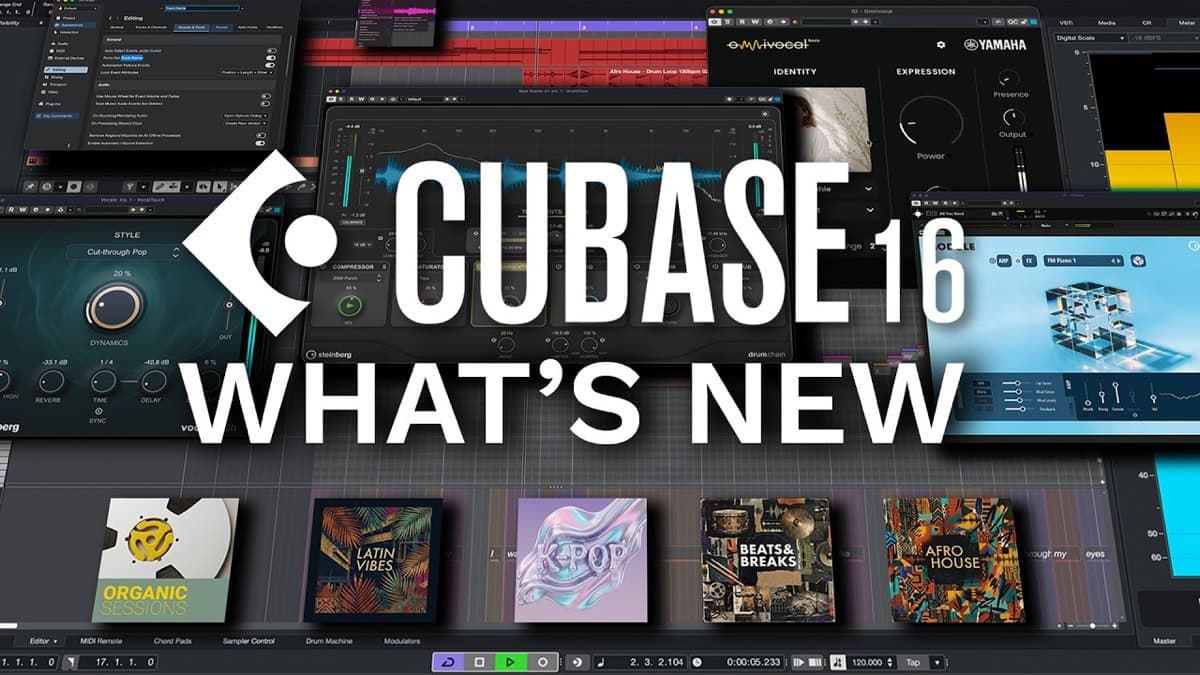
Cubase 16 is Steinberg's desktop DAW for composing, recording, mixing and scoring. It is built around a linear timeline and a deep MIDI toolset rather than a clip grid. That suits songwriters, film and TV composers, and producers who think in tracks, takes and scored parts. Steinberg released it on November 4, 2026, in Pro, Artist and Elements editions. All three are perpetual licenses, and Steinberg offers a free 30-day trial.
Version 16 builds on what Cubase already did well. Instrument Stacks combine several VST instruments, sampler tracks and drum tracks into one stack that you play from a single track. In the Key Editor, Strum adds natural timing to programmed chords, Stretch fits a phrase to a new length, and lyrics sit next to the notes. Stem separation now has dedicated piano and guitar stems. The new Spectral AudioWarp modes reshape vocals, drums and full mixes. Ableton Link, MIDI 2.0 support for Note Expression and Expression Maps, and 16 sends per track complete the list. Our Cubase 16 release guide covers every feature and every update price.
The edition you pick matters. Elements limits tracks and has no VariAudio pitch correction. Artist removes the track limits and adds VariAudio, Instrument Stacks, DrumChain and the Module FM library, which makes it the value pick at $299.99. Pro adds stem separation, Spectral AudioWarp, Control Room, Modulators and 98 effects for $599.99. Cubase Pro 15 owners pay €99 to update. Any Cubase license activated on or after October 7, 2026, gets version 16 for free.
The trade-offs are cost and approach. A paid update arrives every year, and many long-time users see version 16 as an incremental step. The interface rewards study, even with the new Quick Help and Guided Tours for new users. Performers who build live sets from clips will still prefer Ableton Live, and pattern-first beatmakers may feel more at home in FL Studio.
Among the alternatives, Ableton Live 12 wins for electronic performance and clip workflow. Logic Pro is the best value for Mac users who record and score. Studio One 7 is a strong all-rounder with a fast mixing and mastering flow. REAPER undercuts everyone on price and rewards users who build their own tools. Choose Cubase 16 when composition depth, MIDI detail and a pro DAW without a subscription matter more than the lowest price.