Some links on this page are affiliate links. If you buy through them, Dubspot may earn a commission at no extra cost to you. It never affects our scores or what we recommend — read our policy.
Roland JUPITER-08 vs n/vision: Which $649 Boutique Synth?
Roland's two new Boutique synths cost $649 each with a K-25m keyboard. JUPITER-08 is the 32-voice Jupiter-8 tribute, n/vision a 56-voice wavetable synth. Which to buy.
T
Theo Nakamura
October 21, 2026 · 9 min read
Black Friday 2026Roland Black Friday 2026: dates and deals →
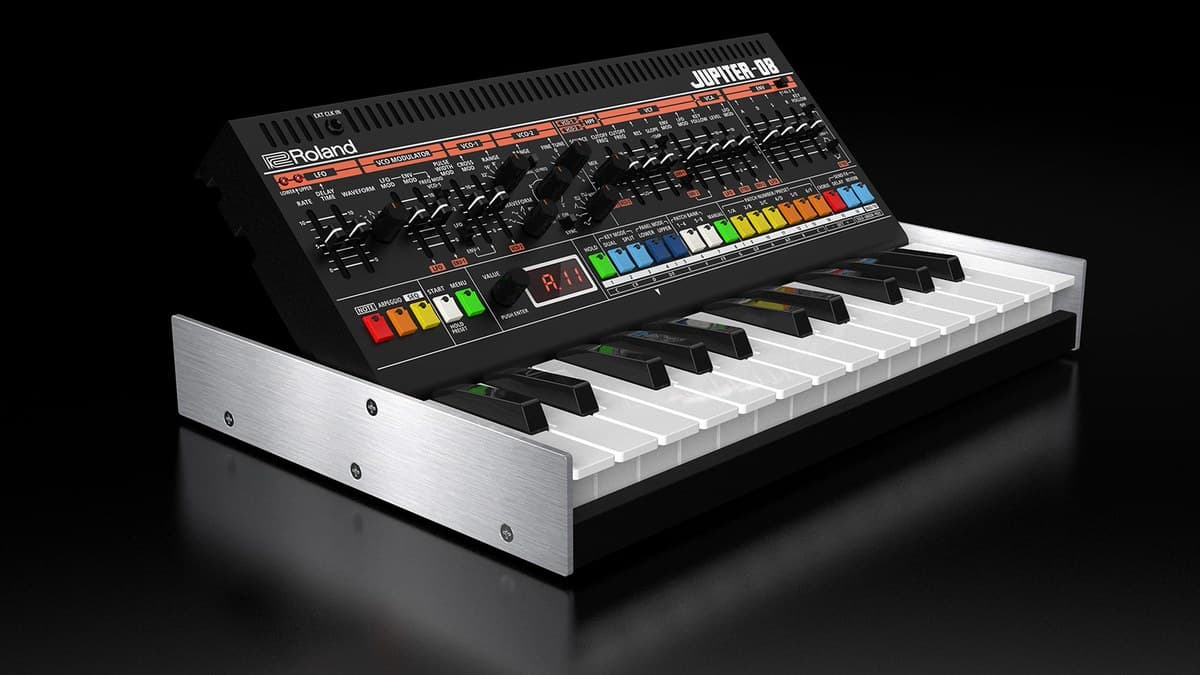
Roland announced two new Boutique synths on October 20, 2026, and they arrive as a matched pair. The JUPITER-08 marks 45 years of the JUPITER-8 with a pocket version of the 1981 polysynth. The n/vision is something Roland has never put in a Boutique case before: a two-layer wavetable synth with a wave shaper. Both share the same chassis, the same sequencer, the same effects and the same price, so the real question is which sound you want under your fingers.
At a glance: both synths are $649 at Thomann, and both ship with the K-25m keyboard dock in the box. JUPITER-08 gives you up to 32 voices of Jupiter-style analog modeling. n/vision gives you up to 56 voices of wavetable synthesis with two layers per part. Each has 240 patch memories, a two-part 64-step polyphonic sequencer, an arpeggiator, 17 MFX types plus delay and a five-type reverb with a shimmer mode, a built-in speaker, USB-C audio and MIDI, and four-AA battery power.
What are the JUPITER-08 and n/vision?
Roland Boutique started in 2015 as a line of small, affordable recreations of classic Roland synths. The current lineup now counts eight models. These two keep the series hallmarks: a compact panel, a built-in speaker, battery or USB-C power, and a USB audio interface so the synth records straight into your DAW over one cable.
What is new for this pair is the bundle. Earlier Boutique modules such as the JX-08 and JU-06A sell as bare modules, and the K-25m keyboard is a $99 extra. Both new models include it. Docked, each one is a self-contained mini keyboard synth that weighs about 1.6 kg (JUPITER-08) or 1.7 kg (n/vision) with batteries.
JUPITER-08: the Jupiter-8 at 45
The JUPITER-08 recreates the panel and voice of the JUPITER-8, the 1981 eight-voice flagship that defined a lot of synth-pop, film and game music. Each voice has two oscillators with cross-modulation, sync and pulse-width modulation, feeding a static high-pass filter and a resonant low-pass filter you can switch between 24 dB and 12 dB slopes. There is an LFO with six waveforms and two ADSR envelopes.
The interesting part is the voice mode. Out of the box, the synth runs what Roland calls the "eight-part/two-voice architecture" of the original. That is the authentic setting, with the original's voice behavior. An advanced polyphony mode lifts the ceiling to 32 voices, which is the setting you want for big pads, layered dual patches and long release tails. Roland also says it refined the voice allocation and pitch behavior, adding the slight pitch drift that makes the original sound alive.
For a producer, this is the quickest route to classic Jupiter brass, strings and arpeggios on hardware that fits in a backpack. If you already work in software, the Arturia Jup-8 V covers the same territory in your DAW, but it does not give you sliders on a desk.
n/vision: Roland's first Boutique wavetable synth
The n/vision is a new design rather than a recreation. Each of its two parts (upper and lower) holds two wavetable layers that you blend with a Layer Mix slider. The Position control scans through each wavetable, and it has its own LFO, envelope and random amount, so a static pad can drift and shift by itself. A Spread control widens the stereo image.
The wave shaper is the Roland twist. It runs the oscillator through nonlinear processing to create new harmonics, with its own LFO and envelope amounts. Think of it as a way to add bite and movement before the filter, rather than a filter effect after it.
The filter section offers a drive-enhanced analog-modeling filter with several types inspired by classic synths, a high-pass knob, resonance, envelope and LFO amounts, and keyboard tracking. Deeper menus add a step LFO, oscillator modulation and motion recording, and there is portamento for leads. The MFX engine includes the JUNO chorus, with two dedicated chorus buttons on the panel. Polyphony reaches 56 voices, though Roland notes that the count varies with the sound generator load.
What they share
The common platform is generous for a Boutique. Both have a two-part, 64-step polyphonic sequencer with up to eight notes per step and motion recording, plus an arpeggiator and a Hold button for hands-free playing. Dual and Split modes let you stack or divide the two parts across the keyboard.
Effects are identical on paper: 17 MFX types (three chorus types, four delays, overdrive, fuzz, drive, bit crusher, lo-fi comp, two phasers, a filter and two pitch shifters), plus a dedicated delay and a reverb with five types and a shimmer mode that adds an octave-shifted color to the tail. Connections cover stereo output, headphones and a stereo mix input on 3.5 mm jacks, an external clock input for analog gear, MIDI in and out, and USB-C for audio and MIDI. Four AA batteries give about six hours with 1,900 mAh Ni-MH cells.
Specifications
| Spec | JUPITER-08 | n/vision |
|---|---|---|
| Synthesis | Analog modeling of the JUPITER-8 | Two-layer wavetable with wave shaper |
| Max polyphony | 32 voices (advanced mode) | 56 voices (varies with load) |
| Oscillators | 2 per voice, cross-mod, sync, PWM | 2 wavetable layers per part, position, spread |
| Filter | Static HPF, resonant LPF (24/12 dB) | Drive-enhanced analog-modeling filter, multiple types, HPF |
| Modulation | LFO (6 waves), 2 ADSR envelopes | LFO, step LFO, position LFO/env/random, wave shaper LFO/env |
| Chorus | Classic Roland stereo chorus in MFX | JUNO chorus, two panel buttons |
| Memory | 240 patches, 96 patterns | 240 patches, 96 patterns |
| Sequencer | 2 parts, 64 steps, 8 notes per step, motion rec | Same |
| Effects | 17 MFX, delay, reverb (5 types, shimmer) | Same |
| I/O | Out, phones, mix in (3.5 mm), clock in, MIDI in/out, USB-C audio/MIDI | Same |
| Power | 4 x AA or USB bus power | Same |
| Size with K-25m | 308 x 209 x 54 mm, 1.6 kg | 308 x 209 x 54 mm, 1.7 kg |
| In the box | K-25m keyboard dock, 4 x AA | Same |
| Price | $649 at Thomann | $649 at Thomann |
JUPITER-08 vs n/vision vs the older Boutiques
| JUPITER-08 | n/vision | Roland JX-08 | Roland JU-06A | |
|---|---|---|---|---|
| Price at Thomann | $649 | $649 | $344 | $369 |
| K-25m keyboard | Included | Included | Extra ($99) | Extra ($99) |
| Price with keyboard | $649 | $649 | $443 | $468 |
| Character | Jupiter-8 analog modeling | Modern wavetable | JX-8P analog modeling | Juno-60 and Juno-106 modeling |
| Max polyphony | 32 | 56 | 20 | 4 |
| Sequencer | 2-part, 64-step polyphonic | 2-part, 64-step polyphonic | 64-step polyphonic | Step sequencer |
The like-for-like rivals here are Roland's own. The JX-08 is the strongest value in the range: 20 voices, a 64-step polyphonic sequencer, and $443 even after you add a K-25m. If you want a vintage Roland poly and do not need the Jupiter name, it is $206 cheaper. The JU-06A is the Juno pick, but four voices is thin for pads in 2026.
Which one should you buy?
Buy the JUPITER-08 if you want the Jupiter-8 sound specifically: brassy stacks, wide strings, arpeggios that sound like 1983. The 32-voice mode removes the main limit of earlier Boutique recreations, and the original-architecture mode is there when you want authenticity.
Buy the n/vision if you want sounds that move. Two layers, position modulation and the wave shaper are built for evolving pads, textures and aggressive leads that a classic subtractive synth cannot make. It also has the highest voice count in the Boutique range.
Skip both if you need full-size keys, aftertouch or a mod wheel. The K-25m has 25 velocity-sensitive mini keys and no aftertouch. Skip them, too, if you already own a JX-08: the JUPITER-08 is a different color, not a big step up in features. For more hardware picks at other budgets, see our best hardware synthesizers guide. If you would rather add a full-size controller to a software rig, start with our best MIDI keyboards list.
Pricing and availability
Both synths are $649 at Thomann, each with the K-25m keyboard dock and four AA batteries included:
Thomann lists both as available at short notice. The optional DK-01 Boutique Dock is sold separately. Full specifications and downloads are on Roland's official JUPITER-08 and n/vision pages.
FAQ
How many voices does the JUPITER-08 have?
Up to 32 in the advanced polyphony mode. By default it runs an architecture modeled on the original JUPITER-8, and you switch to the expanded mode in the settings.
Is the n/vision analog?
No. Its oscillators are digital wavetables. The filter is an analog-modeling design with a drive stage and several types inspired by classic synths.
Do the JUPITER-08 and n/vision come with a keyboard?
Yes. Unlike earlier Boutique modules, both include the K-25m keyboard dock with 25 velocity-sensitive mini keys.
Can I record them over USB?
Yes. Both have a USB-C audio and MIDI interface, so one cable carries audio and MIDI to a computer. Roland provides drivers for Windows 11 and macOS 14 or later.
JUPITER-08 vs JX-08?
Both are Roland analog-modeling polysynths with 64-step polyphonic sequencers. The JUPITER-08 has 32 voices and includes a keyboard for $649. The JX-08 has 20 voices and costs $344 as a module, or $443 with a K-25m.
Verdict
Roland has made the choice simple by pricing these two identically and giving them the same body. The JUPITER-08 is the nostalgia buy, now with the polyphony earlier Boutiques lacked. The n/vision is the more forward-looking synth and the better one for sound design. Neither replaces a full-size poly, and the JX-08 remains the value play. This is a first look based on Roland's official materials, not a hands-on test.