AudioKit Super J8 Review: Jupiter-8 Tone on iOS and Mac
AudioKit Pro Super J8 is a Jupiter-8-inspired virtual analog synth that now runs natively on Mac as well as iPhone and iPad. Full review: engine, specs, pricing and how it compares to Arturia Jup-8 V.
Dubspot's best Black Friday dealsDubspot Tracker Pro: $15, was $24.99 ↗Drum Programming and Groove Production Course: $19, was $99 ↗
See full specs, price, and alternatives in the plugin database →
AudioKit Pro's Super J8 began life as a mobile synth, a Roland Jupiter-8 tribute for iPhone and iPad. With its recent updates it crossed a line that matters: the same purchase now runs natively on Mac, as a standalone app and an AUv3 plugin, with support for both Apple Silicon and Intel. For $29.99 you get one of the warmest polysynths on iOS and a Mac instrument that drops straight into Logic and GarageBand. This review looks at what it sounds like, what it can do, and where its limits sit.
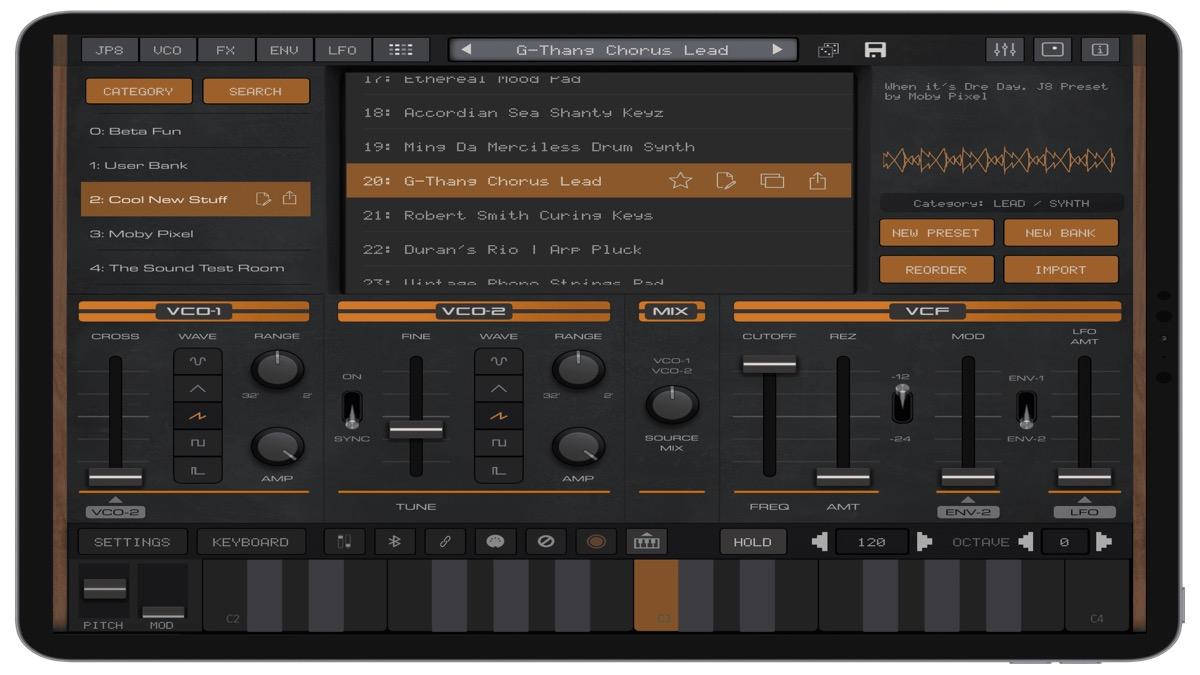
At a glance: a Jupiter-8-inspired virtual analog synth for iOS 15+, iPadOS 15+, macOS 12+ (Apple Silicon and Intel) and visionOS, delivered as a standalone app and AUv3 plugin. It offers 64 voices, 8-voice poly unison, oscillator sync, cross-modulation, three LFOs, a step sequencer and 700+ presets. One $29.99 universal purchase covers iPhone, iPad and Mac. There is no VST3, AAX or Windows version.
What is Super J8?
Super J8 is AudioKit Pro's take on the Roland Jupiter-8, the 1981 flagship that defined a generation of lush analog pads and brass stabs. Rather than sampling the hardware, AudioKit modeled the oscillators using extensive recordings of a real Jupiter-8, then built a synth engine around that tone. It is not an official Roland product and is not endorsed by Roland, but the goal is clearly that warm, slightly unstable Jupiter character that producers keep reaching for.
What sets it apart from the field is reach. Most Jupiter-8 recreations are desktop plugins or hardware. Super J8 is a touch-first instrument that plays beautifully on an iPad, yet the same license now installs on a Mac as a native app and AUv3. That makes it one of the few serious Jupiter-8 tributes you can carry from a phone on the train to a full Logic session without buying it twice.
What Super J8 does, feature by feature
Oscillators modeled on real hardware
The core of the sound is a pair of analog-modeled oscillators whose behavior was trained on recordings of a vintage Jupiter-8. You get oscillator sync, cross-modulation and pulse-width modulation, the three ingredients behind classic Jupiter leads and the metallic, moving timbres the original was loved for. A 2x oversampling mode cleans up the high end when you push sync and cross-mod into aggressive territory. The result is a tone that sits between smooth and raw, with just enough drift to feel analog rather than sterile.
64 voices and true poly unison
Super J8 runs up to 64 voices, and more usefully it offers 8-voice poly unison per note. That means you can stack eight detuned voices under every key and still play chords, which is how you get those enormous Jupiter pads that sound like a string section made of sawtooths. Analog panning spreads the unison voices across the stereo field so the stack breathes instead of sitting in a mono lump.
A Jupiter-style filter and twin envelopes
The filter is modeled on the Jupiter-8's own design, with the rounded resonance that keeps the synth musical even when you slam the cutoff. Two ADSR envelopes handle amplitude and modulation, and an ENV-1 polarity switch lets you invert the modulation envelope for swells that open or snap shut. It is a conventional subtractive layout, which is exactly right for this instrument: the character lives in the oscillators and filter, not in menu diving.
Three LFOs and 60+ modulation destinations
Modulation is deeper than the vintage inspiration ever allowed. Three LFOs feed more than 60 destinations, so you can route slow movement into the filter, fast vibrato into pitch, and tremolo into the amp at the same time. Combined with MIDI Learn, which maps any hardware knob or fader to any parameter, Super J8 becomes a performance instrument rather than a preset player.
Effects, sequencing and tuning
A compact effects section covers reverb, an analog-style tape delay, bitcrush, and two chorus types: a Juno-style chorus and a J60 mode for that specific vintage shimmer. For movement, there is a classic arpeggiator, a dual-arpeggiator mode and a vintage-style step sequencer, plus start-sync so patterns lock to a host AUv3 sequencer. Tuning is a quiet highlight: Super J8 supports microtonal and world scales, imports Scala tuning files, and includes a built-in WAV recorder so you can capture ideas without a host at all.
Super J8 specifications
| Spec | Detail |
|---|---|
| Instrument type | Jupiter-8-inspired virtual analog synthesizer |
| Platforms | iOS 15+, iPadOS 15+, macOS 12+ (Apple Silicon and Intel), visionOS 1.0+ |
| Formats | Standalone app and AUv3 plugin |
| Desktop VST3 / AU component / AAX | Not available |
| Windows | Not available |
| Voices | 64, with 8-voice poly unison per note |
| Oscillators | Analog-modeled, oscillator sync, cross-modulation, PWM, 2x oversampling |
| Filter | Jupiter-style resonant filter |
| Envelopes | Two ADSR, ENV-1 polarity |
| Modulation | 3 LFOs, 60+ destinations, MIDI Learn |
| Effects | Reverb, analog tape delay, bitcrush, Juno and J60 chorus |
| Sequencing | Arpeggiator, dual arpeggiators, step sequencer |
| Tuning | Microtonal, world scales, Scala import |
| Presets | 700+, synced across devices |
| Price | $29.99 one-time (iPhone, iPad, Mac) |
Super J8 vs Arturia Jup-8 V
The obvious desktop rival is Arturia's Jup-8 V, the long-running software model of the same synth and part of V Collection. The choice comes down to format and budget rather than raw sound, since both chase the Jupiter-8.
| Super J8 | Arturia Jup-8 V | |
|---|---|---|
| Platforms | iOS, iPadOS, macOS, visionOS | macOS, Windows |
| Formats | Standalone, AUv3 | VST, VST3, AU, AAX, standalone |
| Runs in Ableton / FL / Cubase | No | Yes |
| Modeling approach | Oscillators trained on a real Jupiter-8 | Component-level analog modeling |
| Extras | Microtonal, Scala, dual arps, WAV recorder | Advanced mod matrix, effects rack, V Collection ecosystem |
| Price | $29.99 one-time | Around $199 standalone, or inside V Collection |
Pick Super J8 if you make music on an iPad or iPhone, or if you mix on a Mac in Logic or GarageBand and want Jupiter warmth for pocket change. Pick Jup-8 V if you live in Ableton, FL Studio, Cubase or Pro Tools on desktop, need a VST3 or AAX, and want the wider V Collection toolkit around it. If you want the vintage polysynth sound without any Jupiter-8 branding, u-he Diva and the Juno-flavored TAL-U-NO-LX are the desktop alternatives worth auditioning.
Who Super J8 is for
Super J8 is for mobile producers and Mac-based Logic users who want authentic Jupiter-8 tone without a desktop-plugin budget. If your studio is an iPad with AUM or Cubasis, or a MacBook running Logic and GarageBand, this is an easy recommendation at the price. The sound is genuinely good, the preset library is deep enough to carry a track, and the tuning and MIDI Learn features reward players who like to perform.
Skip it if your DAW is Ableton Live, FL Studio, Cubase or Pro Tools on desktop. Those hosts want VST3 or AAX, and Super J8 only speaks standalone and AUv3, so it will not load as a plugin in your session. There is also no Windows build, which rules it out entirely for PC producers. For anyone in that camp, a desktop Jupiter model like Jup-8 V is the right call.
How much does Super J8 cost?
Super J8 is $29.99 as a one-time universal purchase, and that single price covers iPhone, iPad and Mac, with Apple Vision support included. Existing owners received the Mac version as a free update rather than a new charge, which is a fair way to handle a cross-platform expansion. AudioKit runs frequent App Store sales, and during promotional periods the price drops well below the list figure, so it is worth checking the current store price before you buy. There is no subscription and no separate desktop license to manage.
You can confirm the current price and read the full feature list on the official AudioKit Pro Super J8 page.
If you are weighing it against other instruments, our best synth VST plugins guide puts the desktop options in context, and our look at the Roland Jupiter-08 N covers Roland's own current take on the same classic.
FAQ
Is Super J8 worth it?
For the money, yes. At $29.99 for a Jupiter-8-style synth that runs on iPhone, iPad and Mac, the value is hard to argue with, and the oscillators modeled on real hardware give it a warmth that punches above its price. The main reason to hesitate is format: it is standalone and AUv3 only, so make sure your workflow lives on iOS or in Logic and GarageBand before you buy.
Super J8 vs Arturia Jup-8 V: which should I buy?
Buy Super J8 if you produce on iOS or mix on a Mac in Logic and GarageBand and want Jupiter tone cheaply. Buy Arturia Jup-8 V if you need a VST3 or AAX for Ableton, FL Studio, Cubase or Pro Tools, work on Windows, or want it as part of V Collection. They sound close; the decision is about format and ecosystem.
Does Super J8 run on Mac and in Logic?
Yes. The current version runs natively on macOS 12 and newer, on both Apple Silicon and Intel, as a standalone app and an AUv3 plugin. AUv3 loads in Logic Pro and GarageBand on Mac. It does not provide a VST3 or an Audio Unit v2 component, so DAWs that only read those formats will not see it.
What are Super J8's system requirements?
Super J8 needs iOS or iPadOS 15 and up, or macOS 12 and up, and it also supports visionOS 1.0. AudioKit recommends a 2018 iPhone XS or newer and a 2016 iPad Pro or newer for the best performance. There is no Windows version.
Is Super J8 a real Jupiter-8 emulation?
It is a tribute, not an official emulation. AudioKit modeled the oscillators using recordings of a genuine Jupiter-8 to capture its character, but the synth is an independent product and is not affiliated with or endorsed by Roland.