Some links on this page are affiliate links. If you buy through them, Dubspot may earn a commission at no extra cost to you. It never affects our scores or what we recommend — read our policy.
Behringer Polyeight: An 8-Voice Polysix With Poly Aftertouch
Behringer Polyeight is an 8-voice analog synth built on the Korg Polysix: 2044 filters, BBD chorus and ensemble, 49 keys with poly aftertouch. Specs and rivals.
M
Marcus Feld
October 26, 2026 · 9 min read
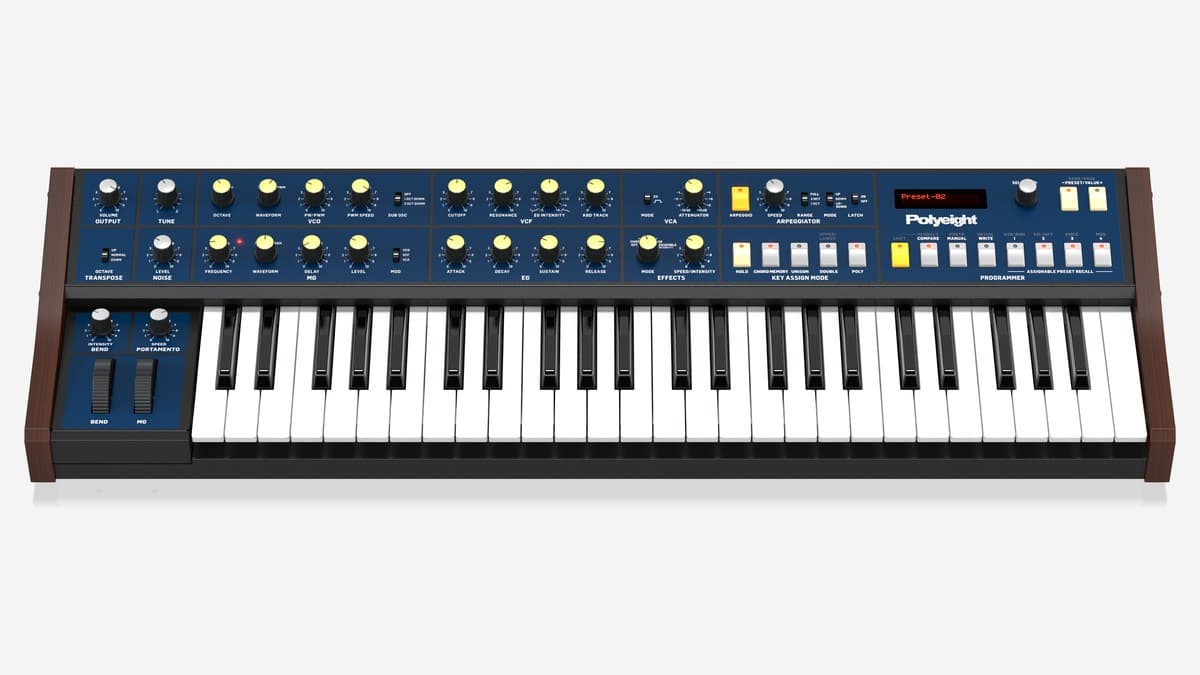
Behringer has published the product page and full user manual for Polyeight, its analog polysynth modelled on the 1981 Korg Polysix. It keeps what made the Polysix loved, discrete VCOs, the 2044 low-pass filter and a built-in BBD chorus, phaser and ensemble, and adds two more voices, a 49-key keyboard with polyphonic aftertouch, 256 program memories and full MIDI. The synth is finished, but Behringer has not yet given a price or a shipping date.
At a glance: 8 analog voices with Poly, Double (4 voices) and Unison (all 8 stacked) modes; one VCO per voice with saw, square and pulse width plus a sub-oscillator down two octaves; SSM2044-type 4-pole 24 dB/oct low-pass filter; one ADSR; one LFO with three waveforms; chorus, phaser and ensemble BBD effects; arpeggiator, chord memory and polyphonic portamento. 49 full-size semi-weighted keys with velocity and poly aftertouch. 825 x 260 x 120 mm, 7.5 kg. Price and release date to be announced.
What is Behringer Polyeight?
The Korg Polysix was one of the first affordable programmable polysynths. It had six voices, one oscillator per voice, a warm and slightly loose 4-pole filter and a chorus and ensemble circuit that did a lot of the work in making it sound big. You hear it on countless early-1980s records, and it still turns up on modern synth-pop, house and lo-fi productions because a single patch fills a mix so easily.
Polyeight follows the same plan with modern additions. Behringer first showed the project in 2021, and it went quiet for years before the finished product page and a version 2.0 manual appeared this month. The panel will look familiar to anyone who has seen a Polysix: VCO, VCF, VCA, envelope, LFO (Korg's "MG") and effects sections in a row, set in blue with wooden end cheeks.
If you are new to analog polys and want to see how this one fits with the rest of the market, our best hardware synthesizers guide covers analog, digital and hybrid keyboards at every budget.
What Polyeight adds to the Polysix formula
Eight voices instead of six. Two extra voices matter more than they sound. Six voices run out quickly on sustained chords with a long release, and eight give you room for pads and held notes while a melody plays on top.
Double and Unison modes. Double layers two oscillators per note for a thicker sound at four-voice polyphony. Unison stacks all eight VCOs on one note for bass and leads. A key split menu sits behind the Double button, and Hold and Chord Memory are on the same Key Assign section, as on the original.
Polyphonic aftertouch. The 49-key semi-weighted keybed senses velocity and pressure on each key separately. That lets you open the filter or add vibrato on one note of a chord without affecting the others, which is rare on analog keyboards at the price level Behringer usually targets.
Sub-oscillator and noise. Each voice gets a sub-oscillator one or two octaves below the main VCO. A global noise generator, which Behringer says takes its design from the MS-20, adds breath and grit.
Dedicated PWM LFO. Pulse-width modulation has its own LFO, separate from the main three-waveform LFO that routes to pitch, filter cutoff or amplitude. You can keep PWM moving while using the main LFO for vibrato or filter sweeps.
BBD effects in the signal path. Chorus, phaser and ensemble use bucket-brigade circuits, with speed and intensity controls. On the Polysix these effects were part of the sound, and Behringer has kept them as an integral section rather than an add-on.
Memory and performance features. There are 256 user programs with Compare and Match, a two-line LCD with an encoder for editing, four assignable preset recall buttons, polyphonic portamento and an arpeggiator with up, down and up-down modes, manual speed and external sync.
Modern connections. 5-pin MIDI in, out and thru with CC and NRPN control, class-compliant USB MIDI, sustain, expression and chord-memory pedal inputs, an arpeggiator sync input and a CV input for filter cutoff.
Behringer Polyeight specifications
| Spec | Polyeight |
|---|---|
| Voices | 8 (Poly), 4 (Double), 1 x 8 VCOs (Unison) |
| Oscillators | 1 VCO per voice: saw, square, pulse width; sub-oscillator 1 or 2 octaves down; octave select |
| Noise | Global noise generator |
| Filter | SSM2044-type 4-pole low-pass, 24 dB/oct; cutoff, resonance, EG intensity, keyboard tracking |
| Envelope | 1 ADSR |
| LFO | 1 main LFO (3 waveforms, delay) to pitch, cutoff or VCA, plus a PWM LFO |
| Effects | Analog BBD chorus, phaser and ensemble with speed and intensity |
| Performance | Arpeggiator (up, down, up-down, latch, sync), Hold, Chord Memory, polyphonic portamento |
| Memory | 256 user programs, Compare and Match, 4 assignable preset recall buttons |
| Keyboard | 49 full-size semi-weighted keys, velocity, polyphonic aftertouch |
| Display | 2 x 16 character LCD with encoder |
| Connections | MIDI in/out/thru (5-pin), USB-B (class-compliant MIDI), 1/4" balanced main out, 1/4" headphones, sustain, expression, chord memory, arp sync in, VCF CV in |
| Power | Internal 100 to 240 V supply, IEC cable, 36 W max |
| Size and weight | 825 x 260 x 120 mm, 7.5 kg |
| Price | To be announced |
The main output is a single balanced jack, so this is a mono synth at the output stage, as the Polysix was. The BBD effects add movement but you will record it on one channel unless you add your own stereo processing.
Polyeight vs JN-80 vs Pro-800 vs UB-Xa
Polyeight joins a crowded Behringer line of 1980s-inspired analog polys. These are the three closest alternatives you can buy today, with Thomann's US store prices on 26 October 2026.
| Polyeight | Behringer JN-80 | Behringer Pro-800 | Behringer UB-Xa | |
|---|---|---|---|---|
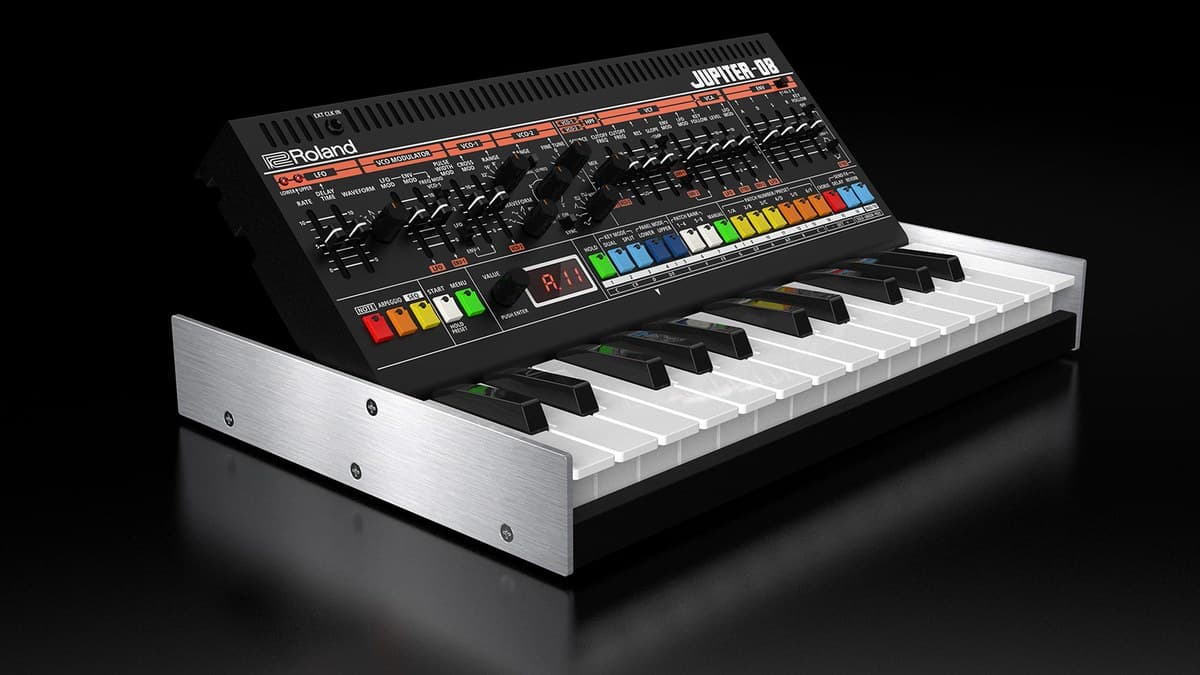
| Design | Korg Polysix recreation | 8-voice analog keyboard | Based on the Prophet-600 | OB-Xa reproduction |
| Price (Thomann US) | TBA | $527 | $235 | $845 |
| Format | 49-key keyboard | 49-key keyboard | Desktop module | 61-key keyboard |
| Voices | 8 | 8 | 8 | 16 |
| Oscillators per voice | 1 VCO + sub | 1 + sub | 2 | 2 |
| Aftertouch | Polyphonic | Yes | None (no keys) | Polyphonic |
| Built-in effects | BBD chorus, phaser, ensemble | Chorus | None | None |
| Stock (26 Oct) | Not yet on sale | 10 to 13 weeks | 1 to 2 weeks | In stock |
Which one to pick: Polyeight is the warm, effect-driven sound in this group: one oscillator per voice, a gentle filter and the ensemble doing the widening. The Pro-800 is the budget pick with two oscillators per voice and Prophet-style poly-mod, but it is a desktop box with no effects. The UB-Xa is the big, brassy option with twice the voices and a 61-key keyboard, at a much higher price and size. The JN-80 is the closest match in format and voice count, so the Polyeight's price will decide a lot. If it lands near the JN-80, poly aftertouch and the extra effects are a strong argument for waiting.
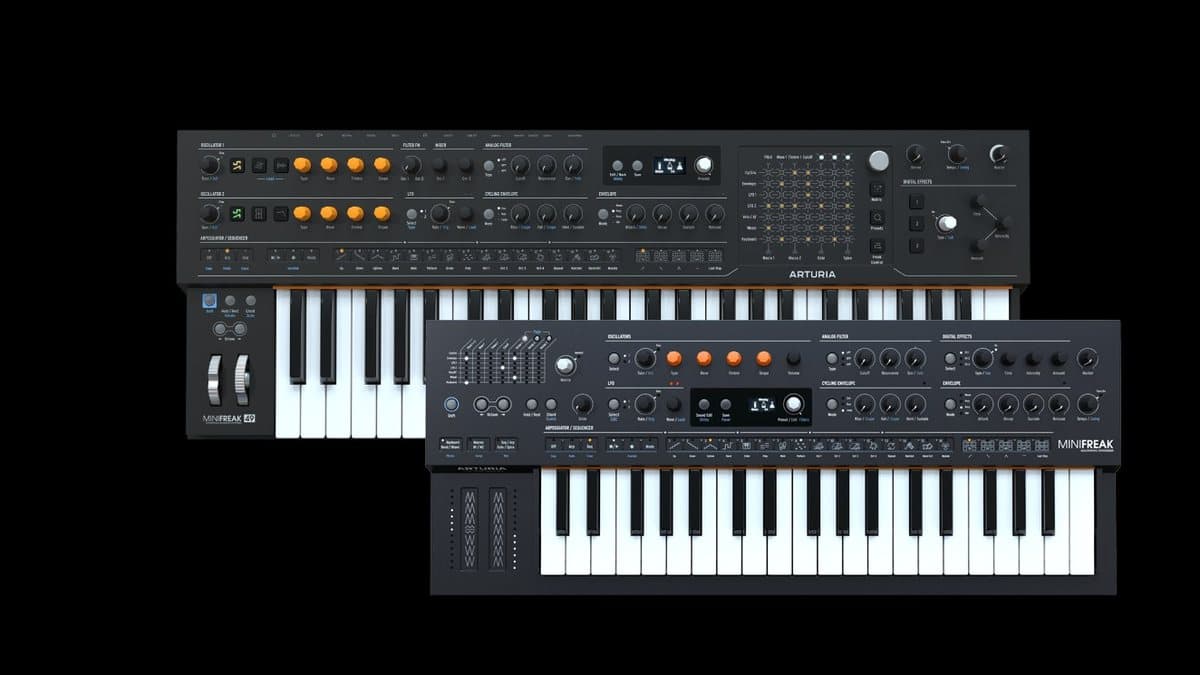
Polyeight's sound is a very different idea from the hybrid engines in Arturia's new MiniFreak 49, which has six voices of digital oscillators into analog filters and a deeper modulation system. If you want an analog chord machine, Polyeight is the more direct tool. If you want sound-design range, the MiniFreak covers more ground.
Who Polyeight is for
- Synth-pop, house and lo-fi producers who want the classic Polysix chord and pad sound without paying vintage prices.
- Keyboard players who care about expression. Poly aftertouch on a 49-key analog synth is the standout feature here.
- Owners of the Korg Polysix plugin in Korg Collection who want the hardware feel and real BBD effects.
Who should skip it: anyone who needs stereo output, multitimbral operation or more than one envelope per voice. Producers who mostly sequence from a DAW and have little desk space will get more from a desktop module like the Pro-800. And if you want a finished price before you plan a purchase, it is worth waiting: Behringer has a history of long gaps between a finished product page and shipping stock.
Price and availability
Behringer has not announced a price or a release date for Polyeight. The product page and the full user manual are live on behringer.com, and the manual is already at version 2.0, which suggests the firmware is close to final. We will update this article with official pricing and retailer stock as soon as they appear.
If you want a Behringer analog poly before then, the JN-80 is $527, the Pro-800 is $235 and the UB-Xa is $845 at Thomann's US store.
FAQ
How much does Behringer Polyeight cost?
Behringer has not announced a price yet. The product page and manual are online, but the synth is not on sale at any retailer.
Is Polyeight a Korg Polysix clone?
It is built around the Polysix design: one VCO per voice, a 2044-type filter and BBD chorus, phaser and ensemble. It adds two voices, poly aftertouch, a sub-oscillator, a noise generator inspired by the MS-20, 256 memories, an arpeggiator with sync and MIDI over USB.
How many voices does Polyeight have?
Eight in Poly mode, four in Double mode, and all eight oscillators stacked on one note in Unison.
Does Polyeight have polyphonic aftertouch?
Yes. The 49 full-size semi-weighted keys send velocity and polyphonic aftertouch.
Is Polyeight stereo?
No. It has one balanced 1/4" main output and a headphone output.
Verdict
Polyeight looks like one of Behringer's most complete vintage recreations: the Polysix sound and effects that people want, with the voice count, keyboard and memory the original never had. Poly aftertouch gives it something the JN-80 and Pro-800 lack. The open question is price. Until Behringer names one, this is a synth to watch rather than a synth to buy, and the Pro-800 and UB-Xa remain the in-stock options either side of it.