Some links on this page are affiliate links. If you buy through them, Dubspot may earn a commission at no extra cost to you. It never affects our scores or what we recommend — read our policy.
Behringer KICK: A $150 Open-Source Sampler Shaped Like an MPC
Behringer KICK is an MPC-style sampler with a 7-inch touchscreen, 16 RGB pads, 300+ effects and open-source firmware, at a target price of around $150. Specs and rivals.
M
Marcus Feld
October 30, 2026 · 9 min read
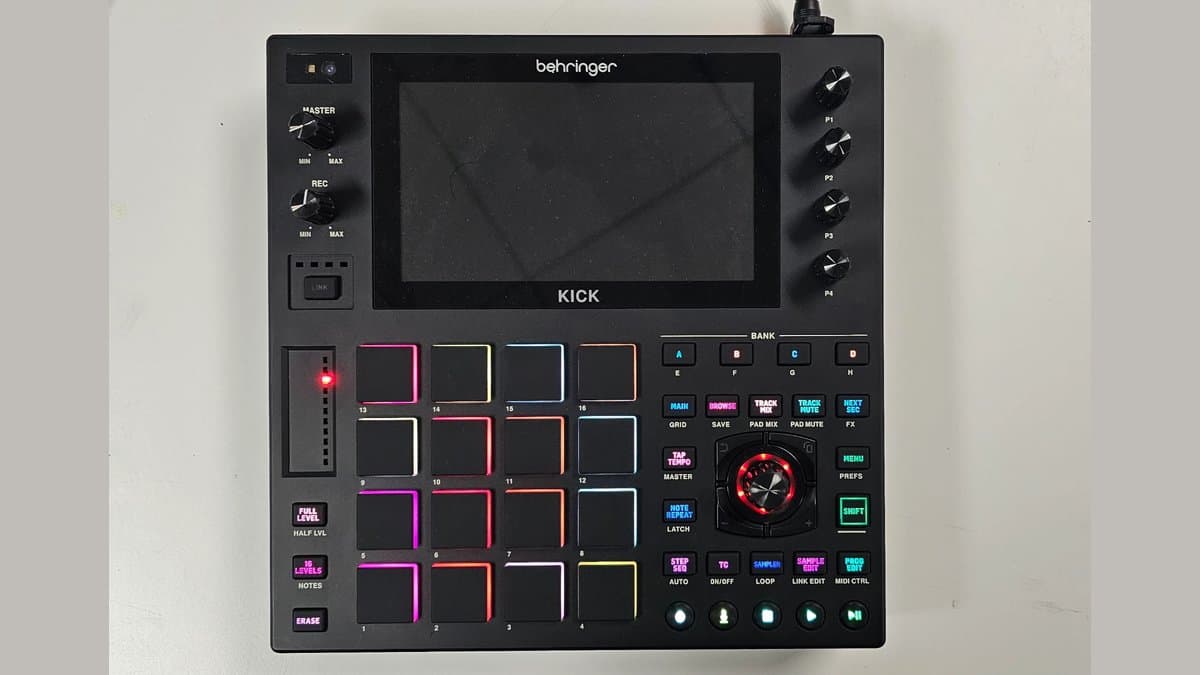
Behringer has announced KICK, a standalone sampler and production center with a 7-inch touchscreen, 16 RGB pads and a layout that will look very familiar to anyone who has used an Akai MPC One. The bigger story is the software. Music Tribe has published the KICK application, its audio engine and the hardware communication protocol on GitHub under the AGPL open-source licence, before the hardware has shipped, and invites anyone to modify or replace the firmware. Behringer gives a target retail price of around US$150.
At a glance: 7-inch touchscreen, 16 RGB pads in eight banks, sampler with sample editing, step sequencer and looper, more than 300 built-in effects, four assignable knobs, a jog wheel, a touch strip and a camera for gesture control. MIDI in and out on 5-pin DIN, USB-C and USB-A, stereo in and out, four CV/Gate jacks, SD card slot. Runs Music Tribe's JAM DAW on embedded Linux. Target price around $150; no release date yet.
What is Behringer KICK?
KICK (model code BE 0700-AAM) is Behringer's take on the standalone MPC format: a square box of pads, a big screen and transport buttons, built for sampling, chopping and sequencing beats without a computer. The repository describes it as a "professional standalone music production center" running Music Tribe JAM DAW, a new piece of software Behringer has not detailed elsewhere yet. The front panel in the official photos carries MPC-style buttons such as Full Level, 16 Levels, Note Repeat, Tap Tempo, Step Seq, Sampler, Loop, Sample Edit and Track Mute.
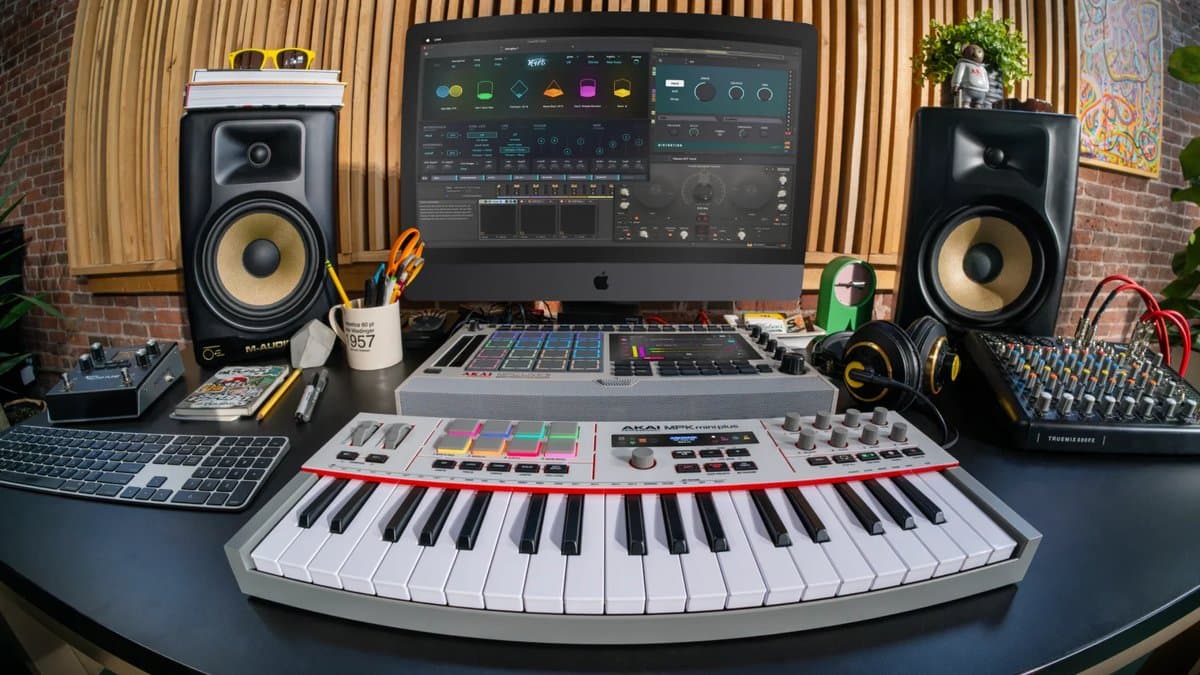
The resemblance to the MPC One is obvious, and that is the point of comparison buyers will make. What Behringer adds is the price. Akai's current MPC One G2 sells for $777 at Thomann's US store, so a $150 box with a similar screen and pad count would land at roughly a fifth of the cost. If you are new to the format, our Akai MPC buyer's guide explains what each part of an MPC workflow does.
What makes KICK different: open firmware
Most hardware ships with closed firmware that only the manufacturer can change. KICK goes the other way. The GitHub repository contains four parts:
- Kick, the application software, written in C++ with the JUCE framework.
- AudIO, the audio engine library.
- ComProtocol, the protocol the software uses to talk to the pads, knobs and screen.
- Linux, a Buildroot tree that builds the embedded Linux system the device boots.
The application, engine and protocol are licensed AGPL-3.0-or-later, and the Linux tree keeps Buildroot's GPL-2.0. Anyone can fork the code and open a pull request, and Music Tribe runs a Discord for developers. Behringer's announcement argues that AI coding tools mean "even people without programming experience can turn their ideas into new features and firmware", and says more open platforms will follow.
That puts KICK in the middle of the trend we covered in our look at custom and vibe-coded firmware, where owners of small synths and grooveboxes are already writing their own features. The difference is scale: this is a major manufacturer designing a product around community firmware from day one.
There are practical limits today. The application's own readme says the build does not work out of the box: there is no prebuilt cross-compilation SDK, so developers have to build one from the Buildroot tree, and factory samples and a licensed font were removed from the public release. Writing firmware for KICK is a real software project, not a one-click install, at least until the community produces tools and ready-made builds.
What KICK does as a sampler
Behringer's feature list is short, so here is what each part means in practice.
Sampler with sample editing. Record or load sounds onto pads, then trim and edit them on the touchscreen. A 7-inch screen is the same size class as the MPC One's, which makes chopping by eye much easier than on a small OLED.
Step sequencer and looper. The step sequencer covers programmed drums and patterns. The looper records audio passes on top of each other, which suits live jamming and layering ideas quickly.
16 RGB pads in eight banks. Eight banks of 16 give 128 pad slots, as on an MPC. The official specs do not say whether the pads sense aftertouch.
Touch strip, knobs and jog wheel. Four assignable knobs sit beside the screen and a jog wheel handles navigation and value changes. A vertical touch strip on the left of the pads is the kind of control MPCs use for filter sweeps and note repeat rates.
More than 300 effects. Behringer gives the count but not yet the list.
Camera for gesture control. A small camera above the master knobs is listed as an "AI camera for gesture control". Behringer has not explained what gestures do yet.
CV/Gate. Four CV/Gate jacks let KICK sequence modular gear or analog synths directly, alongside 5-pin MIDI in and out.
Behringer KICK specifications
| Spec | Behringer KICK (BE 0700-AAM) |
|---|---|
| Type | Standalone sampler, sequencer and production center |
| Display | 7-inch touchscreen |
| Pads | 16 RGB pads, 8 banks |
| Controls | 4 assignable knobs, jog wheel, touch strip, Master and Rec level knobs |
| Gesture control | Camera ("AI camera for gesture control") |
| Functions | Sampler with sample editing, step sequencer, looper |
| Effects | 300+ built-in |
| Software | Music Tribe JAM DAW on embedded Linux (Buildroot) |
| Rear connections | 12 V DC input, power switch, LINK (RJ45), USB-C, USB-A, MIDI in and out (5-pin DIN), stereo output, stereo input, 4 CV/Gate jacks |
| Front connections | SD card slot, headphone output |
| Firmware licence | AGPL-3.0-or-later (application, audio engine, protocol); GPL-2.0 (Buildroot Linux) |
| Target price | Around US$150 |
| Availability | To be announced |
Behringer has not published storage capacity, RAM, polyphony, sample rate, battery operation or dimensions.
KICK vs MPC One G2 vs MPC Sample vs SP-404MKII
KICK is not on sale yet, so the useful comparison is with the standalone samplers you can buy today. Prices are Thomann's US store on 30 October 2026.
| Behringer KICK | Akai MPC One G2 | Akai MPC Sample | Roland SP-404MKII | |
|---|---|---|---|---|
| Price | Around $150 (target) | $777 | $355 | $455 |
| Display | 7" touchscreen | 7" multi-touch | 2.4" colour | OLED |
| Pads | 16 RGB, 8 banks | 16 RGB, 8 banks, poly aftertouch | 16 RGB | 17 RGB |
| Storage | Not stated, SD slot | 64 GB internal | 8 GB internal, microSD | 16 GB internal, SD |
| Effects | 300+ | MPC effects suite | 4 processors, 60 types | 37 |
| CV/Gate | 4 jacks | 8 outputs | Sync out only | None |
| MIDI | 5-pin in/out | 5-pin in/out | 3.5 mm in/out | 3.5 mm in/out |
| Battery | Not stated | No | Built-in | 6 x AA |
| Firmware | Open source (AGPL) | Akai MPC OS | Akai | Roland |
| Status | Announced, no date | In stock | In stock | In stock |
Which to pick: if you need a sampler this month, the MPC One G2 is the full-featured version of this format, with 64 GB of storage, poly aftertouch, stem separation and eight CV/Gate outputs. The MPC Sample and SP-404MKII are smaller, battery-powered and cheaper, and the SP-404MKII has the deeper effects culture behind it. Our MPC Sample review covers the portable option in detail. KICK's case rests on price and openness. At $150 with a 7-inch screen and CV/Gate, it would undercut all three, but nobody outside Music Tribe has used JAM DAW yet, so the software quality is the unknown.
Who KICK is for
- Beatmakers on a tight budget who want the MPC-style big-screen workflow without paying MPC prices.
- Developers and tinkerers who want a capable pad sampler they are allowed to reprogram, with the source code already public.
- Modular and hardware-synth users who want a cheap sequencer and sampler with CV/Gate and 5-pin MIDI.
Who should skip it, for now: anyone who needs a dependable sampler for gigs or sessions soon. There is no ship date, the stock software is unseen, and Behringer products can take a long time to go from announcement to retail. Producers deep in the MPC ecosystem, with its expansions, Stem Pro separation and plugin instruments, will not find those here.
Price and availability
Behringer's announcement gives a target retail price of around US$150. There is no release date, and no retailer is taking orders yet. The source code is available now from Music Tribe's KICK repository on GitHub. We will update this article with confirmed pricing and stock when retailers list it.
Until then, the MPC One G2 is $777, the MPC Sample $355 and the Roland SP-404MKII $455 at Thomann's US store. For pattern-based beat machines without sampling at the centre, see our best drum machines of 2026.
FAQ
How much will Behringer KICK cost?
Behringer is targeting a retail price of around US$150. The final price and release date have not been announced.
Is Behringer KICK an MPC clone?
The layout closely follows the Akai MPC One: a 7-inch touchscreen, 16 RGB pads in eight banks and MPC-style function buttons. It runs Music Tribe's own JAM DAW software, not Akai's MPC OS.
Is the KICK firmware really open source?
Yes. The application, the AudIO audio engine and the hardware communication protocol are on GitHub under AGPL-3.0-or-later, and the Buildroot Linux tree under GPL-2.0. Building it currently needs a self-built cross-compilation SDK.
Does KICK have CV/Gate and MIDI?
Yes. It has four CV/Gate jacks, 5-pin MIDI in and out, USB-C and USB-A.
When is Behringer KICK coming out?
Behringer has not given a shipping date.
Verdict
KICK is one of the most interesting Behringer announcements in years, and not because of the hardware layout, which borrows heavily from Akai. A 7-inch touchscreen sampler with CV/Gate at $150 would be a strong deal on its own, and publishing the firmware under an open licence before launch is a genuine first for a company this size. The unknowns are the stock JAM DAW software and the release date. Watch it closely, but buy an MPC or SP-404MKII if you need a sampler now.