Some links on this page are affiliate links. If you buy through them, Dubspot may earn a commission at no extra cost to you. It never affects our scores or what we recommend — read our policy.
LOVE Synthesizers First Love: FM Synthesis You Draw
LOVE Synthesizers First Love is a 4-part FM synth you program by drawing on a 7-inch touchscreen. $555 at Thomann, with pads, a looper and built-in speakers.
M
Marcus Feld
November 4, 2026 · 9 min read
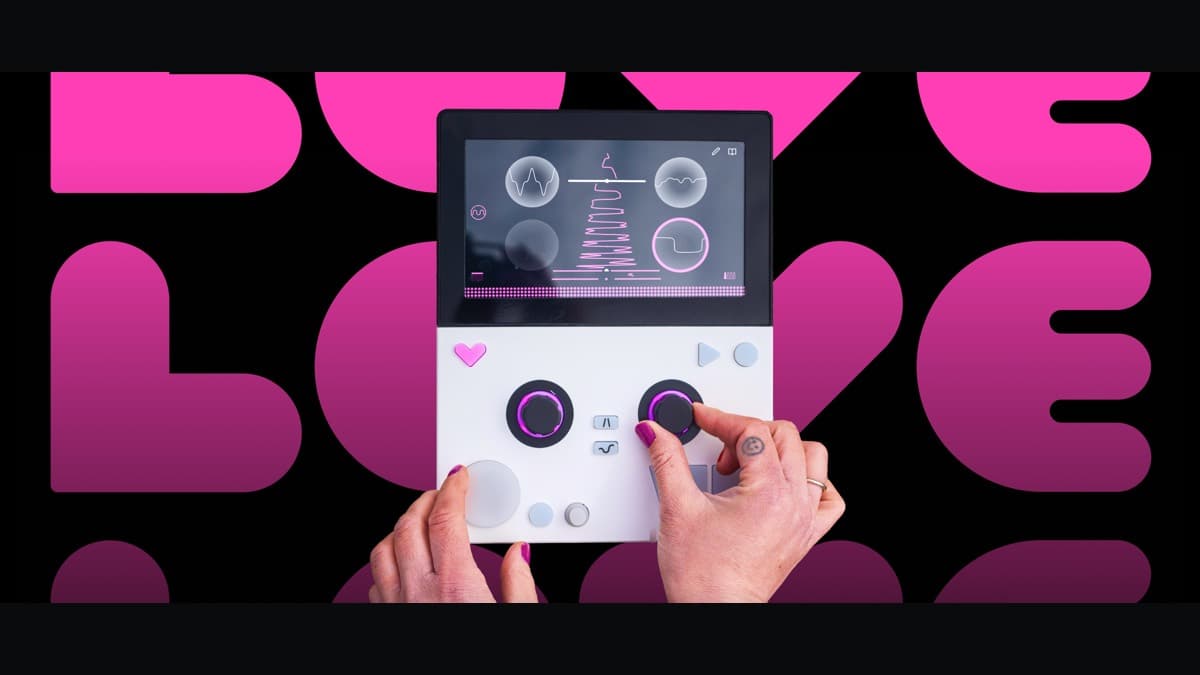
FM synthesis has a reputation. It sounds powerful, and it feels almost impossible to program by ear. LOVE Synthesizers, a small maker in Reykjavik, built the First Love to argue the opposite. It is a standalone, four-part FM synthesizer with a seven-inch touchscreen. The core idea is that you draw the sound. You patch operators by connecting them on screen, so the hidden structure of an FM patch becomes something you can see and move with a finger. The synth won a Best Innovation Award at Superbooth 2024, and it is now shipping, listed at $555 at Thomann.
At a glance: four-part multitimbral FM with wave shaping and morphing envelopes, programmed on a seven-inch touchscreen; velocity- and aftertouch-sensitive pads, a riff sequencer, an arpeggiator and a 4x4 live looper; a scale builder with microtonal tuning; reverb, delay and chorus; built-in speakers and battery power. $555 at Thomann, in white or pink. A playable route into FM, not a workstation.
What is the First Love?
The First Love is a compact FM synthesizer you can pick up and play anywhere. It measures 186 by 237 millimetres and weighs 790 grams. It runs on four rechargeable 18650 cells, with speakers built in. That means it plays on a desk, a train or a sofa without a cable.
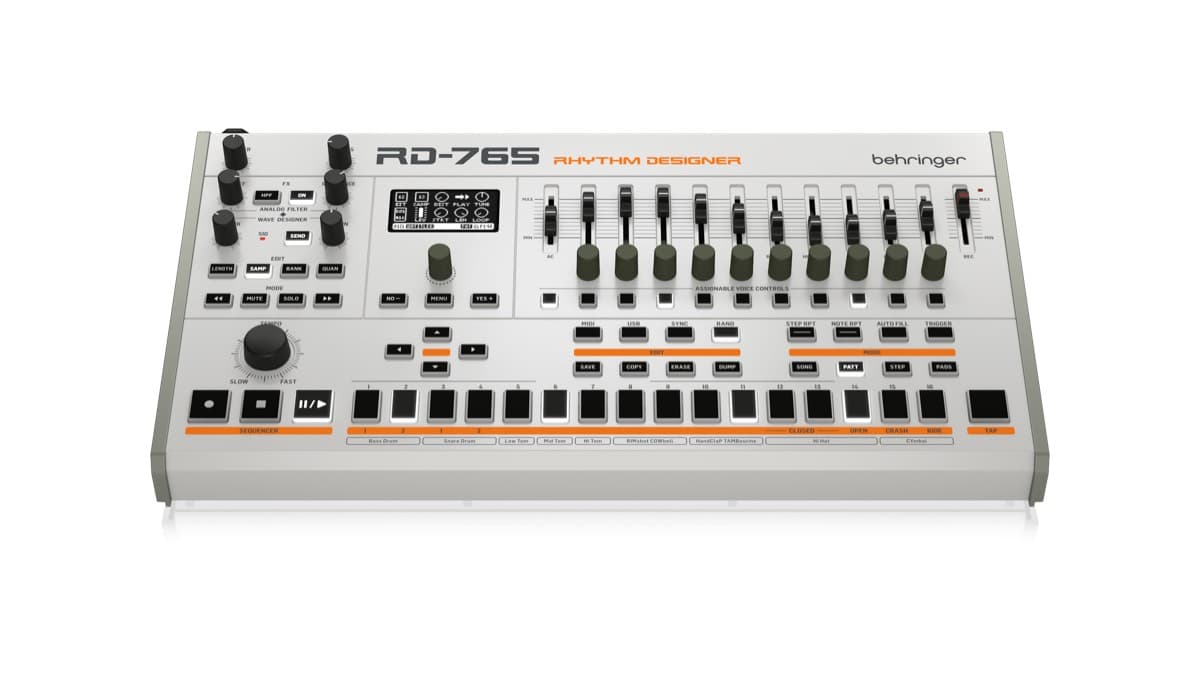
What sets it apart is the interface. Classic FM synths, the Yamaha DX7 above all, buried their power under menus and two-digit displays. A generation of producers learned to fear operators, algorithms and modulation indexes. The First Love puts all of that on a touchscreen as a diagram you build by hand. The pitch is simple: FM you can see. It lands in a busy stretch for new hardware, alongside Behringer's freshly launched RD-765 drum machine.
What's new in the First Love
Draw the patch on a touchscreen
The seven-inch touchscreen is the instrument. Instead of picking a fixed algorithm from a list, you connect operators by drawing the routing. Carriers, modulators and feedback paths sit in front of you, and a touch rearranges them. Anyone who has squinted at an FM algorithm chart, wondering which box feeds which, will get the appeal. Seeing the signal flow and dragging it around takes out the guesswork. It turns FM from a numbers game into something closer to sketching.
Four-part multitimbral, with wave shaping and morphing envelopes
The First Love is four-part multitimbral. It holds four independent FM voices at once, enough for a bass, a pad, a lead and a percussive layer in one box. The engine adds wave shaping to the operators, for tones a pure sine-based FM synth cannot reach. Morphing envelopes move between shapes over time instead of holding one fixed contour. Together they push the sound past vintage FM into something more modern and animated.
Pads, a riff sequencer, an arpeggiator and a 4x4 looper
This is a performance instrument, not just a sound-design tool. A grid of pads sensitive to velocity and aftertouch sits under your fingers, with an encoder and soft-touch buttons alongside. A riff sequencer and an arpeggiator generate and lock in parts. A 4x4 live looper layers them, so you can build an idea on the device and loop it back while you play the next part. With four parts and a looper, the First Love edges close to a tiny FM groovebox.
A scale builder and microtonal tuning
A built-in scale builder with microtonal tuning lets you step outside standard twelve-tone equal temperament. You can set up custom scales and play microtonal ideas straight from the pads. That is rare at this size and price. It pairs naturally with FM, whose metallic, bell-like partials come alive in unusual tunings.
Effects and connectivity
Onboard reverb, delay and chorus finish sounds without a computer, fed by a modulation matrix for movement. Connectivity is generous for the format. You get MIDI In and Thru on DIN5, USB-C for MIDI, power and data, and Sync In and Out on 3.5 mm to lock to other gear. Outputs run up to four mono or two stereo pairs on 6.3 mm jacks, plus a 6.3 mm headphone out.
First Love specifications
| Spec | Detail |
|---|---|
| Developer | LOVE Synthesizers (Reykjavik, Iceland) |
| Type | Standalone FM synthesizer |
| Engine | Four-part multitimbral FM with wave shaping, morphing envelopes |
| Interface | Seven-inch touchscreen, draw operator routing by hand |
| Controls | Velocity- and aftertouch-sensitive pads, encoder, soft-touch buttons |
| Sequencing | Riff sequencer, arpeggiator, 4x4 live looper |
| Tuning | Scale builder with microtonal tuning |
| Effects | Reverb, delay, chorus, modulation matrix |
| Audio out | Up to four mono or two stereo 6.3 mm outputs, 6.3 mm headphone out |
| MIDI | In and Thru (DIN5) |
| Other I/O | USB-C (MIDI, power, data), Sync In and Out (3.5 mm) |
| Power | Built-in speakers, 4 x 18650 Li-ion rechargeable batteries |
| Size and weight | 186 x 237 x 52 mm, 0.79 kg |
| Colours | White, Pink |
| Price | $555 at Thomann |
First Love vs Korg opsix MKII
The closest rival is Korg's opsix MKII, the other synth built to make FM approachable. They take opposite routes to the same goal.
| LOVE First Love | Korg opsix MKII | |
|---|---|---|
| Price | $555 at Thomann | Around $519 |
| Interface | Seven-inch touchscreen, draw the routing | Six physical operator sliders, knob-per-function |
| Format | Standalone, speakers, battery | Keyboard synth, mains powered |
| Multitimbral | Four parts | Single timbre |
| Tuning | Scale builder, microtonal | Standard tuning |
| Best for | Visual, portable FM sketching | Hands-on FM with a keybed |
Which to pick: the opsix MKII gives you a 37-key keybed and a slider for every operator, which many players prefer for fast, tactile FM. The First Love trades that keybed for a touchscreen, four-part multitimbral playback, a looper, microtonal scales and true portability. If you want FM you can carry and build by drawing, the First Love is the more original instrument. If you want a keyboard and physical operator controls, the opsix is the safer buy. Our guide to the best hardware synthesizers of 2026 covers the wider field. Prefer to stay in the box? The best synth VST plugins of 2026 includes FM options in software.
Who the First Love is for
Buy it if FM has always appealed but the programming has put you off. It also fits anyone who wants a portable, battery-powered FM instrument with speakers to play anywhere. It suits sound designers drawn to metallic, bell-like timbres, producers who want microtonal options, and players who like to build and loop a full idea on one device.
Skip it if you need a full keybed or a deep multi-engine workstation. This is a focused FM instrument, not a do-everything synth. The first production runs are limited, so colours and stock move. If your FM needs are occasional, a software synth in your DAW will cost far less than a dedicated box.
How much does the First Love cost?
- $555 at Thomann in white or pink, available since October 2026.
- Pricing varies by region, roughly £519 in the UK and around €579 to €599 in the euro zone, and early runs are limited, so stock can shift between colours.
FAQ
What is the LOVE Synthesizers First Love?
A standalone four-part FM synthesizer with a seven-inch touchscreen, built so you program FM by drawing the operator routing on screen. It has velocity- and aftertouch-sensitive pads, a riff sequencer, an arpeggiator, a 4x4 looper, built-in speakers and battery power, and it is listed at $555 at Thomann.
Does the First Love make FM synthesis easier?
That is its whole purpose. Rather than hiding operators and algorithms behind menus, it shows the signal flow on a touchscreen. You connect operators by drawing, which makes the structure of an FM patch visible and quicker to grasp.
First Love vs Korg opsix MKII?
Both aim to make FM approachable. The First Love uses a touchscreen you draw on, is four-part multitimbral, runs on batteries and adds microtonal tuning, at $555. The opsix MKII uses physical operator sliders and a 37-key keybed, at around $519. Choose by interface: draw on glass, or reach for sliders and keys.
Is the First Love portable?
Yes. It has built-in speakers, runs on four 18650 rechargeable batteries, measures 186 by 237 by 52 mm and weighs 790 grams, so it plays anywhere without a computer or mains power.
Verdict
The First Love is the rare boutique synth with a genuinely new idea, not another take on an old one. FM has waited decades for an interface that makes its structure visible. Drawing operator routing on a touchscreen is the most convincing attempt yet. It is backed by four-part multitimbral playback, a looper, microtonal scales and true portability. This is no workstation. There is no keybed, and small-batch production means stock and colours come and go. But at $555, an award-winning instrument that could finally make FM click looks like strong value. If you have ever bounced off FM, this is the synth to watch. If you want one, check Thomann for the colour in stock, because the runs are limited.