JBL 3 Series MkIII: A Ground-Up Studio Monitor Redesign
JBL's 3 Series MkIII studio monitors add front-firing Slipstream ports, 81 one-touch room EQ options, and new Class D amps across the 305P, 306P, and 308P.
Dubspot's best Black Friday dealsDubspot Tracker Pro: $15, was $24.99 ↗Drum Programming and Groove Production Course: $19, was $99 ↗
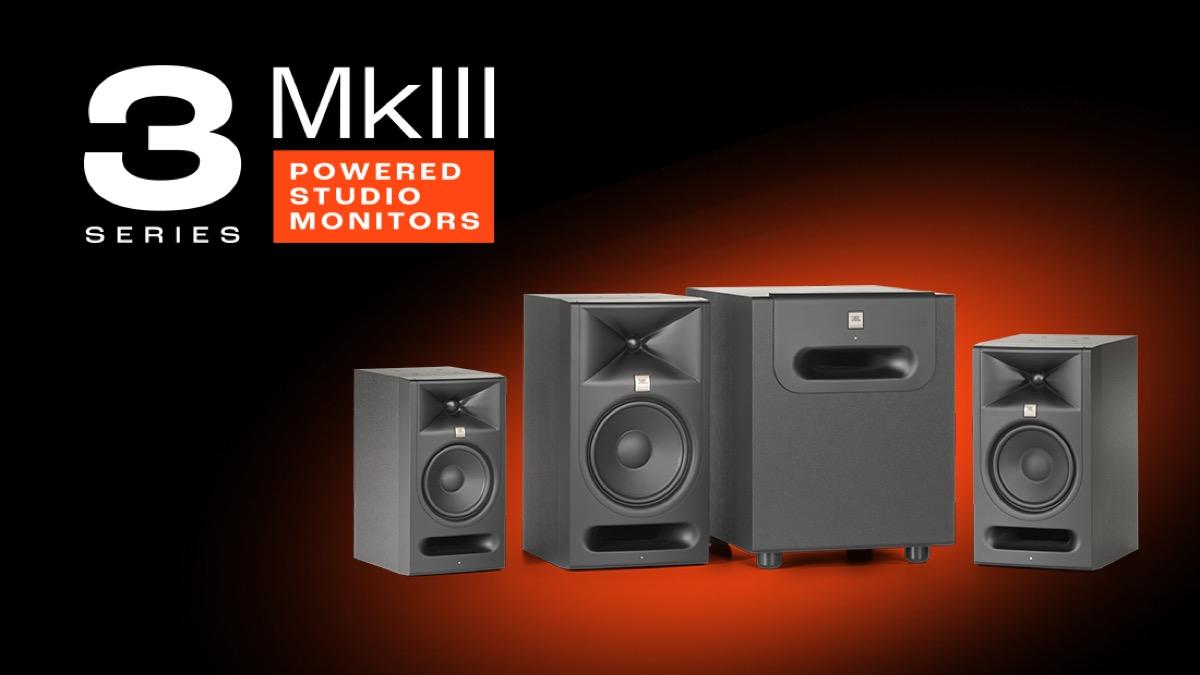
JBL Professional announced the 3 Series MkIII on November 2, 2026, and it's the biggest redesign the budget-friendly 3 Series has ever had. The family covers three two-way monitors, the 305P MkIII, 306P MkIII, and 308P MkIII, plus a new 310S MkIII powered subwoofer. New drivers, a front-firing port, fresh amplifiers, and a one-touch room-tuning system headline the update.
At a glance: The 3 Series MkIII is a full re-engineering of JBL's entry-level studio monitor line. Every full-range model gets a redesigned high-frequency driver, an updated JBL Image Control Waveguide, new low-frequency drivers, a front-firing JBL Slipstream port, and new Class D amplification. Four one-touch controls give 81 room-EQ combinations with no calibration software. The monitors ship first in Asia-Pacific, Europe, the Middle East, and Africa from November 3, 2026, and reach North America on January 7, 2027.
What is the JBL 3 Series MkIII?
The 3 Series is JBL Professional's affordable powered studio monitor line, and it's been a default pick for home and project studios for years. The MkIII is the third generation, and JBL calls it the most extensive redesign the platform has seen. The MkII refined the formula. This one rebuilds the acoustic system, the amplification, and the room-correction tools at the same time.
The lineup maps cleanly to room size. The 305P MkIII is the 5-inch model for compact desks and edit suites. The 306P MkIII is the 6.5-inch middle option for project studios. The 308P MkIII is the 8-inch model for larger rooms and bass-heavy work. The 310S MkIII subwoofer anchors the low end if you're building a 2.1, surround, or immersive rig. If you've been planning a home studio and its room correction, this family is built around real-world placement.
What's new in the 3 Series MkIII?
A redesigned high-frequency driver and waveguide
Every full-range model uses a newly engineered high-frequency driver paired with an updated JBL Image Control Waveguide. The goal is a wider, more consistent listening area instead of one narrow sweet spot. In practice, the stereo image holds together when you lean back, roll your chair sideways, or share the desk with a collaborator. The waveguide also tightens the phantom center, the spot where lead vocals and kick drums sit, so your panning and depth decisions translate with more confidence.
New low-frequency drivers
JBL redesigned the woofers too. They use stiffer cone materials, upgraded magnet assemblies, and aluminum shorting rings. The 306P MkIII and 308P MkIII both move to a new 20 oz magnet. The payoff is better power handling and lower distortion, so the low end stays clean as you push the level. Bass extension reaches 45 Hz on the 305P, 43 Hz on the 306P, and 41 Hz on the 308P.
A front-firing JBL Slipstream port
Here's the structural change most owners will notice. The MkIII moves the bass port to the front and uses JBL's patented Slipstream design. A front port behaves more predictably when a monitor sits close to a wall or near the back of a desk, which describes most home setups. Rear ports can boom or smear when they're boxed in, so moving the port forward is a practical win for small rooms.
New Class D amplification
Each model carries a new Class D amplifier with higher output, more headroom, and lower system noise. The 305P MkIII runs 86 W, the 306P MkIII and 308P MkIII run 110 W, and the 310S MkIII subwoofer runs 300 W. Headroom counts because it keeps transients clean at mixing levels, so snares and plucks keep their snap instead of flattening out.
Balanced Neutrik combo inputs
Connectivity gets simpler. The MkIII uses balanced Neutrik combo inputs with selectable +4 dBu and -10 dBV sensitivity. That combo jack takes both XLR and quarter-inch TRS, so the monitors drop straight onto common interfaces, mixers, and controllers without adapters. The sensitivity switch lets you match output levels so both speakers land where you expect.
One-touch room optimization
There's no calibration software here. Every full-range monitor has four one-touch controls that provide 81 corrective EQ combinations. You set them for speaker placement, wall distance, and high- and low-frequency balance, and the system handles the rest. Nothing to install, no measurement microphone to position. For a producer who moves between rooms or works in an untreated space, it's a fast way to flatten the response by ear.
Built to scale into immersive
Each full-range model carries eight integrated M4 mounting points on a standard 75 by 75 mm pattern. Start with a stereo pair, then mount the monitors on walls, arms, ceilings, or inverted as you grow into 2.1, surround, or immersive layouts. The new 310S MkIII subwoofer extends low-frequency response to 26 Hz and adds selectable crossover settings plus external bass-management bypass, so it slots into a larger monitoring system without a fight.
JBL 3 Series MkIII specifications
| Model | Configuration | LF extension (-10 dB) | Peak SPL | Amplifier | Best for |
|---|---|---|---|---|---|
| JBL 305P MkIII | 5-inch two-way | 45 Hz | 109 dB | 86 W Class D | Compact home studios, creator workstations, edit suites |
| JBL 306P MkIII | 6.5-inch two-way | 43 Hz | 112 dB | 110 W Class D | Project studios wanting balanced size, headroom, and bass |
| JBL 308P MkIII | 8-inch two-way | 41 Hz | 113 dB | 110 W Class D | Larger rooms and low-frequency-critical production |
| JBL 310S MkIII | 10-inch powered subwoofer | 26 Hz | 116 dB | 300 W Class D | Stereo, 2.1, surround, and immersive systems |
All three full-range models share the same features and voicing, so your choice comes down to woofer size, how loud and how low you need to go, and how much room you have.
What changed from the 3 Series MkII?
The MkII became one of the most popular budget monitors on the market, so existing owners will want to know what the redesign changes.
| Feature | 3 Series MkII | 3 Series MkIII |
|---|---|---|
| Bass port | Rear-firing | Front-firing JBL Slipstream |
| Room tuning | Boundary EQ and HF trim switches | Four one-touch controls, 81 EQ combinations |
| Amplifier | Class D | New Class D with higher output and headroom |
| Inputs | Balanced XLR and TRS | Balanced Neutrik combo, +4 dBu / -10 dBV switch |
| High-frequency system | Image Control Waveguide | Redesigned HF driver, updated Image Control Waveguide |
| Mounting | Limited | Eight M4 points, 75 by 75 mm, wall, ceiling, and arm ready |
The pattern holds across the spec sheet. The MkIII keeps the 3 Series promise of high value and accurate sound, then rebuilds the parts that matter most in a real room: the port position, the room correction, and the amplifier headroom. For most people, the front port and the 81 room-EQ options are the two upgrades you'll feel first.
Who the 3 Series MkIII is for
The 3 Series MkIII targets home and project studios that want accurate monitoring without a flagship budget. Music producers are the core audience, but JBL also points it at video editors, podcasters, and content creators, which the three sizes and the immersive-ready mounting reflect. If you work close to a wall or on a crowded desk, the front port and one-touch room EQ are built for your situation.
It competes with the Yamaha HS line and the KRK Rokit series in the entry-to-mid monitor budget, so those are the obvious cross-shops. Pair any of them with good studio headphones or a monitoring tool like Slate VSX for a second reference, since no single monitor tells the whole story. If you already run 3 Series MkII monitors and you're happy with them, treat this as an upgrade to weigh rather than a must-have, unless the front port or immersive expansion solves a specific problem for you.
Pricing and availability
The 3 Series MkIII family becomes available from November 3, 2026, in Asia-Pacific, Europe, the Middle East, and Africa, with North America following on January 7, 2027. JBL hasn't published MkIII list prices in its launch materials. The 3 Series has long been one of the cheapest routes into JBL's professional monitoring, so expect pricing to land at retailers as each region opens. Full specifications and regional details live on the official JBL Professional 3 Series MkIII page.
FAQ
What's the difference between the JBL 3 Series MkIII and MkII?
The MkIII is a ground-up redesign. It moves the bass port to the front with JBL's Slipstream design, adds a redesigned high-frequency driver and updated waveguide, fits new low-frequency drivers and Class D amplifiers, switches to Neutrik combo inputs, and replaces the MkII's EQ switches with four one-touch controls that offer 81 room-EQ combinations.
Which JBL 3 Series MkIII monitor should I buy?
Match the woofer to your room. The 305P MkIII (5-inch, 45 Hz) suits compact desks and edit suites. The 306P MkIII (6.5-inch, 43 Hz) is the balanced middle choice for project studios. The 308P MkIII (8-inch, 41 Hz) fits larger rooms and bass-focused production. Add the 310S MkIII subwoofer for deeper extension or for surround and immersive setups.
Do the 3 Series MkIII monitors need calibration software?
No. Room optimization is built in through four one-touch controls that provide 81 corrective EQ combinations for placement, wall distance, and tonal balance. There's no software to install and no measurement microphone to set up.
When do the JBL 3 Series MkIII monitors ship?
They ship from November 3, 2026, in Asia-Pacific, Europe, the Middle East, and Africa, and from January 7, 2027, in North America.
First look verdict
This is a first look based on JBL's official launch materials, not a hands-on test in a treated room. On paper, the 3 Series MkIII is the most meaningful update the line has had, and the changes read like answers to how people really use these monitors. The front-firing Slipstream port addresses desk and wall placement. The 81 one-touch room-EQ options replace guesswork with quick adjustment. The new Class D amps add the headroom that budget monitors often lack. The immersive-ready mounting is a smart nod to how many rooms now run more than two speakers. Price is the one open question, since JBL hasn't confirmed it. If the MkIII holds the line on the 3 Series value story, it should stay near the top of the budget monitor shortlist.