Some links on this page are affiliate links. If you buy through them, Dubspot may earn a commission at no extra cost to you. It never affects our scores or what we recommend — read our policy.
Akai MPC Sample Review: A Portable, Battery-Powered Standalone Sampler That Channels the MPC60
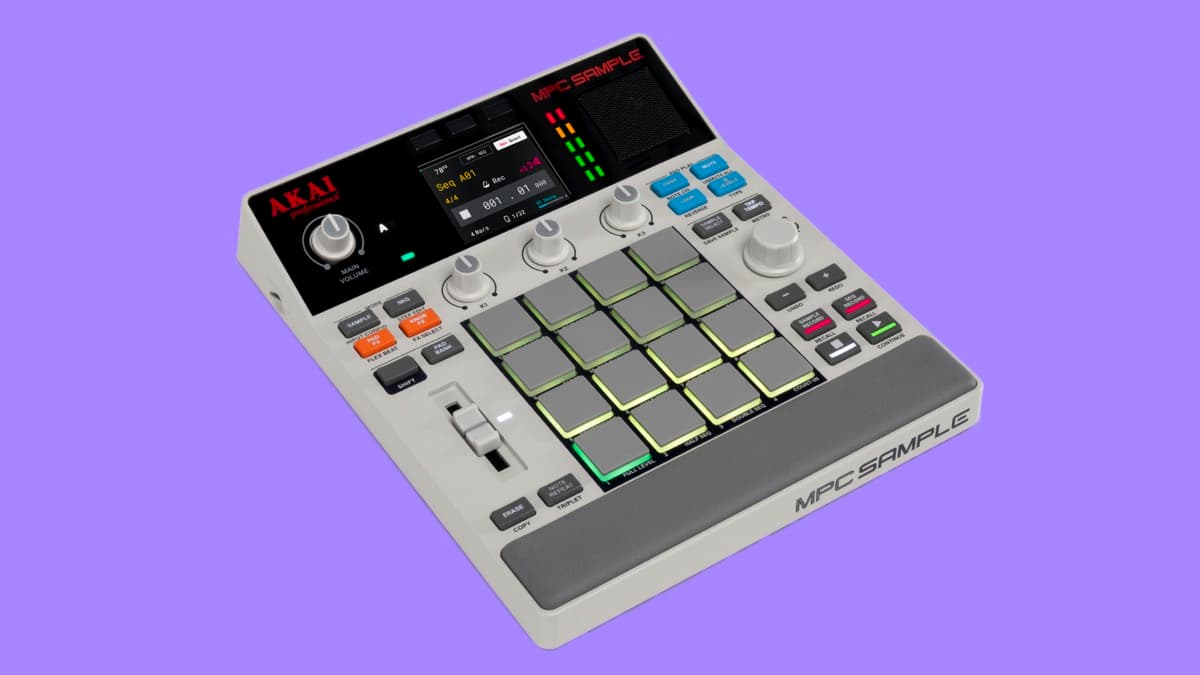
The Akai MPC Sample brings 16 RGB pads, 60 effects, a 5-hour battery, built-in mic and speaker, and classic MPC workflow to a $399 portable standalone.
E
Elena Marsh
April 28, 2026 · 5 min read
Black Friday 2026AKAI Professional Black Friday 2026: dates and deals →
Akai Professional released the Akai MPC Sample on March 24, 2026. This portable, battery-powered standalone sampler brings classic MPC60 and MPC3000 workflow into a compact body. It launched at $399 / £349 / €399 and sold out immediately.
The device offers Akai's most accessible MPC yet. It focuses on what beatmakers use most: pads, chopping, effects, and sequencing. No computer is required.
What is the Akai MPC Sample?
The Akai MPC Sample packs a hardware sampler and sequencer into a 23.6 × 19.4 × 5.0 cm chassis. A rechargeable lithium-ion battery delivers up to five hours of operation. It includes a built-in 3-watt speaker, internal microphone, and 16 RGB-backlit velocity-sensitive pads with poly aftertouch.
The design nods to vintage MPC units while updating the workflow for modern use. It targets producers who want quick, hands-on sampling without starting a DAW.
What's in the box (and on the unit)
Key features focus on sampling, sequencing, effects, and solid connectivity:
- 16 RGB-backlit MPC pads with velocity sensing and poly aftertouch
- 2.4-inch full-color LCD display
- 2 GB RAM, 8 GB internal storage, microSD slot
- 32 stereo voices of polyphony with disk streaming
- 3 real-time knobs plus the legacy MPC parameter fader
- 4 effects engines, 60 effect types (granulator, ring mod, reverb, beat repeat, FlexBeat, color-compressor, lo-fi, more)
- Instant Sample Chop Mode plus real-time Timestretch and Repitch
- 8 sound banks (A–H) and over 100 factory kits
- MPC sequencer at 960 PPQN with real-time swing
- Built-in 3W speaker and internal microphone
- Up to 5-hour battery (Li-ion, rechargeable)
Sampling and chopping that gets out of the way
Sampling on the Akai MPC Sample feels fast and direct. You capture audio via the built-in mic, 1/4-inch inputs, or USB-C. Instant Sample Chop Mode then slices the buffer onto pads within seconds. In software, the DYSEKT slicer plugin imports MPC kits and splits each slice into stems.
Real-time Timestretch and Repitch adjust chops without re-rendering. Internal resampling lets you apply effects in place and layer sounds easily. The 25-second audio buffer supports quick "happy accident" captures.
Effects and pad FX
Four onboard effects engines provide 60 effect types. Standout options include granular processing, ring modulation, beat repeat, FlexBeat, color-compressor, reverb, and lo-fi. Pad FX and Knob FX give direct hardware control for triggering and scrubbing effects.
This effect count delivers strong value at the price. Not every processor reaches studio-grade quality, yet the variety supports the texture and rhythm work beatmakers expect from MPC gear.
Sequencing and workflow
The MPC sequencer runs at 960 PPQN and includes real-time swing. It captures parameter automation from knob movements per pattern. The unit skips a traditional step sequencer and sticks to live pad recording with classic MPC feel.
Shift + pad shortcuts speed up common tasks. Eight banks handle sound organization. The 2.4-inch screen stays small but reads cleanly for waveform editing and sample selection.
Here is the official Akai walkthrough:
Connectivity
The rear panel keeps connections practical for the size:
- 6.3 mm stereo input
- 6.3 mm stereo output
- Headphone output
- MIDI in / out (TRS minijack)
- Sync out (no Sync in)
- USB-C for MIDI, audio, and data
- Record gain control
The missing Sync in stands out as a limitation for users who need to slave the unit to an external master clock. Otherwise, the I/O suits portable sessions well.
Software side: MPC3 compatibility
Projects transfer between the Akai MPC Sample and the MPC3 desktop software on Mac and PC. The MPC 3.8 update from April 2026 added support for device-specific features. This setup works nicely as a hardware sketchpad that moves ideas to a fuller MPC environment.
Firmware 1.3 changes
Akai released firmware 1.3 soon after launch. Key updates include:
- Normalize sample (scales to 0 dB between start and end points)
- Knob takeover modes: pickup, scaled, or instant
- Customizable behavior for knobs, FX, and faders
- Bug fixes
One noted issue persists: audio glitches in FlexBeat during tempo changes. Akai has confirmed ongoing firmware support. Tempted by unofficial mods in the meantime? Read our long read on the custom firmware boom first, because the risks are real.
Where the Akai MPC Sample fits
The unit serves several clear use cases:
- Portable beatmaking — battery, speaker, and mic support real travel sessions
- MPC nostalgia — classic pad response and workflow without extra complexity
- Field sampling — capture, chop, and sequence all in one device
- Sketchpad-to-DAW — create ideas on hardware, then finish in MPC3 software
- Hands-on FX experimentation — granular, beat repeat, and color-compressor on dedicated controls
How it compares
The Akai MPC Sample competes in the portable standalone sampler category. It offers a deeper MPC-style sequencer, a larger waveform display, and a built-in speaker plus microphone in a compact chassis. Other options in the same category may edge it out on FX-chain depth, live-performance ergonomics, or extreme portability.
Pricing and availability
- Price: $399 / £349 / €399
- Released: March 24, 2026
- Availability: Sold out at launch; stock returning at major retailers, including Thomann
- Software: MPC 3.8+ for desktop project transfer
Get it
Visit the official Akai MPC Sample page for full specs and the Akai Professional site for global retailer information. The current firmware is version 1.3.
Check MPC Sample price at ThomannLooking for more hardware sampler coverage? Check out our other reviews of standalone instruments and beatmaking gear on the Dubspot blog.