DAW / plugin file

Cubase 16

Steinberg / $99.99 to $599.99

Steinberg Cubase 16 is a desktop DAW for composing, recording, mixing and scoring, sold as a perpetual license in Pro, Artist and Elements editions.

Some links on this page are affiliate links. If you buy through them, Dubspot may earn a commission at no extra cost to you. It never affects our scores or what we recommend (read our policy).

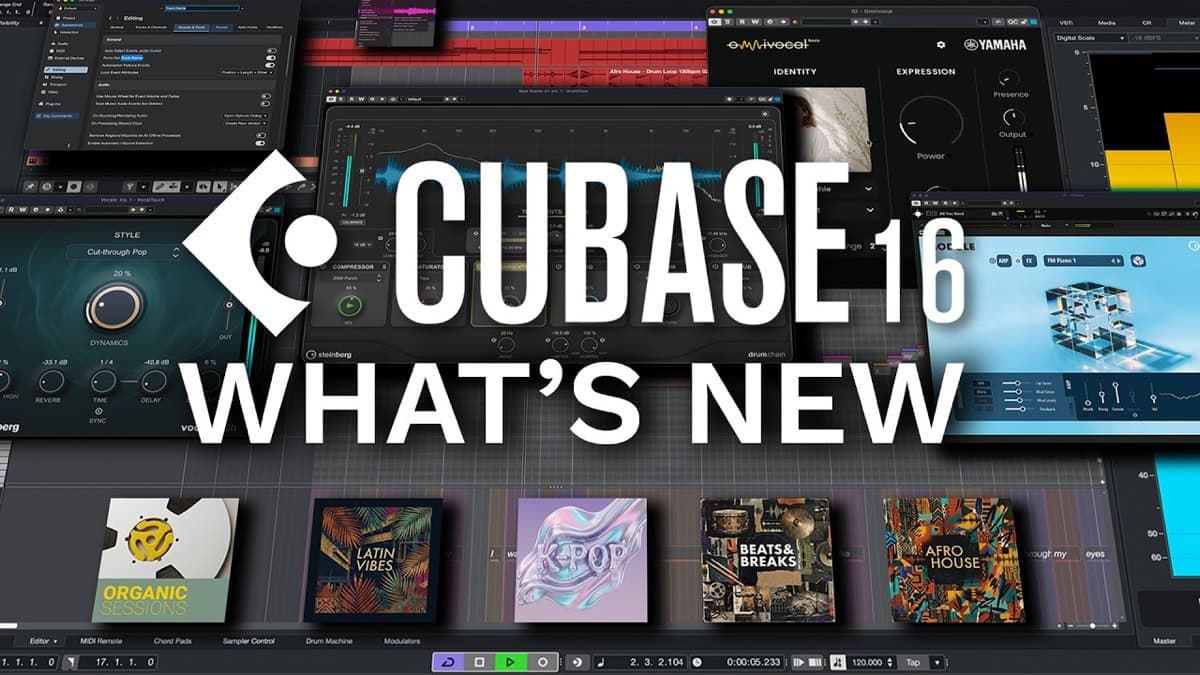
Steinberg's Cubase 16 What's New artwork showing DrumChain, VocalTouch, Omnivocal and the new sample packs
8.8Great
The Dubspot verdict
8.8Great

The Dubspot verdict

A deep DAW without a subscription, built for composition, MIDI and scoring. Version 16 is an incremental release, led by Instrument Stacks, Strum and Stretch and better stem separation.

Best for Composers, songwriters and engineers who want a full desktop DAW with deep MIDI and scoring tools, without a subscription.

Pros

  • Perpetual license in every edition, with a free 30-day trial
  • Deep MIDI, Expression Maps and scoring tools, now with Strum, Stretch and lyrics in the Key Editor
  • Instrument Stacks put several instruments on one track in Pro and Artist
  • Stem separation with dedicated piano and guitar stems, plus Spectral AudioWarp, in Pro

Cons

  • Pro lists at $599.99, and Elements limits tracks and leaves out VariAudio
  • Stem separation, Spectral AudioWarp, Control Room and Modulators are Pro-only
  • A paid update every year: Cubase Pro 15 owners pay €99 to move to 16
  • Built around a linear timeline, so clip-based live sets suit Ableton Live better

Field notes

Overview

Cubase 16 is Steinberg's desktop DAW for composing, recording, mixing and scoring. It is built around a linear timeline and a deep MIDI toolset rather than a clip grid. That suits songwriters, film and TV composers, and producers who think in tracks, takes and scored parts. Steinberg released it on November 4, 2026, in Pro, Artist and Elements editions. All three are perpetual licenses, and Steinberg offers a free 30-day trial.

Version 16 builds on what Cubase already did well. Instrument Stacks combine several VST instruments, sampler tracks and drum tracks into one stack that you play from a single track. In the Key Editor, Strum adds natural timing to programmed chords, Stretch fits a phrase to a new length, and lyrics sit next to the notes. Stem separation now has dedicated piano and guitar stems. The new Spectral AudioWarp modes reshape vocals, drums and full mixes. Ableton Link, MIDI 2.0 support for Note Expression and Expression Maps, and 16 sends per track complete the list. Our Cubase 16 release guide covers every feature and every update price.

The edition you pick matters. Elements limits tracks and has no VariAudio pitch correction. Artist removes the track limits and adds VariAudio, Instrument Stacks, DrumChain and the Module FM library, which makes it the value pick at $299.99. Pro adds stem separation, Spectral AudioWarp, Control Room, Modulators and 98 effects for $599.99. Cubase Pro 15 owners pay €99 to update. Any Cubase license activated on or after October 7, 2026, gets version 16 for free.

The trade-offs are cost and approach. A paid update arrives every year, and many long-time users see version 16 as an incremental step. The interface rewards study, even with the new Quick Help and Guided Tours for new users. Performers who build live sets from clips will still prefer Ableton Live, and pattern-first beatmakers may feel more at home in FL Studio.

Among the alternatives, Ableton Live 12 wins for electronic performance and clip workflow. Logic Pro is the best value for Mac users who record and score. Studio One 7 is a strong all-rounder with a fast mixing and mastering flow. REAPER undercuts everyone on price and rewards users who build their own tools. Choose Cubase 16 when composition depth, MIDI detail and a pro DAW without a subscription matter more than the lowest price.

Technical matrix

Specifications

Editions
Pro, Artist and Elements, plus Cubase AI and LE bundled with hardware
License
Perpetual license, no subscription; free 30-day trial
List prices
Pro $599.99, Artist $299.99, Elements $99.99
Tracks
Unlimited in Pro and Artist; limited in Elements
Instruments and effects
Pro 12 and 98, Artist 12 and 75, Elements 7 and 45
New in 16
Instrument Stacks, Strum and Stretch, piano and guitar stems, Spectral AudioWarp, Ableton Link, 16 sends per track
System
64-bit Windows 11 (25H2 or later) or Windows 10 (22H2 or later); macOS 15 Sequoia, 26 Tahoe or 27 Golden Gate; native on Apple silicon
Processor
4 or more cores: Intel Core i5 (8th gen), AMD Ryzen 3000 or Windows on Arm; on Mac, Apple silicon or an Intel Core i5 from late 2018 or later
RAM / storage
16 GB RAM minimum; 1.5 GB for the core install, 89 GB free with all content
Plugin support
VST3 instruments and effects

Last verified 2026-11-05

Quick reference

FAQ

How much does Cubase 16 cost?

Cubase Pro 16 lists at $599.99, Artist 16 at $299.99 and Elements 16 at $99.99, the prices Plugin Boutique charges. Best Service sells Pro 16 for €559 including German VAT. Updates cost less: Cubase Pro 15 owners pay €99 to move to version 16.

Is Cubase 16 a subscription?

No. Every edition is a perpetual license. You buy the version you need, and later major versions are optional paid updates. Steinberg also offers a free 30-day trial with no automatic purchase.

What is new in Cubase 16?

The main additions are Instrument Stacks, Strum and Stretch in the Key Editor, stem separation with dedicated piano and guitar stems, Spectral AudioWarp, Ableton Link, MIDI 2.0 support for Note Expression and Expression Maps, 16 sends per track and a rebuilt Settings window.

Do Cubase 15 owners get Cubase 16 for free?

Only if the license was activated on or after October 7, 2026. Steinberg gives those licenses a free update to Cubase 16. Everyone else pays for the update: €99 from Pro 15, €79 from Artist 15 and €29.90 from Elements 15 at Best Service.

Which Cubase 16 edition should I buy?

Artist suits most producers. It has unlimited tracks, VariAudio, Instrument Stacks and DrumChain for $299.99. Pro adds stem separation, Spectral AudioWarp, Control Room and Modulators. Elements is the budget entry, with track limits and no VariAudio.

Cubase vs Ableton Live?

Cubase is stronger for linear composition, MIDI and scoring, and large mix sessions. Live is stronger for clip-based performance, electronic sketching and stage use. Cubase 16 added Ableton Link, so the two can now sync tempo. Pick the workflow you work in every day.

Comparison matrix

Direct competitors

Cubase 16 vs — head-to-head specs, price, and Dubspot Score.

Ableton Live 129.2
Cubase 16 vs Ableton Live 12
Compare →
Logic Pro8.8
Cubase 16 vs Logic Pro
Compare →
Studio One 78.2
Cubase 16 vs Studio One 7
Compare →
REAPER9.0
Cubase 16 vs REAPER
Compare →
Pro Tools8.7
Cubase 16 vs Pro Tools
Compare →

Adjacent signals

Related plugins

Further routing

See also