Phaseburn One: The Synth Built on a Phase-Locked Loop
Phaseburn One is a new software synth built around a phase-locked loop oscillator, with a probability sequencer and a patchbay. Full specs, how it compares to Phase Plant, and price.
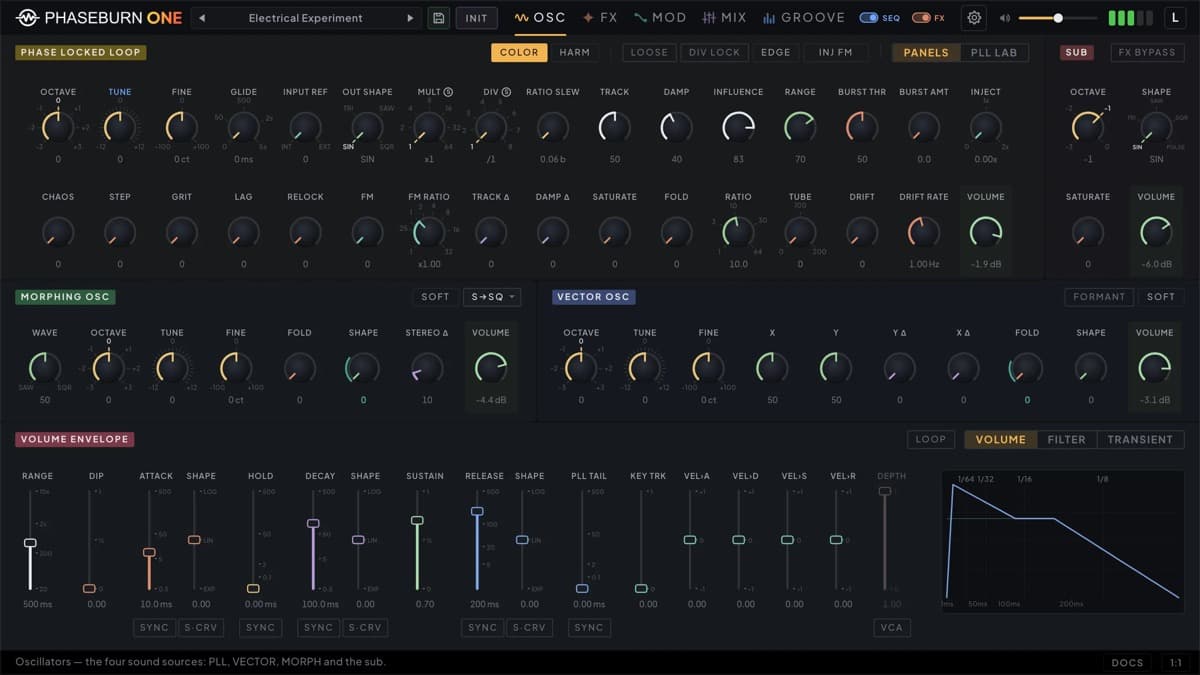
A new developer called Phaseburn has released Phaseburn One, a software synth built around an oscillator you will not find in other plugins: a phase-locked loop borrowed from radio engineering and turned into a playable voice. It is in free public beta now, ahead of a full release on October 15, 2026.
At a glance: free public beta until October 15, 2026, then €149 for a one-time perpetual license. Phaseburn One runs four oscillators in one voice, adds a probability sequencer and a modular patchbay, and ships as a standalone app plus VST3, CLAP, and AU (macOS only) for macOS 10.14 and Windows 10. The whole engine is written in Rust with 64-bit floating-point DSP and true stereo generated at the oscillators.
What is Phaseburn One?
Phaseburn One is a virtual synthesizer, but it starts from an unusual idea. A phase-locked loop, or PLL, is a control circuit used in radios and clock recovery to lock one signal's phase to another. Phaseburn took that circuit and rebuilt it as an oscillator, so the thing that would normally stabilize a radio becomes the unstable, living heart of a synth voice. That is a real departure from the wavetable and virtual-analog engines most new synths ship with. The current first look is Interphase Cartograph.
Around that idea the developer built a full instrument: four oscillators, a probability sequencer instead of a fixed step sequencer, a patchbay for routing, and a stack of effects with feedback taps. It is a first release from an unknown name, and it is in beta, so treat this as a preview of a promising synth rather than a final verdict. What is already clear is that the design has a point of view.
What Phaseburn One does, feature by feature
Four oscillators, led by the phase-locked loop
The voice runs four oscillators. The star is the PLL oscillator, with TRACK, DAMP, and INFLUENCE controls that shape how tightly it locks and how far it drifts, plus a PLL LAB visualization that shows the circuit working. Alongside it sit a Vector Phase Shaping oscillator with X and Y coordinates and stereo offset, a MORPH oscillator with twelve waveform families that span classic shapes, detuned unison, hard sync, additive builds, vowel synthesis, and spectral wavetables, and a dedicated SUB oscillator that runs from three octaves down with continuous shaping. Between them you can build a voice that is stable and fat or unpredictable and alive.
A probability sequencer, not a step sequencer
Instead of a grid of fixed notes, Phaseburn One uses a probability sequencer. Three grids share one bar at once, covering straight, triplet, and dotted timing, and across them sit 152 slots that each carry a probability value rather than a locked note. You draw from note pools across 17 scales, set the chance that each note fires, and the sequencer previews the bar as you build it. The result is a part that stays in key but never repeats exactly, which is a productive way to write evolving arps and generative lines.
A patchbay with feedback
Routing runs through a patchbay whose nodes include the oscillators, the filters, and every effect. Multiple cables into one input simply mix, each with its own gain, and there are dedicated feedback taps on the delay, chorus, and reverb so you can build loops that would be hard to patch in a fixed-signal-path synth. This is where Phaseburn One sits closer to a semi-modular instrument than a preset machine.
Effects that shape rather than sweeten
The effects are chosen for sound design, not polish. The delay puts a frequency shifter in its feedback loop, so every repeat slides in pitch by a fixed number of hertz, drifting a simple echo into metallic, inharmonic territory. The Freezer is a granular freeze that catches a moment and holds it. Around those sit a filter with ladder and state-variable models, a four-mode chorus, a feedback-delay-network reverb, distortion, a bitcrusher, and a master stage. With the feedback taps in the patchbay, these become part of the instrument's voice, not a coat of polish at the end.
Deep modulation
Modulation is generous. There are four LFOs and four modulation sequencers, plus aftertouch, velocity, and envelopes with per-stage curve shaping. The developer counts 145 destinations you can move, and with true stereo generated independently at the oscillators, modulation can open up the stereo field instead of simply widening it afterward.
Phaseburn One specifications
| Spec | Detail |
|---|---|
| Type | Software synthesizer (semi-modular) |
| Oscillators | PLL, Vector Phase Shaping, MORPH (12 waveform families), SUB |
| Sequencer | Probability sequencer, 3 timing grids, 152 slots, 17 scales |
| Routing | Patchbay with mixing inputs and feedback taps |
| Effects | Delay (frequency shifter in loop), Freezer, filter, chorus, reverb, distortion, bitcrusher |
| Modulation | 4 LFOs, 4 mod sequencers, envelopes with per-stage curves, aftertouch, velocity (145 destinations) |
| Engine | 64-bit float DSP, true stereo, written in Rust |
| Presets | 29 factory (beta) |
| Formats | Standalone, VST3, CLAP, AU (macOS only) |
| System | macOS 10.14+ (Apple Silicon and Intel); Windows 10 21H2+/11 (x86-64) |
| Price | Free public beta until Oct 15, 2026; then €149 |
Phaseburn One vs Kilohearts Phase Plant
The closest well-known reference point is Kilohearts Phase Plant, another synth that lets you build a signal path rather than accept a fixed one. They come at the idea from different directions.
| Phaseburn One | Kilohearts Phase Plant | |
|---|---|---|
| Developer | Phaseburn | Kilohearts |
| Core idea | Fixed four-oscillator voice, patchbay for routing | Fully modular generator, modulator, and effect graph |
| Signature oscillator | Phase-locked loop | Analog, wavetable, sample, noise generators |
| Sequencing | Built-in probability sequencer | None built in |
| Effects | Built-in, with feedback taps | Snapin ecosystem, expandable |
| Formats | VST3, CLAP, AU, standalone | VST3, AU, AAX |
| Price | €149 (free beta now) | ~$189 |
Which to pick. Choose Phase Plant if you want a mature, deeply modular synth with a large snapin ecosystem and years of development behind it. Choose Phaseburn One if the phase-locked-loop oscillator, the probability sequencer, and the feedback-tap patchbay sound like tools you would actually use, and if you want them in one fixed-price instrument. Phase Plant is the safe, proven pick. Phaseburn One is the fresh, opinionated newcomer, and while it is in beta it costs nothing to try.
Who Phaseburn One is for
Consider it if you are a sound designer or an electronic producer who likes synths that fight back a little. The PLL oscillator and the frequency-shifting delay push toward inharmonic, evolving, slightly unstable textures, and the probability sequencer is built for generative parts that stay musical. If you already love semi-modular workflows and patch feedback for a living, this will feel like home.
Hold off if you need a finished, road-tested plugin today. It is a beta from a first-time developer, the factory library is still small at 29 presets, and the AU build is macOS only. For reliable, familiar sounds under a deadline, an established synth like Pigments or Vital is the safer choice until Phaseburn One reaches its October release.
How much does Phaseburn One cost?
Right now it is free. Phaseburn One is in open public beta until October 15, 2026, with no card required to download it. After release it will be €149 for a one-time perpetual license, with VAT included for EU buyers. The developer is also running a beta incentive: ten of the most active testers receive a free full license, and testers whose submitted presets make it into the factory banks earn a discount. If you are curious about the engine, the beta is the moment to try it.
FAQ
Is Phaseburn One free?
During the beta, yes. It is a free public beta until October 15, 2026, with no payment or card needed. After that it becomes a paid plugin at €149 for a perpetual license, though the most active beta testers can earn a free or discounted license.
What is a phase-locked loop oscillator?
A phase-locked loop is a circuit from radio engineering that locks one signal's phase to a reference. Phaseburn One rebuilds that circuit as an oscillator, using TRACK, DAMP, and INFLUENCE controls to set how tightly it locks and how much it drifts. The payoff is a voice that can sound stable or unstable and alive in a way conventional oscillators do not.
What formats and systems does Phaseburn One support?
It runs as a standalone app and as VST3, CLAP, and AU, with AU on macOS only. It supports macOS 10.14 or later on Apple Silicon and Intel, and Windows 10 21H2 or later and Windows 11 on x86-64. The engine is written in Rust with 64-bit floating-point processing.
Phaseburn One vs Phase Plant: which should I get?
They overlap in spirit but differ in depth. Phase Plant is a mature, fully modular synth with a large snapin ecosystem. Phaseburn One is a newer, fixed-architecture synth with a distinctive PLL oscillator, a probability sequencer, and a feedback patchbay at €149. Try the free beta to hear whether its character suits you.
The bottom line
Phaseburn One is one of the more original synth ideas of the year. Turning a radio-engineering circuit into an oscillator could have been a gimmick, but the developer has wrapped it in a real instrument, with a probability sequencer, a feedback patchbay, and effects built for sound design rather than gloss. It is a beta from an unknown name, so the sensible move is to download it while it is free, push the PLL oscillator until it misbehaves, and decide before the October release whether it has earned a place in your rack. On this first showing, it is well worth the look.