Hanon B76: A Tonewheel Organ With a Studio-Measured Leslie
LostIn70s Hanon B76 is a physically modeled tonewheel organ with two Leslie models, two amps, and a full effects rack. Specs, price, and how it compares.
Dubspot's best Black Friday dealsDubspot Tracker Pro: $15, was $24.99 ↗Drum Programming and Groove Production Course: $19, was $99 ↗
LostIn70s released Hanon B76 in mid-November 2026. It is a physically modeled tonewheel organ, built as the bigger sibling to the developer's long-running free organ, the B70. Where the B70 earned a following as a low-CPU freebie, the B76 adds a second Leslie model, two amps, and a full effects rack, and asks a small price for the upgrade.
At a glance: Hanon B76 is a tonewheel organ for macOS and Windows, in VST3, AU (Mac only), AAX, and standalone. It models the classic drawbar-organ-and-Leslie sound with physical modeling rather than samples, adds a studio-measured L76 rotary cabinet alongside a vintage L70, and ships with 36 factory presets. It currently sells for 16.99 euros, down 39 percent from 27.99 euros, and a free demo lets you try it first.
What is Hanon B76?
Hanon B76 is a software recreation of the electromechanical tonewheel organ, the instrument most people picture when they think of a Hammond B3 running into a spinning Leslie speaker. That sound carries jazz, gospel, blues, soul, and classic rock, and it has a texture that is hard to fake: the gentle grind of the preamp, the click as keys engage, and the swirl of a rotor speeding up and slowing down.
LostIn70s builds the B76 with physical modeling. Instead of playing back recordings of a real organ, the plugin simulates the tonewheels, the drawbar registration, and the rotary cabinet in real time. That approach keeps the download small and the CPU load low, and it means every note responds to the controls rather than triggering a fixed sample. The developer positions the B76 as the "bigger brother" of the free B70, with more control over expression and a more authentic vintage voice.
It lands in a category that producers search often, because a good organ is useful across many genres. For the wider instrument picture, our roundup of the best synth VST plugins maps where character instruments like this one fit, and the UVI Twin 88 Keys first look covers the sampled-keys side of the same workflow.
What Hanon B76 does, section by section
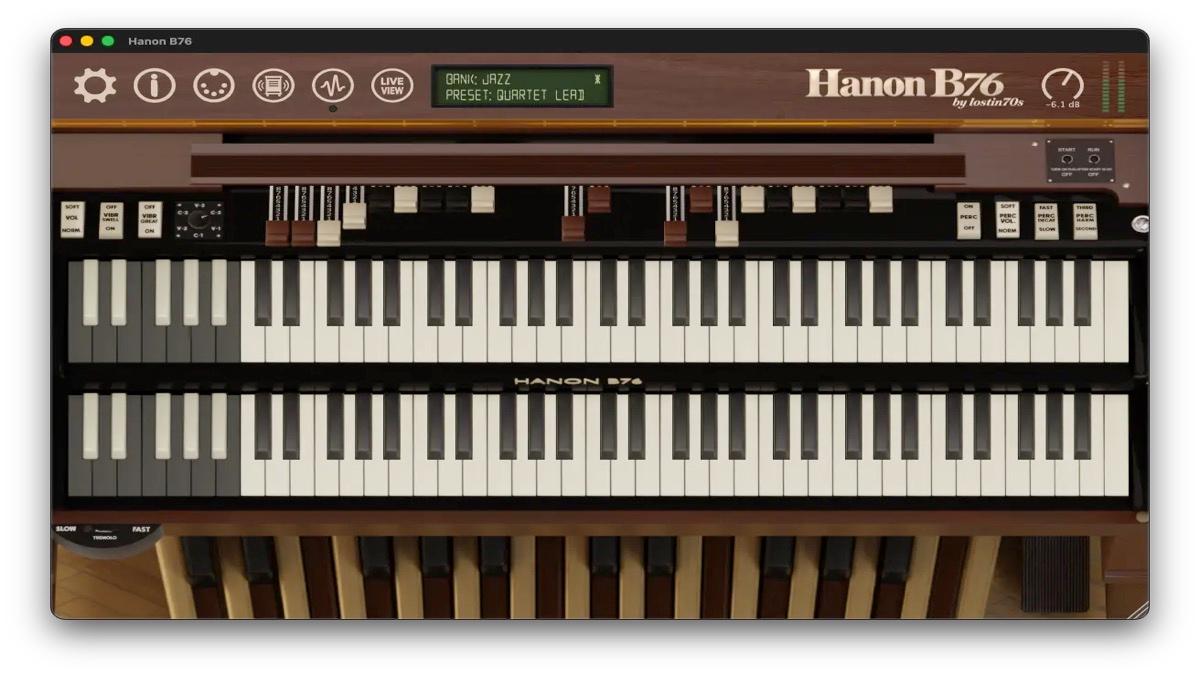
The organ engine is the core. You shape the tone with drawbar registration and can choose between three tonewheel sets, labeled pure, real, and harm, which move the voice from a clean model toward a dirtier, more harmonically rich one. Adjustable key click and leakage let you dial in the mechanical noise that gives a real tonewheel organ its grit, from almost silent to vintage and noisy. A dedicated bass section handles the low pedal tones, so you can cover the left hand the way an organ trio would.
Vibrato and chorus come next, and they matter more than the names suggest. The B76 offers six settings, three vibrato and three chorus, labeled V1 to V3 and C1 to C3, and they are synced to the tonewheel speed the way the original scanner was. That link is what keeps the effect musical rather than mechanical, and it is a detail cheaper organ plugins often miss.
The rotary cabinet is where the B76 earns its headline feature. It ships with two Leslie models. The new L76 is based on measurements LostIn70s made in its own studio, and an older L70 model is kept for a different tonal character. You get adjustable preamp drive for the dirt, independent slow and fast speeds for the horn and bass rotors, adjustable rotor acceleration so the ramp between speeds feels right, a bass and horn balance, and stereo width. Being able to set horn and bass rotor speeds separately is the kind of control that separates a convincing rotary from a generic one.
Two keyboard amp models sit in the chain as well, named Lord Major and American Classic, so you can push the organ through a valve-style voice before it hits the speaker. Around all of that is a surprisingly deep effects rack: a flanger, a phaser, a ring modulator, and a delay, plus an auto-wah, room and spring reverbs, and a three-band EQ. That is enough to finish a part inside the plugin without reaching for extra processing.
Hanon B76 specifications
| Spec | Hanon B76 |
|---|---|
| Type | Physically modeled tonewheel organ |
| Tonewheel sets | Three models: pure, real, harm |
| Mechanical detail | Adjustable key click and leakage, dedicated bass section |
| Vibrato and chorus | Six settings (V1 to V3, C1 to C3), synced to tonewheel speed |
| Rotary | Two Leslie models, L76 (studio-measured) and L70; separate horn and bass rotor speeds, acceleration, drive, width |
| Amps | Two models: Lord Major and American Classic |
| Effects | Flanger, phaser, ring modulator, delay, auto-wah, room and spring reverb, 3-band EQ |
| MIDI | Separate Upper, Lower, and Bass channels (Omni), keyboard split with split-point learn, transpose, MIDI Learn, reversible drawbar direction, MIDImix support |
| Presets | 36 factory (Jazz, Rock, Blues and Gospel), plus user presets |
| Formats | Standalone, VST3, AAX (Mac and Windows), AU (Mac only) |
| Platforms | macOS (through macOS 15 Sequoia), Windows 10 64-bit with ASIO |
| License | Unlimited offline licenses, two devices at once |
| Version | 1.0.5 |
| Price | 16.99 euros, down 39 percent from 27.99 euros |
Hanon B76 vs IK Multimedia Hammond B-3X
The reference point for software organs is IK Multimedia Hammond B-3X, the officially licensed flagship. The two plugins chase the same sound from opposite ends of the price scale.
| Hanon B76 | IK Multimedia Hammond B-3X | |
|---|---|---|
| Approach | Physical modeling, compact | Officially licensed, detailed modeling |
| Rotary | Two Leslie models, separate rotor speeds | Multiple miked Leslie cabinets |
| Amps | Two amp models | Tube preamp and cabinet modeling |
| Effects | Flanger, phaser, ring mod, delay, wah, reverb, EQ | Full pedalboard and effects rack |
| Presets | 36 | Hundreds |
| Formats | Standalone, VST3, AU, AAX | VST, AU, AAX, standalone |
| Price | 16.99 euros | Premium tier, see IK Multimedia |
Hammond B-3X is the deeper instrument. It carries the official Hammond branding, a larger cabinet collection, a pedalboard of guitar-style effects, and a huge preset library, and it is the safer pick for a player who wants one organ to cover every session. Hanon B76 goes the other way. It keeps the signal path tight, gives you two Leslie models and genuinely separate rotor controls, and costs a fraction of the flagship. If you want a believable tonewheel organ for the occasional part, or a cheap way to add swirl and grit to a track, the B76 covers it without the outlay. If an organ is central to your music, the extra depth of B-3X may still be worth the money.
Who Hanon B76 is for
This plugin suits producers and keyboard players who want a real tonewheel-organ voice without buying a flagship. Anyone writing soul, gospel, blues, funk, or classic rock will get a usable organ part out of it quickly, and the effects rack means you can commit a sound inside the plugin. The low CPU load also makes it a good choice for live rigs and older machines, which is where the free B70 built its reputation.
It is a weaker fit if you need the deepest possible organ, with dozens of miked cabinets, a full pedalboard, and a vast preset library. That remains the territory of the licensed flagships. AAX covers Pro Tools users, but anyone on a legacy VST2 host should note that the B76 ships as VST3, not VST2.
How much does Hanon B76 cost?
Hanon B76 currently sells for 16.99 euros, a 39 percent cut from its regular 27.99 euros. A license includes unlimited offline activations and allows use on two devices at the same time, which is generous for the price. A free demo is available from the official page, so you can hear the engine, the two Leslie models, and the effects in your own projects before paying.
You can confirm current pricing and download the demo on the official Hanon B76 page.
Check price at LostIn70sFAQ
Is Hanon B76 better than the free B70?
LostIn70s positions the B76 as the bigger version of the B70. It adds the new studio-measured L76 Leslie model, an improved rotary preamp, two amp models, and a larger effects rack, with more control over expression. The B70 remains a capable free organ, but the B76 is the fuller instrument.
What formats and systems does Hanon B76 support?
It runs on macOS, through macOS 15 Sequoia, and on Windows 10 64-bit with an ASIO soundcard. Formats are standalone, VST3, and AAX on both platforms, plus Audio Units on macOS. There is no legacy VST2 build.
Does Hanon B76 have a Leslie simulation?
Yes. It includes two rotary cabinet models, a new L76 based on the developer's own studio measurements and an older L70 for a different character, with separate slow and fast speeds for the horn and bass rotors, adjustable acceleration, drive, balance, and stereo width.
Is there a free trial of Hanon B76?
Yes. A free demo is available from the official product page, so you can test the full organ, both Leslie models, and the effects before buying.
The verdict
This is a first look based on LostIn70s' official materials, not a hands-on review. On paper, Hanon B76 is a smart upgrade path from a well-liked free organ. It keeps the compact, low-CPU character of the B70, then adds the pieces that make an organ plugin feel finished: a studio-measured Leslie alongside a vintage one, two amp models, synced vibrato and chorus, and an effects rack deep enough to carry a part on its own. At 16.99 euros, with a free demo to audition first, it is an easy instrument to try. Go in expecting a focused, characterful tonewheel organ rather than a licensed flagship, and it looks like a lot of organ for the money.