Some links on this page are affiliate links. If you buy through them, Dubspot may earn a commission at no extra cost to you. It never affects our scores or what we recommend — read our policy.
Melatonin Sine Machine: 10,000 Oscillators, No Knobs
Melatonin's Sine Machine is a friendly additive synth with 10,000 oscillators, a zero-knob UI, and MPE. Full specs, price, and how it compares to Harmor.
T
Theo Nakamura
July 13, 2026 · 7 min read
See full specs, price, and alternatives in the plugin database →
Melatonin's Sine Machine is an additive synthesizer with one clear mission: make additive synthesis fun. Indie developer Sudara took it out of early access in July 2026, after roughly six years of work. The result stacks more than 10,000 sine oscillators behind an interface with, quite literally, zero knobs.
What is Melatonin Sine Machine?
Additive synthesis builds sound by summing many sine waves, one per harmonic. It can produce astonishingly natural, evolving tones, because that is how real acoustic sound behaves. The catch has always been control. Editing hundreds of harmonics by hand is tedious, and most additive synths bury you in tiny parameters. Imaginando COLAPSO takes a different route, building its partials from the measured emission spectra of chemical elements.
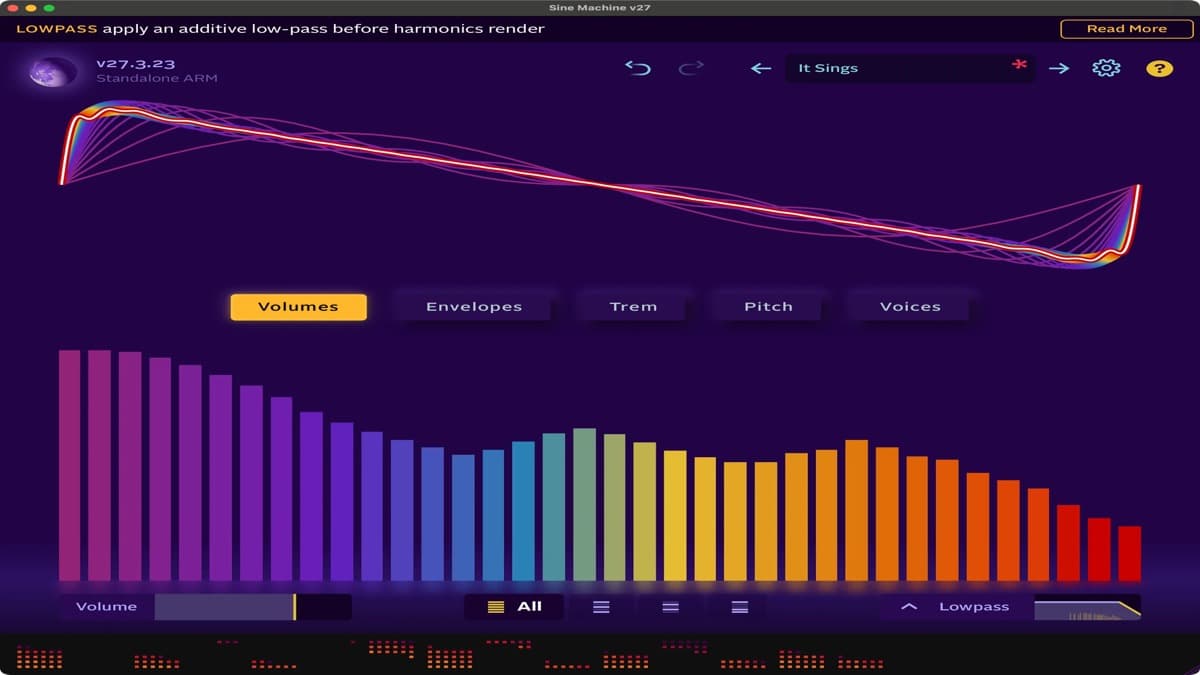
Sine Machine tackles that problem directly. Instead of knobs, it offers visual, gesture-based editing across banks of harmonics. You paint volumes, drag envelopes, and shape motion while an animated display shows what each partial is doing. An abstract, mathematical technique becomes something you can see and feel.
The synth runs on macOS, Windows, and Linux, either as a standalone app or a plugin. Under the hood sits a serious engine: 20 voices, each carrying 511 time-domain oscillators, for more than 10,000 oscillators in total, plus over 20,000 LFOs driving per-harmonic movement.
What Sine Machine does differently
Sine Machine is not another subtractive synth with an oscillator, a filter, and an envelope. Almost every feature exists to make additive tone-shaping fast and musical.
Bulk per-harmonic editing
The core idea is editing many harmonics at once. You bulk-edit per-harmonic ADSR, volume, and pitch LFO across the whole partial series, rather than dialing in each one. That is what makes the workflow practical. Sweeping a tone's brightness, or adding slow independent drift to every harmonic, becomes a single gesture instead of hundreds.
Additive reverb and additive filters
Two effects are built the additive way. The reverb is rendered from 1,000 sine waves rather than a conventional algorithm, so it blends into the harmonic content instead of sitting on top of it. The filters are additive too, with brickwall and Gaussian band-pass shapes that carve the partial series directly. Because they work inside the harmonic engine, they sound different from a normal resonant filter sweep.
Motion, noise, and mapping
Per-harmonic Gaussian pitch noise adds subtle, organic instability, the kind of imperfection that makes acoustic instruments feel alive. You can also map partials to arbitrary frequencies instead of the strict harmonic series, which opens the door to inharmonic, bell-like, and metallic timbres. Absolute pitch glide lets harmonics emerge and slide independently for evolving, cinematic textures.
Expression and tuning
Sine Machine supports MPE, so controllers like the ROLI Seaboard or a LinnStrument can drive per-note expression across the harmonic field. It also includes MTS-ESP microtuning, which matters if you work outside standard 12-tone equal temperament. These features usually sit on high-end instruments only. Here they ship as standard.
Presets you can actually read
The synth loads with more than 140 factory presets, each stored as hackable plaintext JSON. Want to learn how a sound was built, or tweak it outside the plugin? Open the file and read it. Visualizers throughout the interface reinforce the same goal: understanding, not guesswork.
Sine Machine specifications
| Spec | Detail |
|---|---|
| Type | Additive (time-domain) software synthesizer |
| Engine | 20 voices x 511 oscillators (10,000+ total), 20,000+ LFOs |
| Editing | Bulk per-harmonic ADSR, volume, and pitch LFO; zero-knob interface |
| Effects | Additive reverb (1,000 sine waves), additive brickwall and Gaussian band-pass filters |
| Expression | MPE, per-harmonic Gaussian pitch noise, absolute pitch glide |
| Tuning | MTS-ESP microtuning, mappable partials to arbitrary frequencies |
| Presets | 140+ factory presets, hackable plaintext JSON |
| Formats (macOS) | VST3, AU, CLAP, standalone (Apple Silicon and Intel) |
| Formats (Windows) | VST3, CLAP, standalone (Windows 10+) |
| Formats (Linux) | VST3, CLAP, standalone (64-bit) |
| AAX | Not supported (Pro Tools via a plugin wrapper) |
| Licensing | Pay-what-you-want; up to 3 installs per licence; online activation |
| Trial | 14-day fully featured demo |
Sine Machine vs Image-Line Harmor
The obvious point of comparison is Image-Line's Harmor, the best-known additive and resynthesis instrument on the market. Both build sound from partials, but they aim at different users.
| Melatonin Sine Machine | Image-Line Harmor | |
|---|---|---|
| Core approach | Friendly, visual additive synthesis | Additive and image resynthesis |
| Oscillators | 20 voices x 511 (10,000+) | Two additive/subtractive units |
| Standout trick | Zero-knob per-harmonic editing | Resynthesis of audio and images |
| Platforms | macOS, Windows, Linux | macOS, Windows |
| Formats | VST3, AU, CLAP, standalone | VST, standalone, FL Studio native |
| Microtuning / MPE | MTS-ESP and MPE | Limited |
| Price | Pay-what-you-want (approx. $75) | Around $149 |
Harmor is the more powerful sound-mangler, especially for resynthesizing samples and turning images into audio. It is also heavier and more complex. Sine Machine is narrower and friendlier: it does pure additive synthesis, and it makes that one job genuinely enjoyable. For deep resynthesis, Harmor still leads. If additive synthesis has always intimidated you, Sine Machine is the easier way in. Producers who prefer a conventional subtractive workflow should look at Vital or the free Surge XT instead.
Who Sine Machine is for
Sine Machine suits producers chasing organic, evolving, and acoustic-adjacent tones: ambient, cinematic, film scoring, sound design, and experimental work. If you love drones, bells, breathy pads, and textures that shift over time, this is a natural fit. It is also ideal for anyone who bounced off additive synthesis before because the tools felt too fiddly.
It is a weaker pick as your only synth for hard-edged EDM. Additive engines can do aggressive tones, but a classic subtractive synth like Serum 2 or a hybrid such as Phase Plant gets you there faster. Pro Tools users also need a plugin wrapper, since there is no native AAX build.
How much does Sine Machine cost?
Sine Machine uses a pay-what-you-want model with a suggested price of $75. There are no sales, no seasonal discounts, and no third-party resellers; Melatonin sells it directly. A single licence covers up to three installs and uses online activation, with offline activation available in recent versions. A fully featured 14-day demo lets you try the whole synth first.
Download it from the official Melatonin site. To weigh it against other current instruments, browse synths at Plugin Boutique or read our roundup of the best free synth VSTs in 2026.
FAQ
What is additive synthesis, in plain terms?
Additive synthesis builds a sound by adding many sine waves together, one per harmonic. It is the opposite of subtractive synthesis, which starts with a rich waveform and filters parts away. Additive excels at organic, evolving, and acoustic-style tones.
What formats does Sine Machine support?
Sine Machine runs as a standalone app and as VST3, AU (macOS only), and CLAP plugins on macOS, Windows, and Linux. There is no AAX version, so Pro Tools users need a plugin wrapper.
How much does Sine Machine cost?
It is pay-what-you-want with a suggested price of $75. Melatonin does not run sales and sells only through its own site. A 14-day, fully featured demo is available.
Sine Machine vs Harmor, which should I pick?
Choose Harmor for deep resynthesis of audio and images and a more powerful, complex engine. Choose Sine Machine for pure additive synthesis with a friendly, visual, knob-free workflow and a lower price.
Related reading
- The best free synth VSTs in 2026
- The best free VST plugins in 2026
- Browse the plugin and gear database
- MPE Subtractive, when the part wants a filter and per-note pressure instead of additive partials