Ethno World 7 Complete Review: One of the Best Kontakt Libraries Ever Made
Ethno World 7 Complete packs 382 world instruments and voices into 53 GB. After 25 years of development, it is one of the best Kontakt libraries ever made.
See full specs, price, and alternatives in the plugin database →
Some libraries are useful. A few are foundational. Ethno World 7 Complete is the second kind.
Best Service released version 7 in May 2025. It closes out a project Marcel Barsotti started twenty-five years ago and developed more recently alongside Andreas Hofner. The Complete edition folds every previous edition into one install and adds a substantial round of new recordings. What comes out the other side is 382 instruments and voices, roughly 1,000 patches, and 53 GB of uncompressed samples recorded with more than 94 musicians and vocalists from around the world.
That is not a sample pack. That is an archive.
What Ethno World 7 Complete actually is
Ethno World is a world-music instrument collection for Kontakt. It runs in the free Kontakt Player, supports NKS, and covers instruments and voices from Asia, Africa, Europe, and both Americas.
The catalog is genuinely enormous. Bowed instruments run from erhu and dilruba to hurdy-gurdy and Moroccan ribab. Stringed instruments include sitar, oud, kora, pipa, shamisen, koto, balalaika, charango, and about thirty more. Gamelan sets come from Bali and Java. Alpine zither and alphorn sit beside uilleann pipes, shakuhachi, and didgeridoo. The voices section spans Mongolian throat singing, Gregorian chant, Balinese vocals, and Moroccan singers.
Three editions exist. Complete is the full archive at €399 list. Instruments costs €299 and drops the vocal content. Voices keeps only the vocal content at €149. Owners of Ethno World 5 or 6 Complete can upgrade for €128, and a €229 crossgrade is also available.
Why it earns "one of the best Kontakt libraries ever made"
That is a large claim. Here is the case.
Nothing else covers this much ground
Scale alone is not impressive. Plenty of libraries are large and shallow. What makes Ethno World unusual is that its breadth runs horizontally across cultures rather than vertically within one.
Most world-music libraries pick a region and go deep. Ethno World went wide and kept going for twenty-five years. A score that needs a Peruvian toyo pan flute in one cue and a Cambodian bell in the next finds both answers here. That is a workflow advantage no specialist collection can match.
The players are real
Musicians who actually play each instrument recorded every part. Deobrat Mishra played the new Indian sitar and also contributed the male vocal content. Moroccan vocals came from Aziz, Mohammed, Hassan, and Giulia. The difference shows in the phrases and licks, which carry ornamentation a Western player would not produce by instinct.
This matters more than sample count. A perfectly recorded oud played incorrectly is still wrong.
Microtuning that actually works
Each patch carries a MICROTUNING tab. That sounds like a footnote. It is not.
Most non-Western music does not sit on twelve-tone equal temperament. Arabic maqam, Indian raga, and gamelan tunings all need intervals a standard keyboard cannot produce. Ethno World ships the correct tunings per instrument. A maqam phrase lands where it should, instead of arriving as a slightly wrong Western approximation. Libraries that skip this produce sounds that are technically ethnic and musically hollow.
The INFO page
Every patch has an INFO tab explaining what the instrument is, where it comes from, and how it is played, with photographs.
That turns a folder of exotic noises into something you can use with intent. For a collection covering hundreds of instruments most producers have never touched, it is quietly one of the best educational features in any sample library.
What's new in version 7
Version 7 is not a repackage. The new content is substantial, and it targets instruments that were missing or thin in earlier editions.
Strings. A professional Indian sitar with phrases and licks across multiple scales and tempos. Turkish oud, saz, and tanbur. Afghan rubab, Chinese pipa, Japanese shamisen, West African kora, Ecuadorian Andean harps, Nagoya harp, Indian tumbi, gypsy guitar with solo licks, and a Martin western guitar with slide licks.
Bowed. Klezmer and Moroccan violins with licks, recorded alongside Moroccan ribab and clarinets. Han erhu phrases and Arabic maqam phrases.
Gongs, bells and metals. Two handpans with combinable loops, sampled steel drums, metallophones, glockenspiel, tuned Thai gongs, Cambodian bells, and two melodic tongue drums.
Winds. The Indian nagaswaram, the Peruvian toyo pan flute, tin whistle and low whistle, plus klezmer and Moroccan clarinet with licks.
Percussion and voices. Tablas, ghatam, kanjira, mridangam, and konnakol vocal percussion with loops. Moroccan Maghreb congas, darbuka, cajon, karkaba, and handclaps. Indian male vocals and Moroccan vocals.
The handpans and the sitar are the standouts. Both are instruments producers reach for constantly, and both were previously weak spots.
How it plays
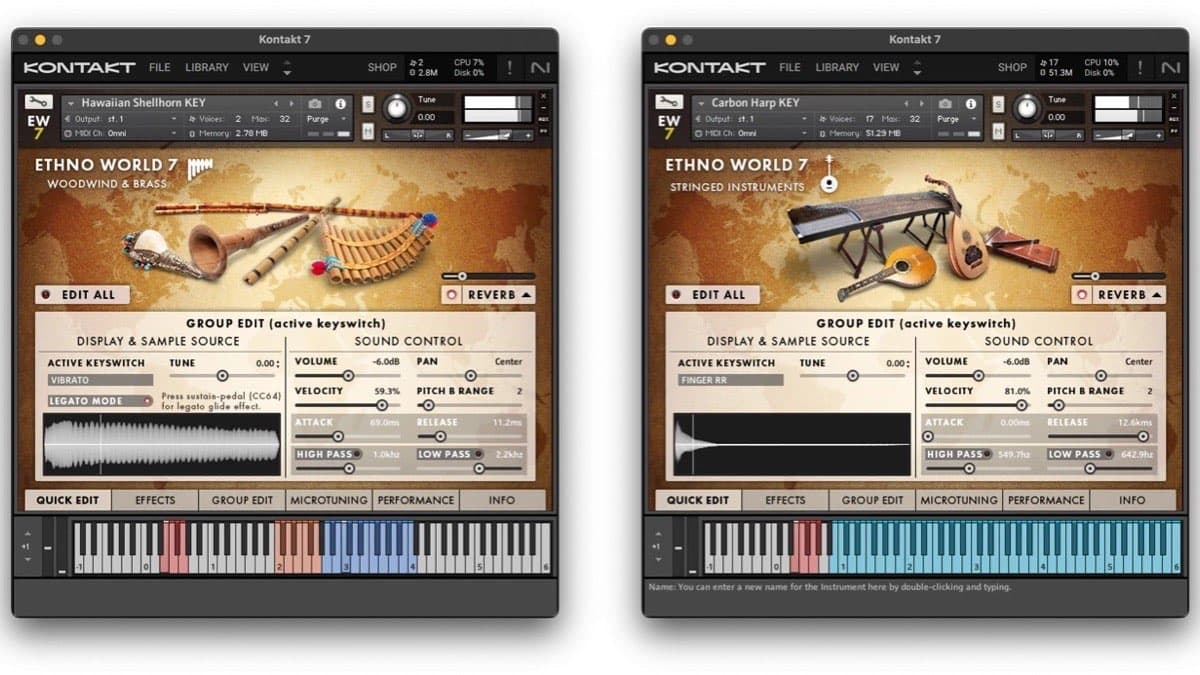
Load a patch and you get Kontakt's standard frame around a custom interface with six tabs: Quick Edit, Effects, Group Edit, Microtuning, Performance, and Info.
Quick Edit covers the basics — volume, pan, velocity, pitch bend range, attack, release, high pass, low pass. Keyswitches change articulation. Many patches include legato modes triggered by the sustain pedal. The Performance tab handles phrase and lick playback, and that is where the library earns its keep on a deadline. Drop a maqam phrase or a sitar lick into a cue and you have something idiomatic in seconds.
Resource demands stay modest for a library this size. Best Service lists 4 GB of RAM as the minimum and recommends 6 GB, on macOS 11 through 13 or Windows 10 and 11. An SSD is strongly advisable given the install footprint. If you want the platform side of this, our Kontakt 8 entry covers the host itself.
Where it falls short
A 9.2 is not a 10, and the gaps are real.
The interface looks its age. The design language comes from an earlier era of Kontakt instruments, and on a high-resolution display you will reach for Kontakt's zoom. It stays functional and responds faster than it looks. Nobody would call it modern.
Navigation assumes knowledge you may not have. Patches are organized by instrument family — bowed, stringed, woodwinds, percussion — not by region. If you know you want a Moroccan sound but not which instrument produces it, you are browsing. The 600-plus previews in the browser help. They do not fully solve it.
Legacy content is uneven. Twenty-five years of recording means the oldest material sits next to the newest, and the difference is audible. Some early patches offer fewer round robins and thinner articulation sets than the version 7 additions. Nothing here is unusable. A library assembled over this long a period is not uniform, though, and exposed solo passages will find the weaker corners.
Installation and licensing. The install requires Native Access and registration with both Best Service and Native Instruments. Activation is online only, with no offline activation on a second machine. If you upgrade from an earlier edition, version 7 installs separately, so keep the old one for legacy projects.
It is 53 GB. That is less a criticism than a fact to plan for.
Ethno World 7 vs the specialists
The honest comparison is not against another encyclopedia. It is against buying regional specialists.
Dedicated libraries built around one instrument or one region will beat Ethno World on depth almost every time. More round robins, more articulations, more control over the specific thing they model. If your project lives or dies on one exposed instrument, buy the specialist.
Ethno World wins on everything else. It wins on coverage, on cost per instrument, and on practical reality: most media work needs a convincing color for eight bars rather than a concert-grade solo performance. Many composers use it as both a working library and a map. It tells you which instrument you actually want, and then you decide whether that one instrument deserves a dedicated purchase.
Within the all-in-one category, its closest comparison is a similarly broad world collection from another developer. Ethno World's edge is the vocal content and the sheer number of playable phrases.
Which edition should you buy
Complete if world colors are a recurring part of your work. The vocal content is a genuine differentiator, and splitting it out to save money is usually a false economy.
Instruments if you never use vocal samples. It is a real saving and you lose nothing else.
Voices if you already own a deep instrument collection and only need the singers and chants.
Upgrade at €128 if you own Ethno World 5 or 6 Complete. The new content alone justifies it.
Price and availability
Ethno World 7 Complete lists at €399. Best Service currently has it at €199.50 — 50% off. Best Service has not published an end date for the Complete discount, so treat it as live-until-it-isn't and check the product page before you plan around it. The Voices edition, at €74.50, is part of the anniversary campaign running through August 10, 2026, and Instruments is €149.50.
At half price this is one of the strongest values in sample libraries. Even at full price it is defensible. At €199.50 it is close to unmissable for anyone who scores to picture.
Ethno World 7 Complete at Best Service
Check price at Best ServiceVerdict
Ethno World 7 Complete is not the deepest library for any single instrument it contains, and it never set out to be. It is the most comprehensive world-music archive available for Kontakt, built over twenty-five years with real players, correct tunings, and documentation that teaches while you work.
The interface is dated and the catalog can overwhelm. Neither changes the fundamental position. No other single purchase gives a composer this much authentic global material. It has been quietly indispensable to film and television scoring for two decades, and version 7 is the best it has ever been.
One of the best Kontakt libraries ever made. That is not hyperbole. It is what twenty-five years of sustained work buys you.
For more on the wider Native Instruments ecosystem this runs inside, see our Komplete 26 review. If you are building a sound library from scratch, our guide to the best sample pack sites in 2026 covers the subscription and one-off options.
FAQ
Do I need the full version of Kontakt? No. Ethno World 7 runs in the free Kontakt Player, minimum version 7.10.7. Full Kontakt is optional.
How much disk space does it need? 53 GB of uncompressed samples. An SSD is recommended.
Can I upgrade from Ethno World 5 or 6? Yes. The Complete upgrade is €128 for owners of Ethno World 5 or 6 Complete, and there is also a €229 crossgrade. Version 7 installs alongside the older version rather than replacing it.
What is the difference between Complete, Instruments, and Voices? Complete has everything. Instruments drops the vocal content. Voices contains only the vocal content.
Does it work offline? The library runs offline once installed, but activation requires an internet connection through Native Access. Offline activation on a separate machine is not available.