Jamstik LOON Stacks Three Synth Layers for MPE Players
Jamstik LOON is a three-layer MPE software instrument with virtual analog, samples and 4-op FM. Released July 15, 2026 at $49.99 intro. Full review.
See full specs, price, and alternatives in the plugin database →
Jamstik released LOON on July 15, 2026. It is a three-layer software instrument built on a new MPE-capable engine, and it replaces Creator, the company's previous sound app. Introductory pricing is $49.99, half the $99.99 regular price, and Jamstik MIDI guitar owners download it free.
The engine list is not the interesting part. The architecture is. LOON runs three layers in parallel, and each layer stacks several sound sources in groups. One patch can send a virtual analog saw, a multi-sampled electric piano and a 4-operator FM voice down three separate signal paths at once. That is a lot of structure for the money.
What is LOON?
LOON is a standalone app and plugin instrument from Jamstik, a company best known for its MIDI guitars. Creator, its predecessor, was effectively a sound engine bundled with the hardware. LOON is a rebuild: a full instrument that Jamstik now sells on its own merits, to keyboardists, composers, producers and sound designers rather than guitar owners alone.
That repositioning shapes how you should judge it. LOON is not competing with the free synth in your DAW. It sits against paid multi-engine instruments, and most buyers will measure it against Arturia Pigments or u-he Zebra 3. LOON costs far less than either and does correspondingly less. Its expression handling, though, matches software several times the price.
Jamstik is explicit that LOON works with any MIDI controller: keyboards, pad controllers, wind controllers, electronic drums and MIDI guitars. Anyone who has tried to drive a general-purpose synth from a wind controller or an MPE surface knows why that scope matters.
What's inside LOON?
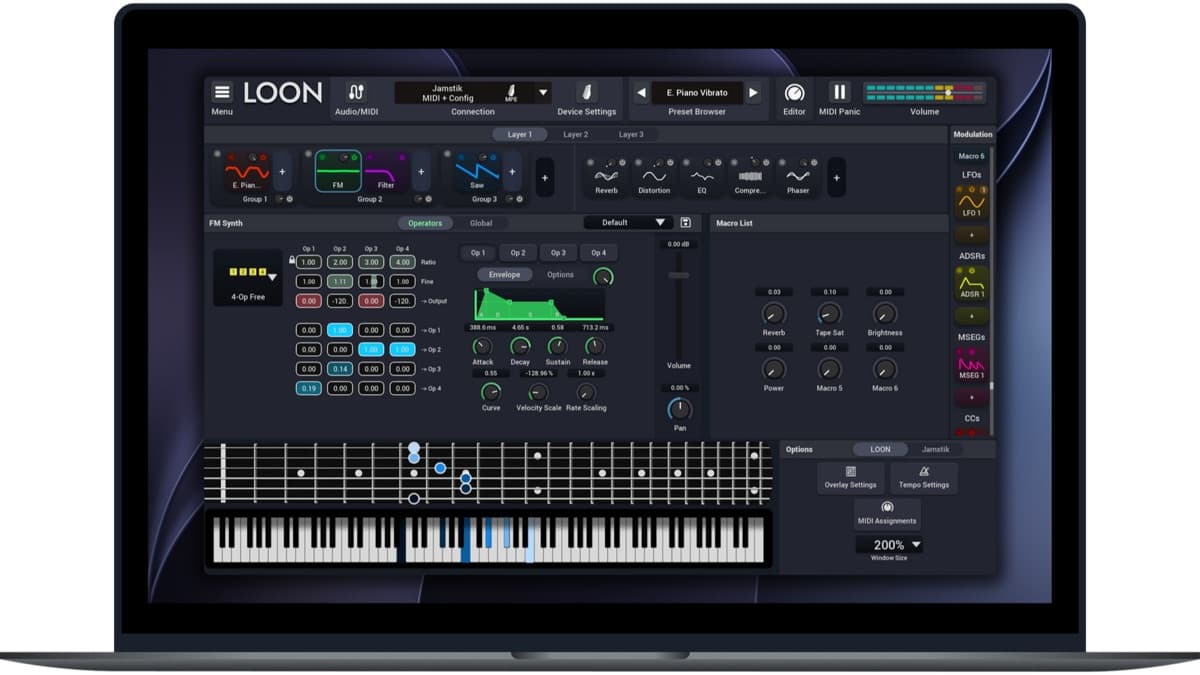
Three layers, in parallel. Layer 1, Layer 2 and Layer 3 tabs sit at the top of the window. Each layer carries its own instrument panel and its own effects panel, and all three run at once rather than in series. You build a stack, not a chain.
Instrument groups inside each layer. Inside a layer you add groups, and each group holds a sound source. Jamstik's own screenshots show a felt piano, an FM voice and a filter in one layer, with a square-wave oscillator and a second FM voice in the next. That nesting is how LOON gets thick without a second instance.
Virtual analog oscillators. Standard subtractive raw material — saw, square and the rest — for pads, leads and bass.
Multi-sampled instruments. Sampled acoustic and electric sources sit alongside the synthesis engines in the same layer structure. Blend a real electric piano with a synth voice under one key press.
4-operator FM. A proper 4-op engine, with per-operator ratio, fine tune, output level and a routing matrix, plus its own envelope with velocity scaling and rate scaling. The interface exposes operator algorithms directly instead of hiding them behind a preset list. That is unusual at this price.
Per-layer filter and effects. Every layer gets a filter module and its own effects chain. Reverb, distortion, EQ, compression, phaser and chorus appear in Jamstik's product screenshots as insert slots you drop into a layer's chain.
Modulation. A panel on the right holds LFOs, ADSR envelopes and multi-segment envelopes, plus a MIDI CC section. Anything you build there routes to targets across the layers.
Six assignable macros. Macros map across layers and groups, which is how a three-layer patch becomes playable from one knob. They respond to DAW automation like any other parameter.
Full MPE. LOON supports MIDI Polyphonic Expression with per-note pitch bend and independent per-note voice response. This is the feature that justifies the rebuild. Bend one note in a chord and the others stay put, while pressure and slide data land on individual voices instead of the whole patch.
200-plus factory presets. The library comes from the Jamstik team and outside collaborators, and a browser steps through it. LOON also loads legacy Jamstik Creator sound packs, so existing Creator content is not stranded, and expansion packs cost extra.
Fretboard and keyboard overlays. Jamstik's guitar heritage shows at the bottom of the interface, where a fretboard and a keyboard both light up incoming notes. It genuinely helps when you translate guitar voicings to keys and back.
LOON specifications
| Spec | Detail |
|---|---|
| Type | Three-layer multitimbral software instrument |
| Sound sources | Virtual analog oscillators, multi-sampled instruments, 4-operator FM |
| Per-layer processing | Filter module plus dedicated effects chain |
| Modulation | LFOs, ADSR envelopes, multi-segment envelopes, MIDI CC |
| Macros | Six assignable, mappable across layers and groups |
| Expression | Full MPE, per-note pitch bend, independent per-note voice response |
| Presets | 200+ factory presets; loads legacy Jamstik Creator packs |
| User sampling | Not supported |
| Formats | Standalone app, VST3, AU, AAX |
| macOS (minimum) | OS X 10.13, Intel Core 2 Duo 2.1GHz+, 4GB RAM, 7.55GB storage |
| macOS (recommended) | macOS 10.15, Intel Core i5 2.5GHz+, 8GB+ RAM |
| Windows (minimum) | Windows 7, Core 2 Duo / AMD dual-core 2.1GHz+, 4GB RAM, 7.55GB storage |
| Windows (recommended) | Windows 10, Core i5 / Ryzen 5 2.5GHz+, 8GB+ RAM |
| Licensing | Valid across multiple computers; internet needed for install and updates only |
| Interface | Fully scalable, high-DPI and Retina aware |
| Release date | July 15, 2026 |
| Price | $49.99 intro, $99.99 regular; free with a Jamstik MIDI guitar |
LOON vs Arturia Pigments 7
Pigments is the obvious comparison: another multi-engine, MPE-compatible instrument that combines unrelated synthesis types in one patch. It also costs four times as much at list.
| Jamstik LOON | Arturia Pigments 7 | |
|---|---|---|
| Price | $49.99 intro, $99.99 regular | $199 list, $129 on current sale |
| Architecture | 3 parallel layers, stackable groups per layer | 2 main engines plus a utility engine |
| Engines | Virtual analog, multi-sampled, 4-op FM | Wavetable, virtual analog, granular, sample, harmonic, modal |
| MPE | Full, per-note independent response | MPE compatible |
| User samples | Not supported | Supported, including granular |
| Modulation | LFOs, ADSRs, MSEGs, MIDI CC | Deep modulation grid with combinate and function generators |
| Presets | 200+ | 1,700+ across the factory library |
| Install size | 7.55GB | Varies by content selection |
The honest read: Pigments is the deeper instrument, and it is not close. Six engines, granular, user sample import and a modulation grid bordering on modular give it a ceiling LOON never approaches. If you buy one multi-engine synth this decade, buy Pigments — check current Pigments 7 pricing at Plugin Boutique.
LOON wins on two things. Price comes first: $49.99 costs less than a sample pack, and the guitar bundle makes it free. Structure comes second, because three parallel layers with stackable groups reach a big layered patch faster than Pigments' two-engine model — nothing competes for slots. If you care more about expressive performance from an unusual controller than deep sound design, LOON gets you there for a quarter of the money.
Who LOON is for
LOON suits players first. Drive software from an MPE controller, a wind controller, electronic drums or a MIDI guitar, and the per-note handling is the reason to look. The fretboard overlay makes it unusually friendly to guitarists moving into synthesis. It also suits producers who want layered, characterful patches fast, without learning a flagship's modulation system to get them.
Jamstik guitar owners have no decision to make. LOON is a free download, a straight upgrade on Creator, and it still loads Creator sound packs.
Who should skip it? Anyone whose workflow depends on dropping their own samples into an instrument. LOON does not currently support custom sample import, and that is a hard limit rather than a rough edge. Anyone who already owns a deep multi-engine synth will find the overlap high and the content library modest by comparison. If you need a huge preset library to work from, 200 patches is a starting point, not a destination. Our round-up of the best free VST plugins in 2026 is the better first stop when budget is the binding constraint.
How much does LOON cost?
LOON launched at an introductory $49.99, marked as 50% off a $99.99 regular price. It is a perpetual licence rather than a subscription, valid across multiple computers, and free to Jamstik MIDI guitar owners.
There is no conventional time-limited demo. Jamstik ships a Lite Mode instead. Install without a licence and you get the preset browser, device configuration and access to expansions. The Edit view stays locked until you hold a valid licence or connect a Jamstik guitar. You can audition the sounds, then, but not the sound design. Expansion sound packs are sold separately, and legacy Creator packs carry over at no cost.
The install claims 7.55GB of storage on macOS and Windows alike. An internet connection is required for installation and updates, but not for day-to-day use. Jamstik states that it plans major updates at least once a year.
FAQ
Does LOON support MPE?
Yes, fully. LOON handles MIDI Polyphonic Expression with per-note pitch bend and independent per-note voice response, so expression data applies to single notes rather than the whole patch. It also works with standard MIDI keyboards, pad controllers, wind controllers and electronic drums.
Can I load my own samples into LOON?
No. LOON does not currently support custom sample import. You work with the multi-sampled instruments in the factory library, legacy Jamstik Creator sound packs and separately sold expansions. If user sampling is essential, u-he Zebra 3 or Pigments fits better.
Is LOON free for Jamstik guitar owners?
Yes. LOON is included free with a Jamstik MIDI guitar purchase, and connecting the guitar also unlocks the Edit view in an otherwise unlicensed install.
What are LOON's system requirements?
macOS 10.13 or later with an Intel Core 2 Duo 2.1GHz or better and 4GB RAM covers the minimum, or Windows 7 or later with a 2.1GHz dual-core processor and 4GB RAM. Jamstik recommends macOS 10.15 or Windows 10 with a Core i5 or Ryzen 5 and 8GB or more RAM. Either way, you need 7.55GB of free storage on the drive.
LOON vs Pigments, which should I buy?
Pigments is the deeper instrument, with six engines, user sampling and a far larger preset library, and it earns its price. Buy LOON if you want expressive per-note playing from an alternative controller, a fast route to three-layer patches, or the most capable multi-engine instrument under $50.
Verdict
LOON is a better instrument than its price suggests, and MPE is the real story. It responds per note in a way plenty of costlier synths still fumble. The three-layer, group-stacking structure builds big patches quickly, and the 4-op FM engine is more usable than most bolt-on FM sections.
The limits are just as clear. No user sampling narrows the audience, the licence-gated Edit view makes evaluation awkward, and 7.55GB is a lot of disk for 200 presets. None of that stops LOON being an easy recommendation to expressive-controller players, or an obvious free upgrade for anyone with a Jamstik guitar. For the hardware side of the same idea, our piece on the Expressive E Osmose CE is worth a read.