Some links on this page are affiliate links. If you buy through them, Dubspot may earn a commission at no extra cost to you. It never affects our scores or what we recommend (read our policy).
GForce Oberheim Matrix-12 Review: The Real Thing
GForce ships the first officially licensed Oberheim Matrix-12 and Xpander plugin. We cover the 15-mode filter, matrix modulation, formats, price, and how it compares to Arturia.
M
Marcus Feld
November 6, 2026 · 9 min read
Dubspot's best Black Friday dealsDubspot Tracker Pro: $15, was $24.99 ↗Drum Programming and Groove Production Course: $19, was $99 ↗
See full specs, price, and alternatives in the plugin database →
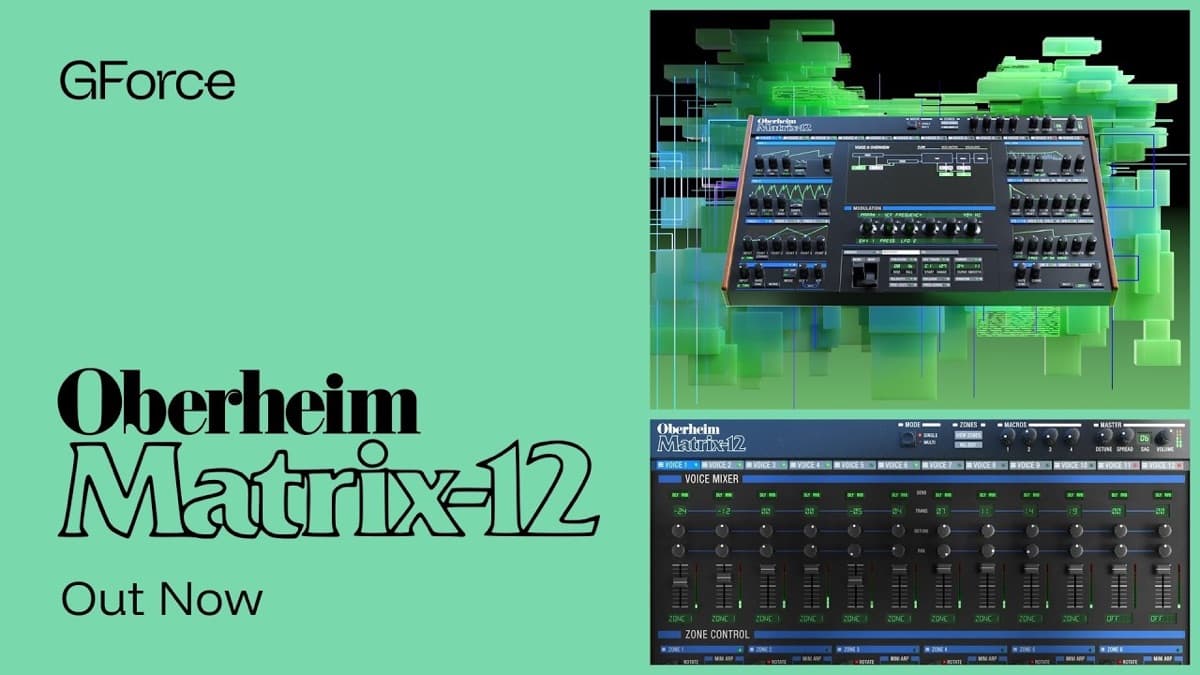
For forty years the Oberheim Matrix-12 has been the name producers reach for when the subject turns to the deepest analog modulation ever put in a keyboard. On November 5, 2026, GForce Software released the first officially licensed software version, built in direct partnership with Oberheim and with Marcus Ryle, one of the original hardware's designers. It recreates both the Matrix-12 and its rarer sibling, the Xpander. Every detail below comes from GForce's official product page.
At a glance: The GForce Oberheim Matrix-12 is a 12-voice analog-modeling synth in Standalone, VST2, VST3, AU, and AAX for macOS and Windows. It carries the real 15-mode filter, full matrix modulation, full MPE, six micro arpeggiators, and 570+ patches. Intro price is $83.99 until December 5, 2026, then $119.99, with a 14-day trial.
What is the Oberheim Matrix-12?
The Matrix-12 arrived in 1984 as Oberheim's flagship. It stacked twelve voices, each with two oscillators, a resonant filter, and an unusually deep modulation system, into one instrument that could cost around five thousand dollars. It became a studio legend for its huge, three-dimensional pads, its brass, and its ability to layer and split sounds across the keyboard.
Its defining feature was the modulation matrix that gave the synth its name. Instead of a handful of fixed routings, you could assign a wide set of sources to a wide set of destinations in software. That flexibility was extraordinary for the era, and it is still the reason the Matrix-12 sounds different from every other vintage poly. The Xpander, released a year earlier, is the six-voice module that pioneered the same voice architecture.
GForce has recreated both. That matters because the two instruments share a voice design but differ in scope, and owning the pair in one plugin is something no hardware buyer could ever do affordably.
What GForce changed beyond the hardware
The original Matrix-12 was powerful and famously awkward. Almost everything lived behind a small display and a bank of buttons, so programming it was slow. GForce kept the signal path and the modulation engine intact, then built an interface designed to make that depth usable.
- Single and Multi modes. Single mode plays all twelve voices as one instrument, with polyphony, unison, detune, and spread. Multi mode gives each voice its own timbre across six overlapping keyboard zones, which is how the hardware did splits and layers.
- Full MPE. The synth responds to per-note pitch, pressure, and slide from MPE controllers, modulation the 1984 hardware could never reach.
- Six micro arpeggiators. Each of the six zones gets its own arpeggiator, so a Multi patch can run several independent arps at once.
- Four global macros. Quick, assignable controls sit on top of the deep matrix for fast performance tweaks.
- Three modulation views. A Flow diagram, a Mod Matrix grid, and a Visualiser let you see routings instead of memorizing them, which is the single biggest workflow gain over the original.
The sound engine stays true to the source. Each voice has two oscillators with triangle, saw, and pulse waves, with noise and hard sync on the second oscillator, plus FM. The filter is the heart of it: fifteen modes covering one- to four-pole low pass, high pass, band pass, notch, phase, and combinations, feeding two VCAs in series. That filter is why a Matrix-12 pad breathes the way it does.
GForce Oberheim Matrix-12 specifications
| Spec | Detail |
|---|---|
| Developer | GForce Software (with Oberheim and Marcus Ryle) |
| Models | Oberheim Matrix-12 (1984) and Xpander |
| Voices | 12, in Single and Multi (6-zone) modes |
| Oscillators | 2 per voice (triangle, saw, pulse); osc 2 adds noise and hard sync; FM |
| Filter | 15 modes (1-4 pole LP, HP, BP, notch, phase, combinations), 2 VCAs in series |
| Modulation (per voice) | 5 envelopes, 5 LFOs, 4 ramps, 3 trackers, lag processor, vibrato |
| Mod sources | Keyboard, velocity, release velocity, pressure, pitch bend, mod wheel, full MPE, random per note |
| Mod routing | Any source to any destination (including itself), 6 bipolar slots per parameter with quantize |
| Arpeggiators | 6 micro arpeggiators (one per zone) |
| Macros | 4 global |
| Patches | 570+ (380+ new, 190+ original Matrix-12 and Xpander) |
| Formats | Standalone, VST2, VST3, AU, AAX |
| System (Mac) | Intel or Apple Silicon, macOS 10.15 or later, 8GB RAM |
| System (PC) | Intel i5 / Ryzen 5 or better, Windows 7 or later, 8GB RAM |
| Trial | 14 days; installers 34MB (Mac), 31MB (PC) |
| Price | $83.99 intro (until Dec 5, 2026), $119.99 full |
GForce Matrix-12 vs Arturia Matrix-12 V
Until now, the Arturia Matrix-12 V was the only way to get this sound in software. The difference is the licensing. Arturia models the instrument through its own DSP, while GForce built its version with Oberheim and an original designer, so it is the only officially authorized Matrix-12 and Xpander in software.
| GForce Oberheim Matrix-12 | Arturia Matrix-12 V | |
|---|---|---|
| Models | Matrix-12 and Xpander | Matrix-12 |
| Licensing | Official, with Oberheim and Marcus Ryle | Unlicensed emulation |
| Voices | 12 | 12 |
| Multitimbral | Yes, 6 zones | Yes |
| MPE | Full | Limited |
| Patches | 570+ | Large factory library |
| Price | $83.99 intro / $119.99 full | Around $149 |
If you want the Arturia-style workflow inside the V Collection ecosystem, the Arturia Matrix-12 V is still a capable plugin. If you want the officially sanctioned version with the Xpander included and full MPE, GForce is the one to beat. For a different flavor of analog authenticity, u-he Diva models mix-and-match classic circuits, and the free OB-Xd covers the earlier Oberheim OB-X sound.
Who the GForce Matrix-12 is for
This is a synth for producers who build sounds, not just load presets. The payoff of the matrix is total: any modulator can reach almost any destination, and with five envelopes and five LFOs per voice you can design movement that keeps evolving over a long note. Film and ambient composers, synthwave producers, and anyone chasing huge analog pads will find the character immediately.
It is also the obvious pick for Oberheim devotees. Getting the Matrix-12 and the Xpander in one plugin, officially licensed, with a modern editor over that notorious menu system, is a genuine event. Pair it with the equally official GForce Prophet-5 and you have two of the most storied polysynths ever made, running natively.
You can skip it if you only need a quick, simple analog poly for the occasional chord bed. The depth here is the whole point, and if you will not use the modulation, a lighter synth you already own will do. The learning curve is real, even with the new views.
How much does the GForce Matrix-12 cost?
The intro price is $83.99 (£69 or €83.99) until December 5, 2026, after which it rises to the full $119.99 (£99 or €119.99). A 14-day trial lets you test the full version before buying, which is the right move given the depth on offer.
Check price on Plugin BoutiqueIf you are weighing this against other analog instruments, our best synth VST plugins guide puts it in context, and the free Matriq-Six offers a taste of the smaller Oberheim Matrix-6R at no cost.
FAQ
Is the GForce Oberheim Matrix-12 officially licensed?
Yes. GForce built it in partnership with Oberheim and with Marcus Ryle, one of the original hardware's designers, so it is the only officially authorized Matrix-12 and Xpander in software.
Does it include the Xpander?
Yes. The plugin recreates both the Matrix-12 and its predecessor, the Xpander, which share the same voice architecture.
What formats and systems does it support?
Standalone, VST2, VST3, AU, and AAX. On Mac it needs macOS 10.15 or later on Intel or Apple Silicon. On Windows it needs Windows 7 or later with an Intel i5, Ryzen 5, or better, and 8GB of RAM either way.
How is it different from the Arturia Matrix-12 V?
Arturia's version is an unlicensed emulation of the Matrix-12. GForce's is officially authorized by Oberheim, adds the Xpander, and supports full MPE. Both are 12-voice instruments.
Is there a free trial?
Yes. GForce offers a 14-day trial of the full version, with installers of 34MB on Mac and 31MB on PC.
Verdict
The GForce Oberheim Matrix-12 pulls off what collectors assumed would never happen: it puts the real Matrix-12 and Xpander in your DAW, officially, with the modulation and the 15-mode filter intact. The modern editor is the quiet hero, turning a synth that was painful to program into one you can actually explore, and full MPE pushes it past anything the 1984 hardware could do. The depth is a commitment, and the price climbs after launch, so grab the trial and the intro window if this sound speaks to you. For anyone who loves big, moving analog, this is the authentic one. See where it lands among the rest in our best synth VST plugins guide.