Currents & Nostalgia: A Polysynth Without Menus
Currents & Nostalgia is Unusable Engineering's six-voice virtual-analog synth with two slot sequencers, per-voice drift, and no modulation matrix, for €89.
Dubspot's best Black Friday dealsDubspot Tracker Pro: $15, was $24.99 ↗Drum Programming and Groove Production Course: $19, was $99 ↗
Unusable Engineering has released Currents & Nostalgia, a six-voice virtual-analog synthesizer that sequences its own sound. It shipped on 8 November 2026 as a desktop plugin for macOS and Windows. This is a first look drawn from the developer's official product page and walkthrough, not a hands-on review.
At a glance: Currents & Nostalgia is a six-voice analog-style polysynth priced at €89 including VAT (€71.20 excluding VAT). It runs as VST3 and AU on macOS and Windows, ships with 350 presets, and is sold directly by Unusable Engineering ApS. Two independent slot systems move the oscillators and filter through sequenced positions, while a Discrepancies section drifts each voice apart like real analog hardware. There is no modulation matrix and there are no hidden menus. Everything sits on one panel.
What is Currents & Nostalgia?
Currents & Nostalgia sits in the virtual-analog category, the software synths that chase the warmth and behavior of classic subtractive hardware. That field is crowded, with u-he Diva at the top for pure circuit realism. A new analog-style synth needs a clear reason to exist, and this one has two.
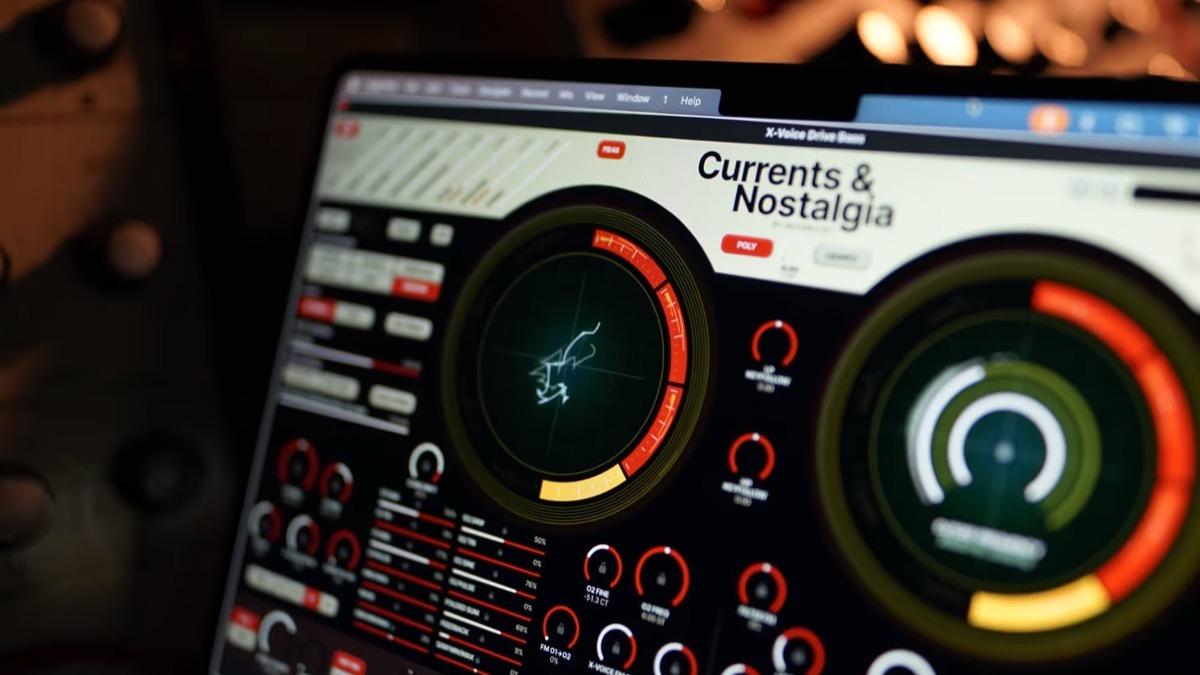
The first is the oscillator. Developer Rasmus Nyåker built a circuit-modeled saw core that he originally designed for a hardware project, and the plugin keeps that lineage. The "Currents" in the name points at the electrical currents charging the capacitors in that circuit. The second reason is the movement engine. Rather than a modulation matrix, the synth uses two slot systems that step and blend settings across a short sequence, so patches breathe and evolve on their own.
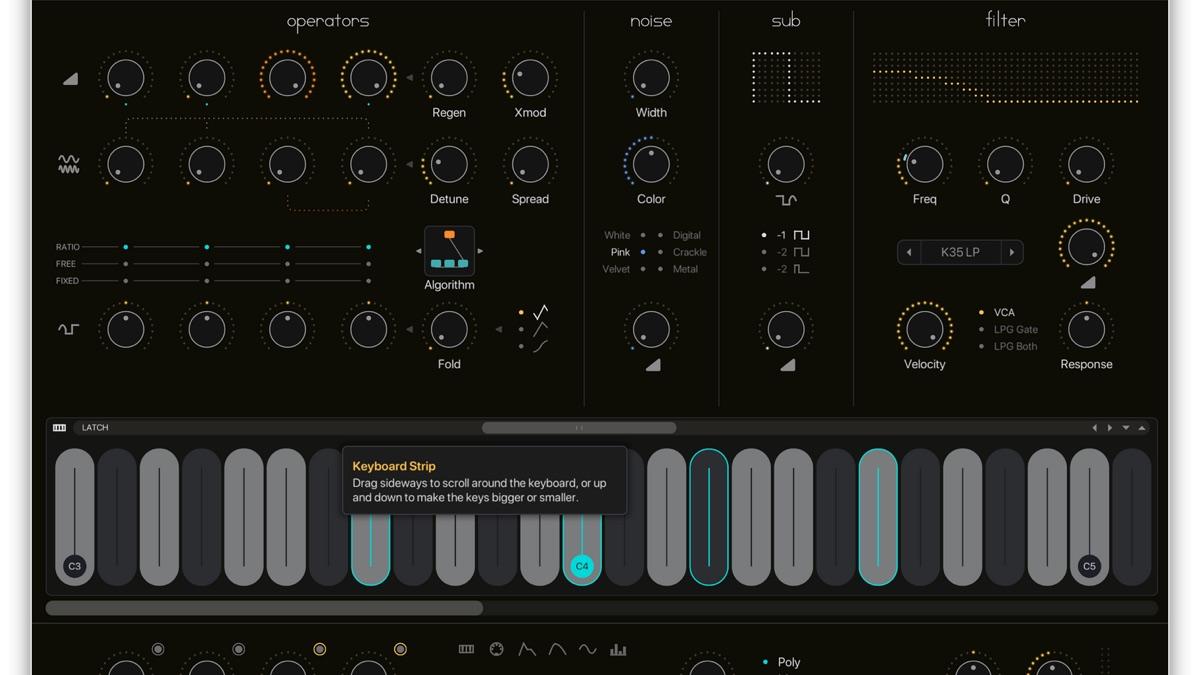
The design philosophy is deliberately plain. The developer states there are no hidden menus and no modulation matrix, so the whole instrument reads at a glance. For producers who stall in deep menu trees, that is the pitch: a synth you drive by ear, not by manual.
What Currents & Nostalgia gives you
Two circuit-modeled oscillators. O1 and O2 run saw, triangle, sine, and pulse shapes, and you can blend them per voice. The engine also offers Ring Mod, Folded Sum, Sine Min/Max, and Saw Min/Max as extra sound sources in the mixer. A Fixed mode locks oscillator pitch, which is handy for drones and tuned noise.
Two independent slot systems. This is the core idea. One slot system drives the oscillators and mixer, the other drives the filter. Each holds a short sequence of positions with its own bank, and a voice steps through the enabled slots and the blends between them. Because the oscillator and filter systems are set up the same way, you program movement once and apply the logic to both halves of the synth. The result is patches that shift tone and timbre over time without a single LFO assignment.
A Discrepancies section for per-voice drift. Real analog polysynths never sound perfectly uniform, because each voice card is slightly different. Currents & Nostalgia models that on purpose. The Discrepancies sliders set how far the six voices diverge in tune, scale, wave mix, oscillator position, filter, envelopes, and stereo placement. Each voice keeps its own stable set of variations, saved with the patch, and a Dice button rolls a fresh set. Hold a chord, raise one slider, and the stack widens from clinical to alive.
Classic filters with musical movement. The filter pairs a low-pass and a high-pass with resonance, and the filter slot system sweeps cutoff and character across its sequence. Discrepancies can offset cutoff per voice too, so a chord spreads across the spectrum rather than sitting in one band.
Two envelopes and straightforward modulation. Each patch runs an amplitude envelope and a modulation envelope, both with attack, decay, and release, and Discrepancies can vary their speed per voice. There is no sprawling mod matrix to wire. The slot systems and per-voice drift do the heavy lifting instead.
350 presets as a starting map. The synth ships with 350 factory patches that cover vintage pads, keys, basses, and the stranger textures the slot engine is built for. They double as a teaching tool, since opening one shows how the two slot systems were programmed.
Currents & Nostalgia specifications
| Spec | Detail |
|---|---|
| Type | Virtual-analog (subtractive) polysynth |
| Developer | Unusable Engineering ApS (Rasmus Nyåker) |
| Voices | 6 |
| Oscillators | 2 circuit-modeled (saw, triangle, sine, pulse), plus Ring Mod, Folded Sum, Sine and Saw Min/Max |
| Movement | Two independent slot systems (oscillators and filter), sequenced positions with blends |
| Per-voice drift | Discrepancies section (tune, scale, wave mix, position, filter, envelopes, stereo, Dice) |
| Filter | Low-pass and high-pass with resonance |
| Envelopes | 2 (amplitude and modulation), ADR |
| Modulation matrix | None by design |
| Presets | 350 factory presets |
| Formats | VST3, AU |
| Platforms | macOS and Windows |
| Price | €89 incl. VAT (€71.20 excl. VAT) |
| Purchase | Direct from unusable.net, 30-day refund |
Currents & Nostalgia vs u-he Diva
The obvious benchmark is u-he Diva, the standard for analog emulation in software. Diva models classic circuits with heavy DSP and gives you a full modulation matrix, mix-and-match oscillator and filter models, and more than 1,200 presets. It also costs roughly twice as much and asks a lot of your CPU. Currents & Nostalgia aims somewhere else: fewer menus, a lower price, and a built-in way to make patches move.
| Currents & Nostalgia | u-he Diva | |
|---|---|---|
| Type | Circuit-modeled VA with slot sequencing | Circuit-modeled analog synth |
| Voices | 6 | Up to 16 |
| Price | €89 | Around €179 |
| Modulation | Two slot systems, per-voice drift | Full modulation matrix, LFOs, envelopes |
| Presets | 350 | 1,200+ |
| Learning curve | Shallow, one panel | Deeper, menu-driven |
| Reach for it when | You want movement and simplicity | You want the truest vintage tone and depth |
Which to pick. If you want the most authentic analog character and the deepest routing, check the price on Diva and spend up. If you want an analog-style synth that animates itself and stays readable, Currents & Nostalgia makes a strong case for less money. For a free route into subtractive and wavetable sound, Vital still covers a lot of ground. If you want a single vintage recreation instead, Repro-5 models a specific five-voice classic.
Who Currents & Nostalgia is for
Buy it if you like analog character but dislike deep menus, and you want patches that move without hand-wiring modulation. The slot systems and Discrepancies section are built for exactly that: evolving pads, drifting keys, and wide stacks that sit in a mix.
It is also a good pick if you are building an Unusable Engineering collection. The company's catalog includes the Partials & Discrepancies additive synth and several effects, and the slot-sequencing concept carries across them.
Skip it if you need circuit-level authenticity above all else, a full modulation matrix, or 16-voice polyphony. There, Diva or a specialist recreation remains the better spend. Skip it too if you only work in Pro Tools, since there is no AAX build listed.
How much does Currents & Nostalgia cost?
Currents & Nostalgia is €89 including 25 percent Danish VAT, or €71.20 excluding VAT, with the final total set by your billing address at checkout. It is a one-time purchase sold directly through unusable.net, and it comes with a 30-day, no-questions-asked refund. It is not part of the developer's Full Suite v2 bundle, so it is bought separately. To see where it sits among no-cost options, our guide to the best free synth VSTs of 2026 covers the free route, and the best synth VST plugins of 2026 rounds up the paid field.
FAQ
Does Currents & Nostalgia have a modulation matrix?
No, and that is by design. Instead of a matrix, it uses two independent slot systems that sequence the oscillators and filter through a short run of positions, plus a Discrepancies section that drifts each voice. The developer's stated goal is a synth with no hidden menus.
What formats and systems does Currents & Nostalgia support?
It runs as VST3 and AU on macOS and Windows. There is no standalone or AAX build listed on the official page, so Pro Tools users and anyone wanting standalone operation should check before buying.
Is Currents & Nostalgia worth it over u-he Diva?
They solve different problems. Diva offers deeper routing, more voices, and arguably the most convincing analog tone in software, for roughly twice the price. Currents & Nostalgia trades that depth for sequenced movement, per-voice drift, and a single uncluttered panel at €89.
How many voices and presets does it have?
It is six-voice polyphonic and ships with 350 factory presets that span vintage pads, keys, basses, and the evolving textures the slot engine is built for.
Verdict
Currents & Nostalgia is a refreshing take on a familiar idea. Most analog-style plugins compete on circuit accuracy and then bury that sound under menus. This one keeps the panel flat and spends its cleverness on motion instead, with two slot sequencers and a drift engine that turns six voices into something that sounds hand-built rather than cloned. It will not replace Diva for producers chasing the last five percent of vintage realism, and the lack of a standalone or AAX build narrows its reach. But as an affordable, animated polysynth you can learn in an afternoon, it earns a demo. Based on the official specs and walkthrough, it looks like one of the more characterful analog-style synths to arrive this season.