Schmidt Vi: The €18,900 Eightvoice Synth as a €179 Plugin
Schmidt Vi recreates the Schmidt Eightvoice analog polysynth in software with UJAM: four oscillators, five filters, 16 LFOs, MPE and a randomizer for €179.
Dubspot's best Black Friday dealsDubspot Tracker Pro: $15, was $24.99 ↗Drum Programming and Groove Production Course: $19, was $99 ↗
Black Friday 2026UJAM Black Friday 2026: dates and deals →
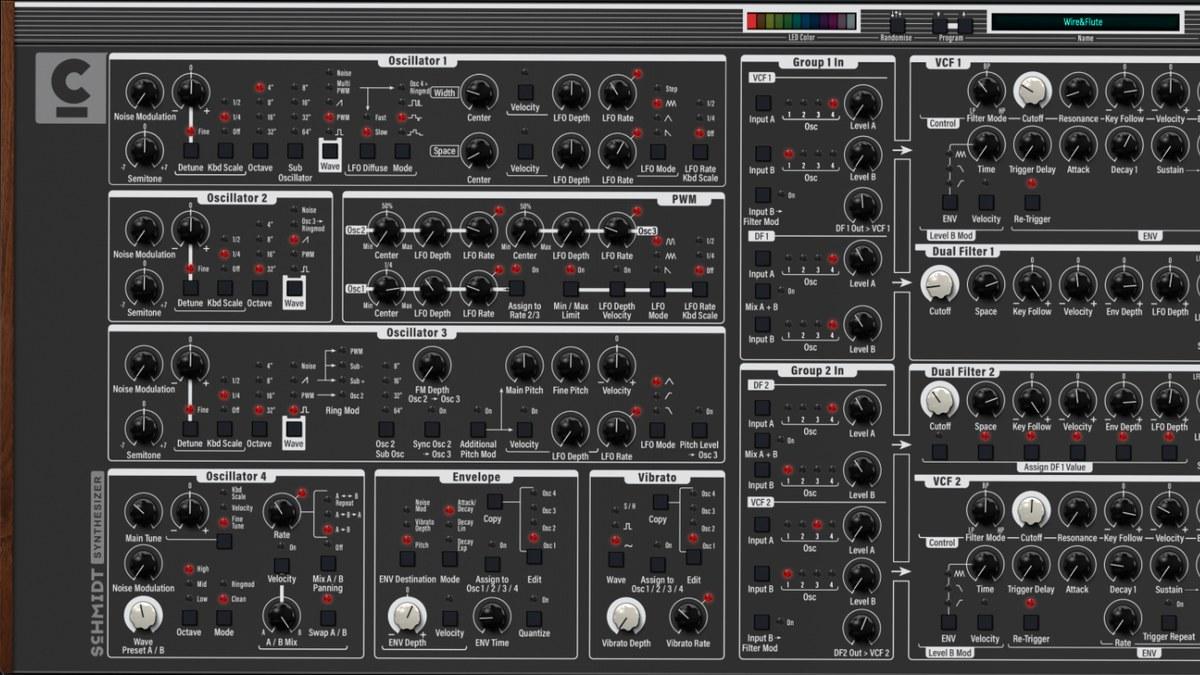
The Schmidt synthesizer is one of the rarest and most expensive analog polysynths ever made, and now it runs in a DAW. Schmidt Vi is the official software recreation of the Schmidt Eightvoice, built with UJAM and on sale now from Schmidt for €179. The hardware, hand-built in Germany since its 2012 debut, costs €18,900, and its production is winding down. The plug-in keeps the whole architecture: four oscillators, five filters across two parallel signal paths, 16 LFOs and nine envelopes, with no modulation matrix in sight.
At a glance: software recreation of the Schmidt Eightvoice analog polysynth; four oscillators (two with sub-oscillators, Oscillator 4 built from five chained ring modulators); two four-pole VCFs, two Dual Filters and a final 12 dB low-pass; 16 LFOs, nine envelopes; eight voices with poly, mono and unison modes; MPE, multi-destination pitch bend and aftertouch, a randomizer; iLok. €179, taxes included. The most complex analog voice of its era, finally within reach.
What is the Schmidt synthesizer?
Stefan Schmidt's synth appeared at Musikmesse Frankfurt in 2012 and at NAMM in 2013, and the reaction was strong enough for an initial run of 25 units. Its appeal was scale: a polyphonic analog instrument with an enormous front panel, built the old way with through-hole components so it can be repaired for decades. About 95% of its sound-generation functions sit on knobs and buttons rather than in menus.
That build method is also why the hardware is ending. Schmidt says the way it makes the instrument is no longer viable as component and manufacturing costs rise, so production of the Eightvoice hardware is winding down. The plug-in is the company's answer, developed with UJAM through a long friendship between the two firms' leadership. The analog signal path was analysed in detail and rebuilt with a new modelling process, and an early prototype was shown at Superbooth in May 2026.
Inside the Schmidt Vi sound engine
Four very different oscillators
Oscillators 1 and 2 each have a square-wave sub-oscillator with its own octave setting. Oscillator 2 can frequency-modulate and ring-modulate Oscillator 3 and hard-sync to it, so a single voice can move from a clean saw to a metallic, clangorous tone without leaving the oscillator section. Oscillator 4 is the famous one: a chain of five ring modulators fed by six pulse waves of different widths, producing two groups of 32 wave presets. A/B controls crossfade between two presets, under velocity or a dedicated LFO, and its output also ring-modulates Oscillator 1.
Two parallel signal paths and five filters
The voice splits into two groups that can generate two different timbres at once. Each group has a router (Group In), a four-pole 24 dB VCF that morphs between response types, and a Dual Filter, a pair of filters combined for different responses. The Dual Filter output can feed back into the VCF. A fifth filter, VCF 3, is a traditional 12 dB low-pass that Schmidt calls the afterburner. Schmidt likens the VCFs to Moog designs and the Dual Filters to Oberheim's, which explains the range: thick and round on one side, vocal and nasal on the other.
16 LFOs and nine envelopes, no matrix
Modulation sits where you need it. Each oscillator and filter has dedicated LFOs and envelopes, with PWM, FM and ring modulation spread across the panel and an LFO dedicated to sweeping sounds around the stereo field. Some modulation controls combine, others are exclusive. It looks intimidating, but every routing is a visible knob, which makes patches easier to read than a matrix list.
Output, voices and performance
Group Out mixes the filters into stereo, a level and panning section can crossfade or pan the two groups, and a master VCA envelope shapes the final output. Eight voices run in poly, mono or unison mode, with eight voices stacked and detuned on a single key in unison, and a Voice Spread control spreads voices across the stereo field. Glide covers portamento for pitch and filter cutoff.
What the plug-in adds to the hardware
- Two display modes: a full view of the whole panel for large monitors, or a three-panel view that switches between the left, centre and right sections, with a resizable window for laptops.
- Knob positions that show the real value, which the hardware's endless controls cannot.
- A randomizer that generates new patches, a fast way to explore an engine this deep.
- Pitch wheel and aftertouch to multiple destinations, and MPE support for expressive controllers.
- Hardware control: Eightvoice owners can play and edit the plug-in from the instrument's own panel.
The hardware's multimode (multitimbral) setup is omitted, because you can simply load several instances.
Schmidt Vi specifications
| Spec | Detail |
|---|---|
| Type | Software recreation of the Schmidt Eightvoice analog polysynth |
| Developer | Schmidt Synthesizer with UJAM |
| Oscillators | 4: Osc 1 and 2 with sub-oscillators; Osc 2 to Osc 3 FM, ring mod and sync; Osc 4 five-stage ring-mod complex wave with 2 x 32 wave presets |
| Filters | 2 four-pole 24 dB morphing VCFs, 2 Dual Filters, 1 12 dB low-pass (VCF 3) |
| Signal path | Two parallel groups, stereo Group Out, level and panning modulation, master VCA |
| Modulation | 16 LFOs, 9 envelopes, no modulation matrix |
| Voices | 8; poly, mono and unison |
| Control | MPE, multi-destination pitch bend and aftertouch, MIDI learn, hardware Schmidt control |
| Extras | Randomizer, full and three-panel views, resizable window |
| Licensing | iLok account required |
| Price | €179 (taxes included) |
Schmidt Vi vs Diva vs Jup-8 V vs Matrix-12
| Schmidt Vi | u-he Diva | Arturia Jup-8 V | GForce Oberheim Matrix-12 | |
|---|---|---|---|---|
| Price | €179 | $179 | $149 | $83.99 intro / $119.99 |
| Recreates | Schmidt Eightvoice | Several classic analog circuits | Roland Jupiter-8 | Oberheim Matrix-12 |
| Oscillators per voice | 4 plus 2 subs | Depends on model | 2 | 2 |
| Filters | 5 across two paths | Switchable models | 12/24 dB low-pass plus high-pass | Multimode, 15 modes |
| Character | Huge, complex, layered | Warm and authentic, CPU-heavy | Bright, classic poly | Deep, modulation-heavy poly |
| Pick it if | You want a rare, complex analog voice | You want classic analog tone in one synth | You want the Jupiter sound | You want deep Oberheim modulation |
Which to pick: Diva remains the most flexible analog-modelling synth here and Jup-8 V the cheapest route to a famous polysynth sound. Our GForce Oberheim Matrix-12 coverage explains why that one is the modulation monster. Schmidt Vi is the outlier: no other plug-in gives you two complete filter paths and a ring-mod oscillator like Oscillator 4, and nothing else recreates this instrument. For more options, see our best synth VST plugins guide.
Who Schmidt Vi is for
Buy it if you love big analog polysynths and want something rarer than another Jupiter or Prophet; if you design pads, evolving textures and huge layered leads; or if you have wanted a Schmidt and never had €18,900 to spend.
Skip it if you want a quick preset player: this is a deep instrument rewarded by programming time, even with the randomizer. Producers who like UJAM's simple, preset-led instruments such as Bounce will find Schmidt Vi a very different animal.
How much does Schmidt Vi cost?
- €179, taxes included, direct from Schmidt's online shop. An iLok account is required.
- The hardware, the Schmidt Eightvoice Polyphonic Synthesizer, costs €18,900, so the plug-in is less than 1% of the hardware price.
Our Schmidt Vi plugin page tracks the price.
Price-timing note: Schmidt Vi launched at its full €179 price with no introductory offer, sold direct from Schmidt, so early buyers pay the same as everyone else. There is nothing to gain by holding out for a launch deal.
FAQ
What is Schmidt Vi?
The official software recreation of the Schmidt Eightvoice analog polysynth, made by Schmidt Synthesizer with UJAM. It reproduces the hardware's four oscillators, five filters, 16 LFOs and nine envelopes.
How much does Schmidt Vi cost?
€179 including taxes from Schmidt's online shop. It requires an iLok account.
Does Schmidt Vi support MPE?
Yes. MPE is supported, and pitch bend and aftertouch can be routed to multiple destinations.
Is Schmidt Vi multitimbral like the hardware?
No. The hardware's multimode is omitted because you can run several instances of the plug-in instead.
Schmidt Vi vs u-he Diva?
Diva ($179) models several classic analog circuits in one flexible synth. Schmidt Vi (€179) recreates one specific, very complex instrument with two complete filter paths and a ring-modulation oscillator. Diva is the all-rounder; Schmidt Vi is the specialist.
Verdict
Schmidt Vi puts one of the great analog polysynths within reach. The architecture is the story: four oscillators led by the extraordinary ring-mod Oscillator 4, two parallel filter paths with five filters, and modulation laid out knob by knob. The plug-in adds sensible modern extras in MPE, a randomizer and true knob values, and drops only the multitimbral mode instances make redundant. It asks for programming time, but for sound designers and polysynth lovers, €179 for a Schmidt is an easy call.