discoDSP OB-Xd 4: An Oberheim OB-X8 in Your DAW
discoDSP OB-Xd 4 rebuilds the Oberheim emulation around the OB-X8 hardware, adding new filters, MPE, MTS-ESP microtuning, and a hardware librarian.
Dubspot's best Black Friday dealsDubspot Tracker Pro: $15, was $24.99 ↗Drum Programming and Groove Production Course: $19, was $99 ↗
discoDSP released OB-Xd 4 in mid-November 2026, and it's the biggest leap this long-running Oberheim emulation has taken. The plugin now models the Oberheim OB-X8, with its engine matched to measurements of a real unit. discoDSP rewrote the DSP and the interface too, so version 4 is a new instrument, not a point update.
At a glance: OB-Xd 4 is a polyphonic virtual analog synth modeled on the Oberheim OB-X8. It runs as VST3, AU, AAX, LV2, and standalone, on Windows, macOS, and Linux. Earlier OB-Xd versions were free, but version 4 is a paid release: $99 as an intro price through December 31, 2026, then $199. Owners of OB-Xd 2 or 3 plus TED-8 upgrade for $29, and other discoDSP synth owners for $49, for a limited time. A free, limited demo is available.
What is discoDSP OB-Xd 4?
OB-Xd has been a staple free synth for years. It started as a faithful emulation of the Oberheim OB-X, and it earned its reputation by nailing the big, detuned polysynth sound that defined early 1980s records. discoDSP has maintained and expanded it across versions 2 and 3, which remained free to download.
Version 4 changes the target and the business model. The engine is now built around the Oberheim OB-X8, the modern hardware that folds the OB-X, OB-Xa, and OB-8 into one instrument. OB-Xd 4 matches that hardware's behavior, adopts its panel layout, and even talks to it. For producers who love Oberheim character but can't justify a hardware synth, it's the most direct software route to that sound yet. If you came up on the free OB-Xd, this is the paid, grown-up version of the same idea. If you want to explore other Oberheim takes, Dubspot has covered the GForce Oberheim Matrix-12 and the free Full Bucket Matriq-Six.
What's new in OB-Xd 4?
Modeled on the Oberheim OB-X8
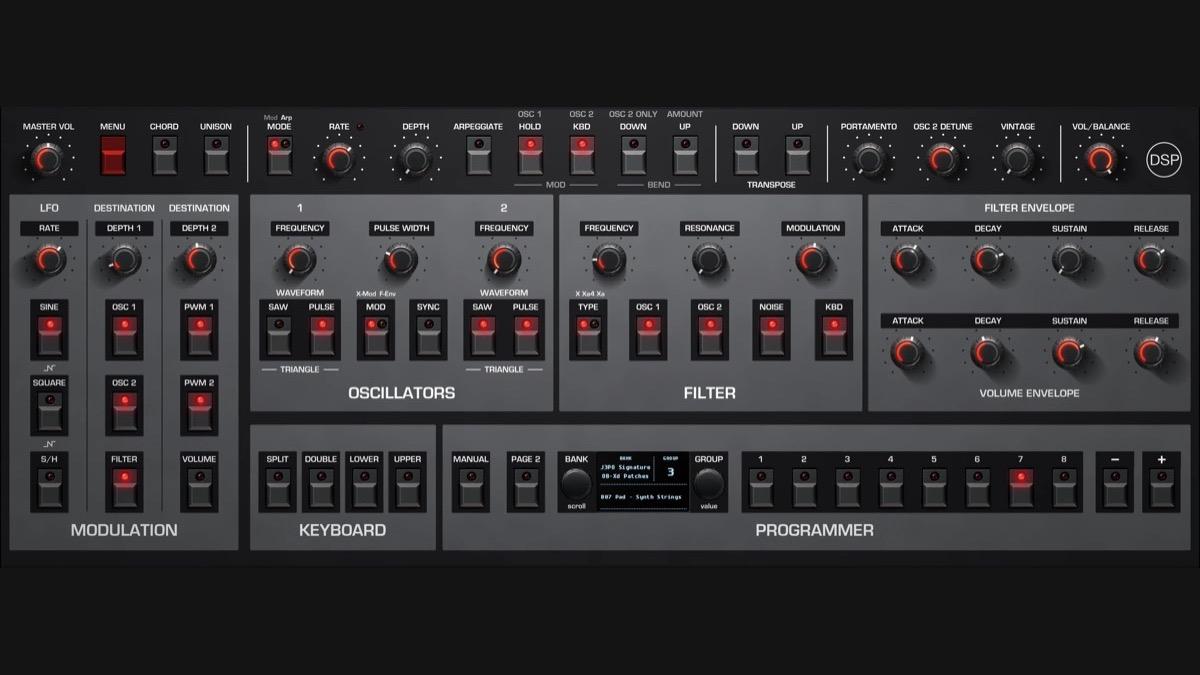
This is the headline. discoDSP matched the OB-Xd 4 engine to measurements of a real OB-X8, so the oscillators, filters, envelopes, LFO, and portamento follow the hardware's firmware behavior. The goal is software that behaves like the hardware it models, right down to how it responds under your fingers. The panel layout now mirrors the OB-X8 too, which makes patches and tutorials transfer more cleanly between the plugin and the instrument.
Two oscillators with sync and cross modulation
Each voice runs two oscillators offering saw, pulse, and triangle waves, with hard sync and cross modulation on tap. Sync gives you those tearing, aggressive leads, while cross modulation pushes the tone into metallic and clangorous territory. These are the building blocks of the classic Oberheim sound, and that's where most of the character lives.
A deeper, two-page filter section
OB-Xd 4 puts the filters across two pages. Page one holds three OB-X8 filter types. Page two adds SEM-style high-pass, band-pass, and notch options plus a Modified OB-Xa 4-pole. That spread lets you move from the smooth, vocal low-pass of the OB-X to the sharper, more surgical SEM responses without leaving the instrument. For sound design, having the OB-Xa 4-pole alongside the SEM modes is a real range extender.
Arpeggiator, chord memory, and layering
The synth includes an arpeggiator and chord memory for quick movement and instant stacks. On top of that, Split, Double, and Binaural layering let you divide the keyboard, stack two programs, or spread voices across the stereo field the way the OB-X8 does. Those modes turn a single instance into a performance-ready rig.
MPE and MTS-ESP microtuning
OB-Xd 4 supports MPE, so expressive controllers can drive per-note pitch, pressure, and slide. It also supports MTS-ESP microtuning, which means it can follow alternative tuning systems in real time alongside other MTS-ESP plugins. MIDI Learn rounds out the control options for mapping hardware knobs to the panel.
An OB-X8 librarian built in
Hardware owners will care about this one. With an OB-X8 connected over USB, OB-Xd 4 can act as its editor and librarian. You get a screen-sized view of the hardware's parameters and a way to organize its programs from the DAW. With that, the plugin becomes a working companion to the OB-X8, handy for anyone building and sorting patches on the instrument itself.
A full rewrite, with a legacy path
discoDSP rebuilt both the DSP and the GUI on the structure of the OB-Xd 3 codebase. The new OB-X8 program parameters and the second parameter page come out of that work. Your existing OB-Xd 3 programs still play, running on a dedicated Legacy engine inside version 4, so you don't lose old patches when you move up.
OB-Xd 4 specifications
| Spec | Detail |
|---|---|
| Type | Polyphonic virtual analog synthesizer |
| Models | Oberheim OB-X8 |
| Oscillators | Two per voice (saw, pulse, triangle), hard sync, cross modulation |
| Filters | Three OB-X8 types, plus SEM HP/BP/notch and Modified OB-Xa 4-pole |
| Performance | Arpeggiator, chord memory, Split, Double, Binaural layering |
| Expression | MPE, MTS-ESP microtuning, MIDI Learn |
| Hardware link | OB-X8 editor and librarian over USB |
| Formats | VST3, AU, AAX, LV2, Standalone (Universal Binary 2) |
| Systems | Windows 10+, macOS Monterey 12.0+, Debian 10+ |
| Price | $99 intro through Dec 31, 2026, then $199 |
OB-Xd 4 vs OB-Xd 3
Plenty of producers still run the free OB-Xd 3. So does version 4 justify paying for it?
| OB-Xd 3 | OB-Xd 4 | |
|---|---|---|
| Price | Free | $99 intro, then $199 |
| Modeled hardware | Oberheim OB-X | Oberheim OB-X8 |
| Engine | Original | Fully rewritten (OB-Xd 3 patches run on a Legacy engine) |
| Filters | Multimode | Three OB-X8 types plus SEM and Modified OB-Xa 4-pole on two pages |
| Hardware librarian | No | Yes, for the OB-X8 over USB |
| Formats | VST3, AU, AAX, plus iOS | VST3, AU, AAX, LV2, standalone (no VST2) |
OB-Xd 3 is still a capable free synth, and it isn't going anywhere. Version 4 is the upgrade for people who want the OB-X8 model specifically, the deeper two-page filter section, or the hardware librarian. If you just need a dependable free Oberheim sound, the older version covers it. Want the modern instrument's voice and tools? Version 4 is the step up.
Who OB-Xd 4 is for
OB-Xd 4 suits producers and sound designers who want authentic Oberheim polysynth character: lush pads, brassy stabs, detuned leads, and the kind of wide stereo movement that sits under a lot of synthwave, pop, and film scoring. It's an especially easy call for anyone who owns an OB-X8, since the librarian makes the plugin a working part of the hardware setup.
It's less essential if you already run a strong analog-modeled synth and only occasionally need Oberheim tones. In that case a tool like u-he Diva may already cover the ground. Budget-minded producers who want the sound for nothing should look at the best free synth VSTs, including the earlier OB-Xd, before paying for version 4. discoDSP's own TED-8 is also worth a look if you want a different vintage flavor from the same developer.
How much does OB-Xd 4 cost?
OB-Xd 4 is a paid release. The intro price is $99 through December 31, 2026, and it rises to $199 on January 1, 2027. discoDSP offers discounted upgrades for a limited time: $29 for owners of OB-Xd 2 or 3 plus TED-8, and $49 for owners of other discoDSP synths. A free demo is available for non-commercial use, though it disables oversampling, caps the engine quality, blocks AAX and LV2 bounces, and adds noise bursts to bounces made with the new engine. You can buy or download it from the official discoDSP OB-Xd page.
FAQ
Is OB-Xd 4 free?
No. Earlier OB-Xd versions were free, and OB-Xd 3 still is, but OB-Xd 4 is a paid release. It costs $99 as an intro price through December 31, 2026, then $199. A limited free demo is available for non-commercial use.
What hardware does OB-Xd 4 emulate?
OB-Xd 4 is modeled on the Oberheim OB-X8, with its engine matched to measurements of a real unit. Earlier OB-Xd versions emulated the original Oberheim OB-X.
Can OB-Xd 4 control an OB-X8?
Yes. With an OB-X8 connected over USB, OB-Xd 4 can act as an editor and librarian for the hardware, giving you a larger view of its parameters and a way to manage its programs from your DAW.
What formats and systems does OB-Xd 4 support?
It runs as VST3, AU, AAX, LV2, and standalone, built as a Universal Binary 2. Supported systems are Windows 10 and later, macOS Monterey 12.0 and later, and Debian 10 and later. Version 4 doesn't include a VST2 build.
First look verdict
We based this first look on discoDSP's official materials, not hands-on studio time. On paper, OB-Xd 4 is a meaningful step up from the free synth that made the name. Modeling the OB-X8, rewriting the engine, adding a two-page filter section, and building in a hardware librarian all point to a more serious instrument than the free versions that came before. The move to a $99 intro price (then $199) will divide fans of the free releases, and that's fair, but the OB-X8 model and the extra filters are real reasons to pay. For Oberheim lovers, and especially OB-X8 owners, this looks like the most complete OB-Xd yet.