Some links on this page are affiliate links. If you buy through them, Dubspot may earn a commission at no extra cost to you. It never affects our scores or what we recommend — read our policy.
discoDSP TED-8: The Oberheim TEO-5 as a $99 Plugin
discoDSP TED-8 models the Oberheim TEO-5 in software, with 8 voices, up to 48-voice Poly Unison, an SEM-style filter and USB sync. Specs, pricing and how it compares.
M
Marcus Feld
October 26, 2026 · 7 min read
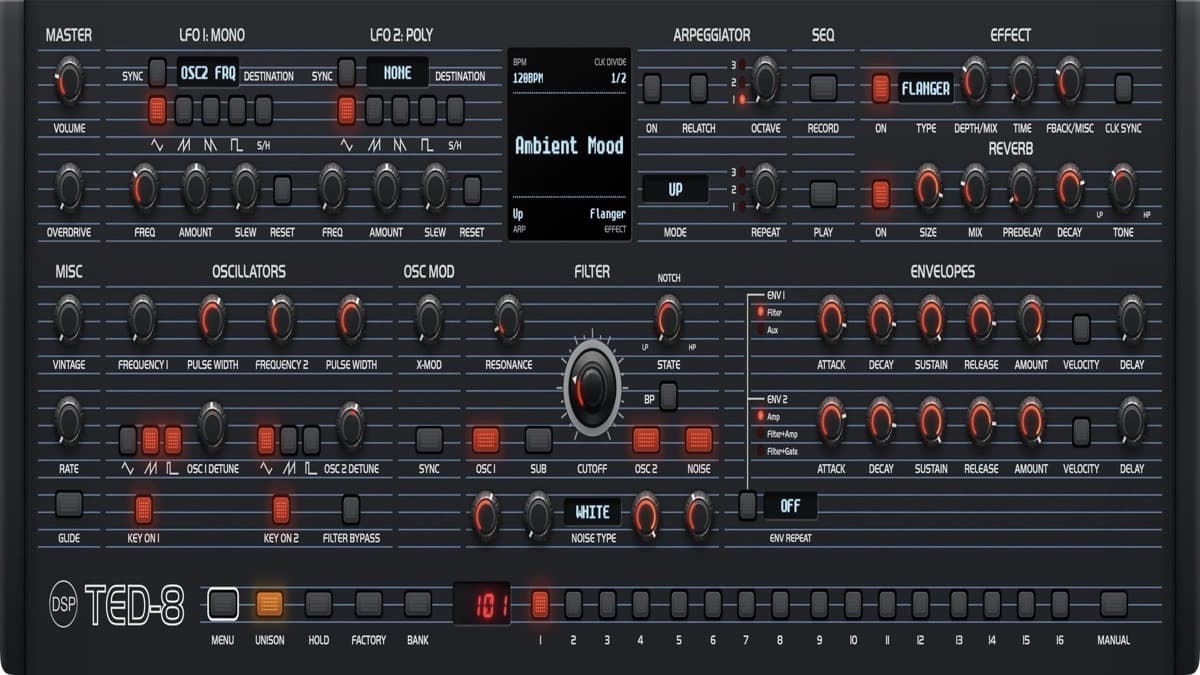
discoDSP has released TED-8, a software synth that models the Oberheim TEO-5. Instead of sampling the hardware, discoDSP rebuilds its signal path and then adds the things a plugin can do that a desktop module cannot: more voices, deep Poly Unison and total recall. It launched at an introductory $99, rising to $199, with a $49 price for existing discoDSP customers.
At a glance: 8 voices, Poly Unison up to 48, two oscillators plus sub and noise per voice, an SEM-style 2-pole state-variable filter, a 16-slot modulation matrix, a 64-step sequencer, an arpeggiator, 12 effect types plus reverb, and a USB link to a real TEO-5. Standalone, VST, VST3, AU and AAX as a Universal Binary 2, on Windows, macOS and Debian Linux. $99 intro, then $199.
What is discoDSP TED-8?
The Oberheim TEO-5 is a compact five-voice analog synth that carries the SEM filter sound Oberheim is known for. It has a loyal following, but like any hardware polysynth it costs around a thousand dollars and up, takes desk space, and saves nothing you cannot recall from a patch sheet. Behringer's upcoming Polyeight Polysix recreation shows the other route, a vintage design rebuilt as lower-cost hardware.
TED-8 is discoDSP's answer to that. It is a virtual analog instrument that models the TEO-5's architecture in software, which means the character travels into any session, loads with the project, and never needs a free input on your interface. discoDSP already makes Oberheim-flavoured tools, including the free OB-Xd, so the brief here is specific: capture the TEO-5 in particular, then push past its limits.
What TED-8 adds over the hardware
The number in the name is the first clue. The TEO-5 has five voices. TED-8 has eight, and its Poly Unison mode stacks up to six of them on each of eight notes, for as many as 48 voices on a single chord. That is a different instrument for pads and wide stabs, where the hardware runs out of notes quickly.
Two oscillators, sub and noise per voice. Each voice carries two oscillators with triangle, saw and pulse waves, a sub oscillator an octave down, and a noise source. That is the raw material the TEO-5 players know, with enough on hand for fat unisons and hollow pulse-width tones.
An SEM-style filter. The filter is a 2-pole state-variable design modelled on the Oberheim SEM. It morphs continuously from low-pass through notch to high-pass, with a separate band-pass option. This is the part most people mean when they talk about the Oberheim sound, and it is the heart of the model.
A 16-slot modulation matrix. Sixteen routings let you send envelopes, LFOs and performance controls to the parameters that matter, so patches move rather than sit still.
Sequencing and arpeggios. A step sequencer runs up to 64 steps, with chords of up to five notes, rests and ties. The arpeggiator covers up, down, up and down, random and as-played orders across up to three octaves, with note repeat and relatch.
Effects on board. TED-8 carries a dozen effect types, including stereo, BBD and tape delays, chorus, flanger, phaser, distortion, ring modulation, a rotating speaker and lo-fi, plus a reverb with size, predelay, decay and tone. Patches arrive finished rather than dry.
TED-8 specifications
| Spec | TED-8 |
|---|---|
| Models | Oberheim TEO-5 analog synthesizer |
| Voices | 8; Poly Unison stacks up to 6 per note on 8 notes (up to 48) |
| Oscillators | 2 per voice (triangle, saw, pulse) plus sub oscillator and noise |
| Filter | 2-pole state-variable, SEM-modelled: low-pass to notch to high-pass, plus band-pass |
| Modulation | 16-slot matrix |
| Sequencer | Up to 64 steps, chords up to 5 notes, rests and ties |
| Arpeggiator | Up, down, up+down, random, as-played; up to 3 octaves; note repeat, relatch |
| Effects | 12 types plus reverb |
| Hardware link | USB sync with a physical TEO-5 |
| Formats | Standalone, VST, VST3, AU, AAX (Universal Binary 2); iOS in testing |
| Systems | Windows 10+, macOS 12 Monterey+, Debian 10+ (AVX2, 8 GB RAM) |
| Price | $99 intro (then $199); $49 for existing discoDSP owners |
TED-8 vs the real Oberheim TEO-5
The comparison that matters is with the hardware TED-8 models. The two do different jobs.
| TED-8 (plugin) | Oberheim TEO-5 (hardware) | |
|---|---|---|
| Price | $99 intro, then $199 | Around $1,499 |
| Voices | 8 (up to 48 Poly Unison) | 5 |
| Filter | SEM-modelled state-variable | SEM analog |
| Recall | Total, saves with the project | Patch memory, no DAW recall |
| Portability | Any session, any machine | One desk, one audio input |
| Hands-on control | On screen or via MIDI | Knob-per-function panel |
| Signal path | Modelled | Real analog |
If you want knobs under your hands and genuine analog voltage, the hardware is the point. If you want the TEO-5's voice in a dozen projects at once, with more polyphony and instant recall for a fraction of the cost, TED-8 is the sensible pick. Owners of the hardware get a third option: the USB link lets the plugin act as an editor and patch librarian for the real thing.
Among software rivals, discoDSP's own OB-Xd covers the older OB-X sound for free, Cherry Audio Memorymode 2 models the Memorymoog, and Diva offers mix-and-match analog circuits. TED-8 is the one aimed squarely at the TEO-5.
Who TED-8 is for
Reach for it if you like the Oberheim SEM sound and want it in the box, if you need more voices than a five-voice synth allows, or if you own a TEO-5 and want recall and an editor. It also suits producers who prefer a focused instrument over a do-everything synth, and the Linux build is a rare bonus in this category.
Skip it if you already own several analog-modelling synths that cover the same ground, or if the whole reason you want a TEO-5 is the physical panel and the real circuits. A plugin cannot give you either.
How much does TED-8 cost?
TED-8 launched at a $99 introductory price, moving to a regular $199. Existing discoDSP customers pay $49. A separate iOS version is priced lower and was in TestFlight at launch, awaiting App Store approval. Licensing needs a one-time online activation, after which the plugin runs offline. See TED-8 on discoDSP.
FAQ
Is TED-8 worth it over the hardware TEO-5?
If you work in a DAW and value recall and polyphony, yes. TED-8 gives you eight voices, up to 48-voice Poly Unison and project recall for $99 to $199, against roughly $1,499 for a five-voice module. The hardware still wins on hands-on control and real analog circuits.
What does TED-8 emulate?
The Oberheim TEO-5, a five-voice analog synth with an SEM-style filter. TED-8 keeps that character and extends the voice count and unison.
What are the system requirements?
Windows 10 or later, macOS 12 Monterey or later, or Debian 10 or later, with an AVX2 processor and 8 GB of RAM. It installs as Standalone, VST, VST3, AU and AAX.
Can TED-8 control my real TEO-5?
Yes. A USB link lets the plugin sync with a hardware TEO-5, so you can use it as an editor and keep recall of your patches.
Verdict
TED-8 is a focused piece of work: discoDSP set out to capture one synth, the TEO-5, and then gave it the polyphony and recall the hardware lacks. On paper it is a strong value, especially at the intro price and with Windows, macOS and Linux all covered. Whether the model fully lands the analog character is the question every emulation faces, and the demos are the place to judge that for yourself. For anyone chasing the Oberheim SEM sound inside the DAW, it belongs on the shortlist next to the best synth plugins of 2026.