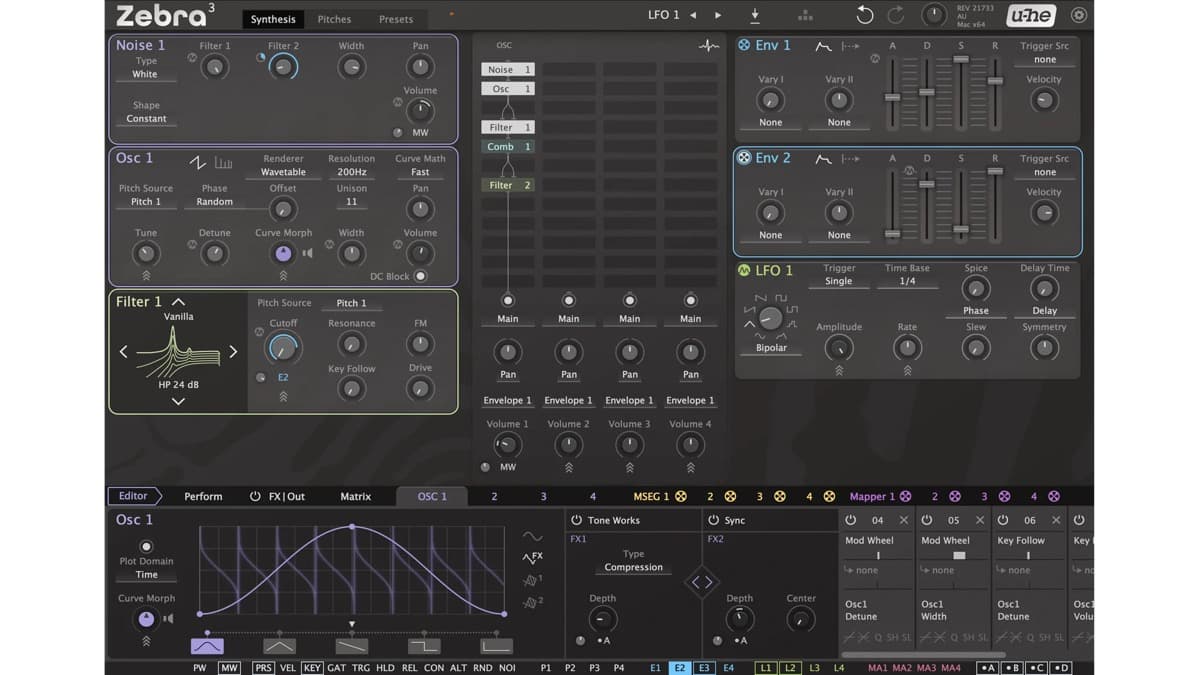
Zebra earned its cult following by being the synth sound designers reach for when they want something no preset library can supply, and version 3 is a genuine ground-up rebuild rather than a cosmetic refresh. At its core is a modular wavetable and additive engine where you draw waveforms freehand as splines, then push the additive side to as many as 1,024 partials. The result is a palette that runs from clean digital tones to gritty, organic textures, all with u-he's familiar analog-leaning character baked in. The current first look is Våld Labs Tresse.
It excels at evolving, motion-rich patches. The adaptive interface is the quiet star here: rather than burying you in a fixed grid of modules, it reshapes around whatever you build, so a sprawling modulation network stays legible instead of collapsing into visual noise. That makes deep patching feel approachable in a way most modular soft synths never manage, and it rewards experimentation without punishing you for it.
The trade-offs are real. At €249 this is a premium purchase, and it is a single instrument rather than a sprawling multi-format ecosystem. The same depth that makes it powerful also means a learning curve — newcomers who just want quick, playable presets may find it more instrument than they need. Dense additive and heavily modulated patches can also lean on your CPU.
Against its main rival, the difference is one of philosophy. Omnisphere 3 leads with an enormous curated sound and sample library and is arguably faster for pulling finished, cinematic patches on demand. Zebra 3 is the better choice when you want to build a sound from first principles and own something genuinely yours. Producers who prize sound design and originality over a browse-and-go workflow should pick Zebra 3; those who want the widest ready-made library may prefer Omnisphere.
For a full breakdown, see our complete u-he Zebra 3 review.