u-he Zebra 3 Review: A Ground-Up Rebuild, Spline Oscillators, and an Adaptive Modular Interface
u-he released Zebra 3 on April 20, 2026 for €249. The cult-favorite synth has been rebuilt from scratch with spline-based wavetables, additive synthesis up to 1,024 partials, and an adaptive modular interface.
Black Friday 2026u-he Black Friday 2026: dates and deals →
See full specs, price, and alternatives in the plugin database →
After a four-month public beta, u-he released Zebra 3 on April 20, 2026 for €249. The Berlin developers rebuilt their cult-favorite synth from the ground up. The new version combines analog modeling, physical modeling, and digital synthesis in one adaptive interface.
Zebra 2 has served as a staple for film scoring and sound design for years. Zebra 3 builds on that foundation. It adds a spline-based wavetable editor, an additive engine with up to 1,024 partials, through-zero FM, and a tool palette that shows only the modules used in each patch.
What Zebra 3 Is
Zebra has always functioned as an everything-synth. It offers modular routing, multiple oscillator types, and a deep modulation system. The original version earned respect for pads, evolving textures, and unusual timbres. Many film composers integrated it into their workflows.
Zebra 3 keeps this identity. It does not chase trends. The synth suits sound designers who prefer shaping sounds over browsing presets. You will spend real time with it. That is the point.
The Adaptive Interface
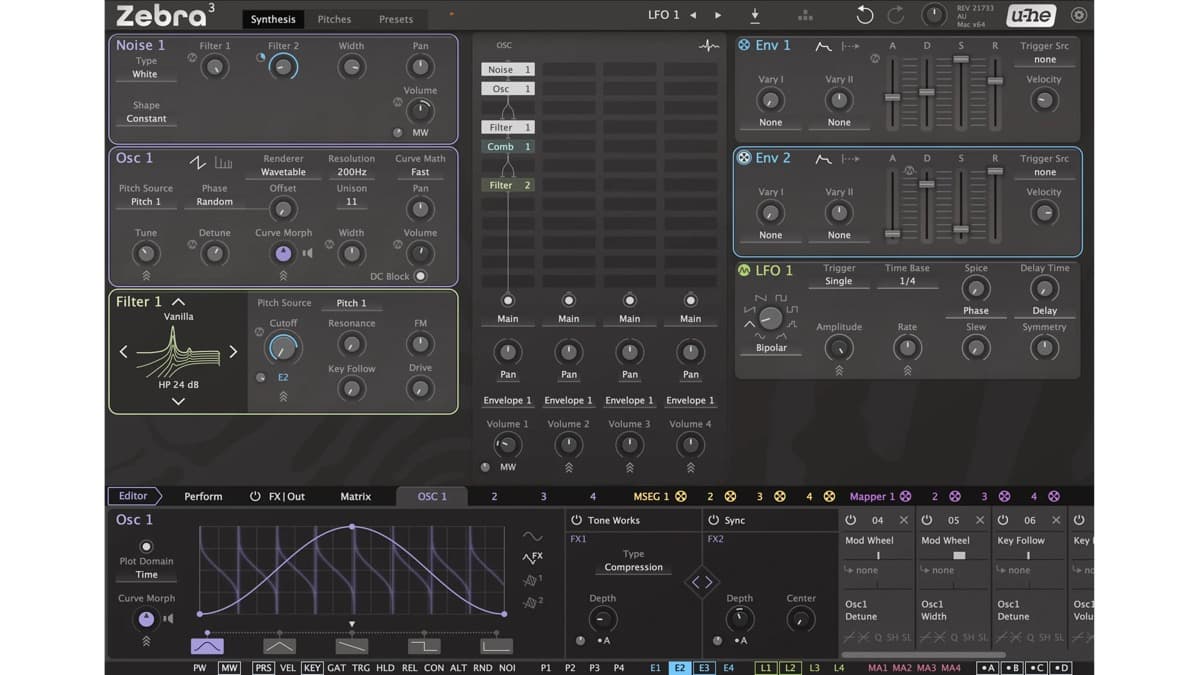
The most visible change appears in the structure. Zebra 2 displayed every module on a fixed grid. Zebra 3 starts empty. You drag in oscillators, filters, envelopes, and effects as needed. Only active modules appear. The signal flow stays clear and visible.
This approach changes the experience. New users face less clutter. Power users build cleaner patches. A complex Zebra 3 patch resembles a compact modular rack rather than a crowded grid.
Two New Oscillator Engines
The oscillator section stands out as Zebra 3's strongest feature. Two engines work side by side.
The wavetable oscillator uses a unified spline editor. You draw curves freehand, edit harmonic amplitudes directly, and morph shapes geometrically. The process feels closer to drawing than adjusting numbers. It supports up to 16-voice unison.
The additive engine reaches 1,024 partials. It handles non-harmonic spectra naturally. Bell tones, metallic sounds, and evolving inharmonic clouds all live inside this engine. Most additive synths limit partials to lower counts. The extra headroom helps.
Both engines include 20 oscillator-level effects. Tools such as spectral decay and phase remapping shape the sound before it reaches a filter.
Through-Zero FM With Audio Input
Zebra 3 includes four dedicated FM oscillators. They chain together and support through-zero FM, a technique familiar to anyone who has spent time in analog modular territory.
The audio input on the FM oscillator adds real flexibility. You can route external audio or another internal module as a third operator. That enables vocal processing, drum mangling, and live-input synthesis without leaving the synth.
Filters, Resonators, and the Physical-Modeling Side
Zebra 3 ships with 13 filter models. Each offers up to 12 response types. That range covers clean linear lowpass, ladder-style growl, and comb-based pitch shifting.
Modal resonators and comb filters provide the physical-modeling tools. They help create plucked strings, struck metals, and resonant bodies with acoustic character. Combined with the additive engine, these elements produce sounds that feel physically grounded.
Film and TV composers will likely lean on this section. Modal resonators inside a single soft synth, without needing a separate physical-modeling plugin, are still uncommon.
The Modulation System
Zebra 3 offers four ADSR envelopes, four LFOs, four MSEGs, four Mappers, and four Mod Math modules.
The Mod Math units stand out for advanced users. They let you sum, multiply, scale, and offset modulation sources before they hit a destination. This is closer to how Eurorack utility modules work than to how most soft synths handle CV math.
Pitch, gate, and trigger signals also serve as modulation sources. MIDI velocity, key tracking, and note number can drive any destination directly.
Global Effects Grid
A global effects grid sits at the output. It includes modulation effects, delays, reverbs, compressors, and EQs. Each voice carries its own send amount. That detail allows per-voice processing, such as drier reverb on lower notes within the same patch.
Pricing, Compatibility, and the Upgrade Path
Zebra 3 costs €249. It runs on macOS 10.13 or later, Windows 7 or later, and Linux with glibc 2.28 or higher. Supported formats include CLAP, VST3, AU on macOS, and AAX. The minimum display resolution is 1300 × 910. A quad-core CPU (Intel Nehalem, Apple M1, or AMD Bulldozer or newer) and around 300 MB of disk space are required.
Owners of Zebra 2 who registered before November 1, 2022 can check upgrade pricing in My Licenses on the u-he website. Standard upgrades are also available there.
A public beta ran from December 2025 to April 2026. The release version (3.0.0, revision 21799) reflects feedback from that period. The synth ships with over 1,200 factory presets.
Who Zebra 3 Is For
Zebra 3 does not suit every beatmaker. It rewards patience. The interface is cleaner than Zebra 2, yet it still requires time to learn.
If your workflow relies on presets and tight deadlines, a faster wavetable plugin like Serum 2 may fit better.
Sound designers, film and TV composers, ambient producers, and experienced synth users will find real value here. The additive engine and modal resonators offer capabilities most soft synths lack. The adaptive interface addresses the long-running complaint that earlier Zebra versions felt overwhelming on first open.
Get It
Zebra 3 is available now for €249 directly from the u-he website. It is also sold at Plugin Boutique and Best Service. A free demo is available. The user guide and preset details appear on the product page.
Buy u-he Zebra 3 at Plugin BoutiqueProducers expanding their plugin collections can find complementary wavetable and modulation tools at Plugin Boutique, and Loopcloud sample packs pair well for ambient and cinematic projects.