Arturia Pure SUB Review: A Synth Made Only for Bass
Arturia Pure SUB is a $49 bass design synth with independent sub, harmonics, and texture layers plus a built-in processor. Full specs, sound, and pricing.
See full specs, price, and alternatives in the plugin database →
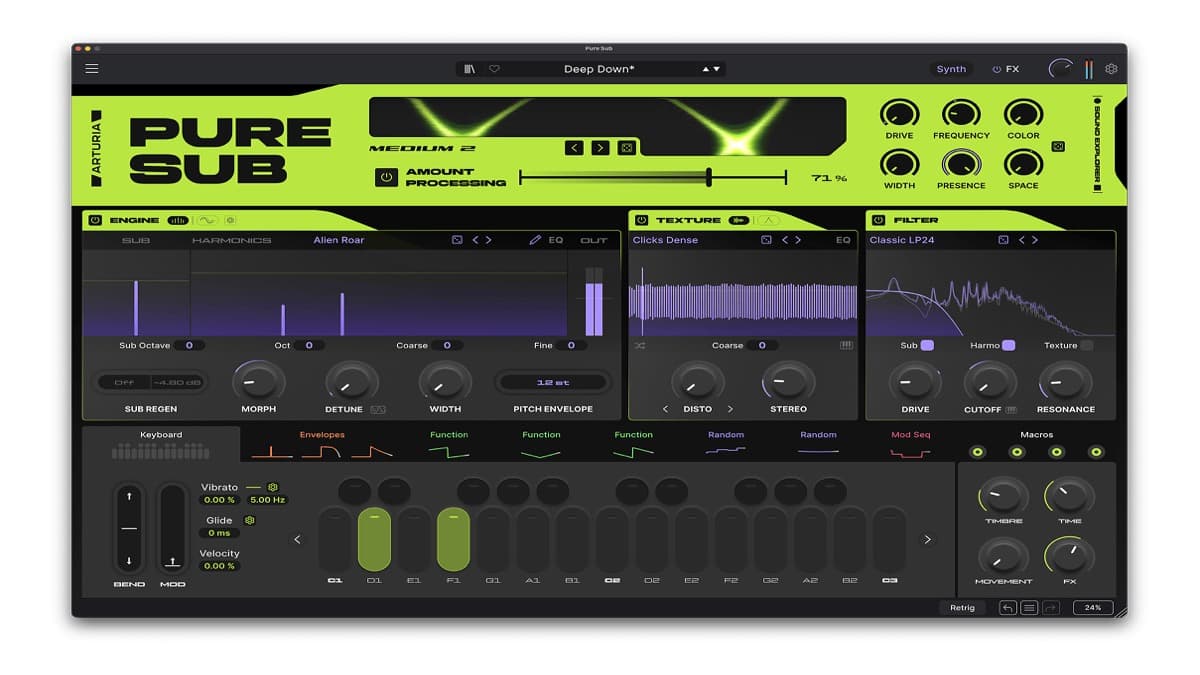
Arturia released Pure SUB on August 27, 2026, a synthesizer that does one thing on purpose: design bass. Instead of a general instrument you bend toward low end, Pure SUB splits a bass sound into three independent layers, then wraps them in processing built for weight, punch, and movement.
At a glance: $49 intro (regular $79), through September 15, 2026. A dedicated bass design synth with separate sub, harmonics, and texture layers, 40-plus filter modes, a 33-mode sub processor, a 12-slot effects rack, 300 presets, and MPE. Runs as VST, VST3, AU, AAX, standalone, and NKS on Windows 10+ and macOS 11+.
What is Arturia Pure SUB?
Pure SUB is a bass synthesizer, not a general soft synth that happens to reach low notes. The idea behind it is that a great bass is really three things layered together: a clean fundamental, a set of harmonics that give it tone, and some grit or movement on top. Most synths force you to build all three from one oscillator stack. Pure SUB gives each its own dedicated layer, so you can dial in the weight, the character, and the texture separately, then blend them at the filter stage. The current first look is Interphase Cartograph.
That focus puts it in a small but growing category of purpose-built bass instruments. The closest reference point is UVI Rumble, a multiband bass synth that splits low, mid, and high bands. Pure SUB takes a different route to the same goal, splitting by sonic role rather than frequency band, and it undercuts Rumble heavily on price.
What Pure SUB does, layer by layer
The Sub layer: your fundamental, protected
The Sub layer generates the fundamental independently, with its own level, octave, and modulation controls. The key feature here is Sub Regen. When you distort or saturate a patch, drive tends to eat the low end and thin out the fundamental. Sub Regen restores a clean sub underneath everything else, so the note keeps its weight no matter how aggressive the rest of the patch gets. If you have ever watched an 808 vanish the moment you add drive, this solves a real, recurring problem.
The Harmonics layer: tone and body
The Harmonics layer is where the bass gets its character, and it offers two modes. Pressure builds low-density harmonic tones and includes custom waveform editing, so you can sculpt the exact harmonic shape you want. Reese produces wide, high-density unison, which is the classic detuned, moving texture behind drum and bass and neurofunk basslines. You can morph between harmonic positions and apply key-tracked EQ, so the tone stays consistent as you play up and down the keyboard.
The Texture layer: grit and movement
The Texture layer adds the top-end interest that separates a flat sub from a produced bass. Texture mode blends samples into the signal through ring modulation, amplitude modulation, or distortion. Corroder adds noise, sine, saw, square, or frequency-modulated sources at fixed or key-tracked frequencies. Between them, you get everything from a subtle air of movement to full harsh, distorted growls, all sitting on top of the protected sub.
Processing built for low end
The layers merge into processing that is unusually deep for a bass tool. There are more than 40 filter modes with independent routing for each layer, so the sub, harmonics, and texture do not all have to pass through the same filter. A dedicated Sub Processor offers 33 modes for distortion and tonal reshaping, driven by six shaping macros. After that comes a 12-slot FX rack with 18 effects, including compression, multiband processing, and EQ. A Maximiser rounds it off with Soft and Hard modes, one for transparent loudness and one for deliberate, aggressive pumping.
Modulation and the pitch envelope
Modulation covers three envelopes, six flexible modulator slots (Function, Random, Envelope, Step Sequencer, or Voice Modulator), four assignable macros with a Modulation Sidechain, and full MPE with Slide. The standout is a dedicated Pitch Envelope, which is exactly what you need for 808-style attacks: that quick downward pitch drop at the start of a note that gives trap and hip-hop bass its punch. Having it as a first-class control, rather than something you rig by hand, makes those sounds fast.
Arturia Pure SUB specifications
| Spec | Detail |
|---|---|
| Product | Arturia Pure SUB |
| Type | Bass design synthesizer |
| Layers | Sub, Harmonics (Pressure / Reese), Texture (Texture / Corroder) |
| Filters | 40+ modes, independent routing per layer |
| Sub Processor | 33 distortion/reshaping modes, 6 shaping macros |
| Effects | 12-slot FX rack, 18 effect types, plus Maximiser (Soft/Hard) |
| Modulation | 3 envelopes incl. dedicated Pitch Envelope, 6 modulator slots, 4 macros, MPE + Slide |
| Presets | 300 |
| Formats | VST, VST3, AU, AAX, standalone, NKS (64-bit) |
| System | Windows 10+ (64-bit, no ARM); macOS 11+ (Intel or Apple Silicon) |
| Price | $49/€49 intro (regular $79/€79) |
Pure SUB vs UVI Rumble
Both are dedicated bass synths that reject the one-oscillator approach, but they split the work differently.
| Arturia Pure SUB | UVI Rumble | |
|---|---|---|
| Approach | Splits by role: sub, harmonics, texture | Splits by band: Body, Character, Air |
| Oscillators | Layer-based, with custom waveform + Reese modes | 9 oscillator models across three engines |
| Processing | 40+ filters, 33-mode sub processor, 12-slot FX | Per-band FX, multiband master compressor/EQ |
| Presets | 300 | Large factory bass library |
| Formats | VST, VST3, AU, AAX, standalone, NKS | VST3, AU, AAX, standalone, NKS |
| Price | $49 intro / $79 regular | €199 |
Which to pick. Choose Pure SUB if you think about bass as fundamental, tone, and grit and want to shape each separately, and if the price matters. Choose UVI Rumble if you want true multiband architecture with independent oscillators and effects per frequency band, and you are comfortable at a premium price. Both go far beyond a stock sub oscillator; Pure SUB simply gets you most of the way there for a quarter of the cost.
Who Pure SUB is for
Consider it if you make bass-led electronic music: trap, hip-hop, drum and bass, dubstep, techno, or anything where the low end is the hook. The layered design and Sub Regen reward producers who care whether the fundamental holds up under heavy processing.
Consider it if you want to finish a bass inside one plugin. The internal filters, sub processor, FX rack, and Maximiser mean you rarely need to chain external plugins to get a release-ready low end.
Skip it if you want a general-purpose synth. Pure SUB does not make pads, leads, or keys, and it is not trying to. If your synth budget has to cover everything, a broad instrument like Serum 2 or a bass-capable classic makes more sense than a single-purpose tool.
How much does Pure SUB cost?
Pure SUB is $49/€49 as an introductory price through September 15, 2026, after which it returns to $79/€79. It is also bundled with personalized pricing on V Collection 11 Intro or Pro, so existing Arturia owners should check their account before buying it standalone. Arturia offers time-limited demos of its instruments through the Arturia Software Center, which is the easiest way to try it before paying.
Check Pure SUB price at Plugin BoutiqueFAQ
Is Arturia Pure SUB worth it?
If you regularly design bass, yes. At $49 it is far cheaper than the dedicated bass synths it competes with, and the three-layer architecture plus Sub Regen solve the specific problems bass producers hit: keeping a clean fundamental under heavy processing and shaping tone and texture independently. If you only need occasional simple bass, a sine sub and a saturator already do that.
Pure SUB vs UVI Rumble: which is better for bass?
They target the same goal differently. Pure SUB splits a bass into sub, harmonics, and texture and costs $49 intro. UVI Rumble splits it into low, mid, and high frequency bands with nine oscillator models and costs €199. Rumble is deeper and more expensive; Pure SUB is more focused and far more affordable.
What are the system requirements for Pure SUB?
Windows 10 or later (64-bit; ARM processors are not supported) or macOS 11 or later on Intel or Apple Silicon. You need 4GB of RAM, a 4-core CPU at 3.4 GHz (or an M1 chip), 3GB of free disk space, and an OpenGL 2.0-compatible GPU. It runs as VST, VST3, AU, AAX, standalone, and NKS.
Can Pure SUB make 808s?
Yes, and it is built for them. The dedicated Pitch Envelope handles the signature 808 pitch drop, the Sub layer keeps the fundamental clean, and the Sub Processor and FX rack add the distortion and glue that modern 808s need.
The bottom line
Pure SUB is a specialist. It breaks a bass into a protected fundamental, a shapeable harmonic layer, and a texture layer, then finishes them with a genuinely deep processor. The result is a tool that makes designing weighty, characterful low end fast and controllable. It will not stand in for your main synth, and it never claims to. For anyone whose tracks live and die on the bass, $49 for this much focused control is easy to justify.