WetEQ and WetCompressor: Free Desk EQ and 76 Comp
WET VST ships WetEQ and WetCompressor as free MIT-licensed VST3 plugins for Windows, Linux, and macOS. Specs, how they work, and who should download them.
WET VST, the open-source project by Ronald Klarenbeek, now lists WetEQ and WetCompressor as available downloads next to the already-shipping WetDelay and WetReverb. Both shipped as v1.0.0 on 30 August 2026. They are free VST3 plugins for Windows, Linux, and macOS, built on the Steinberg VST3 SDK with no JUCE layer and no store login. Source lives on GitHub under the MIT licence. This is a first look at the live product page and the public repositories. We have not used them in a session.
At a glance: Free. WetEQ is a British console-style four-band EQ with desk saturation and channel crosstalk. WetCompressor is a 76-style FET compressor with a feedback detector and three time constants. VST3 on Windows, Linux, and macOS, including Apple Silicon. Download them from wetvst.com.
What WET VST is
Most free analog-style EQs and compressors arrive as closed binaries. You get a GUI, an installer, and a licence that can vanish if the developer does. Klarenbeek's approach is the opposite. Every plugin is a readable VST3 project. The site lists Visual Studio Build Tools, CMake, and Git as the only tools you need to build. No paid SDK beyond Steinberg's own.
The lineup is a small 1980s rack:
- WetDelay — already available. Six delay times from 20 ms to 400 ms, 24 kHz internal rate, 12-bit quantization, stereo with 1% channel crosstalk.
- WetReverb — already available. Five modes (Room, Plate, Hall, Cathedral, Cosmos), the same 24 kHz / 12-bit path, stereo crosstalk, LED meters.
- WetEQ — now available. British console-style four-band, HPF, LPF, input gain.
- WetCompressor — now available. 76-style FET, feedback detector, three time constants.
- WetChorus — coming soon. Antiphase L/R modulation, fixed rate and depth, combo-amp voicing.
WetDelay and WetReverb are vintage digital: they downsample and quantize on purpose. WetEQ and WetCompressor take the other path. Both run at the host sample rate with no downsampling. The color is supposed to come from the circuit model, not from a 12-bit converter.
If you want a free lo-fi crusher instead of a desk EQ, TAL-Bitcrusher is the current no-cost download on that job. WetEQ and WetCompressor are the free, stepped, analog-flavored pair.
WetEQ: a British console strip without the rest of the desk
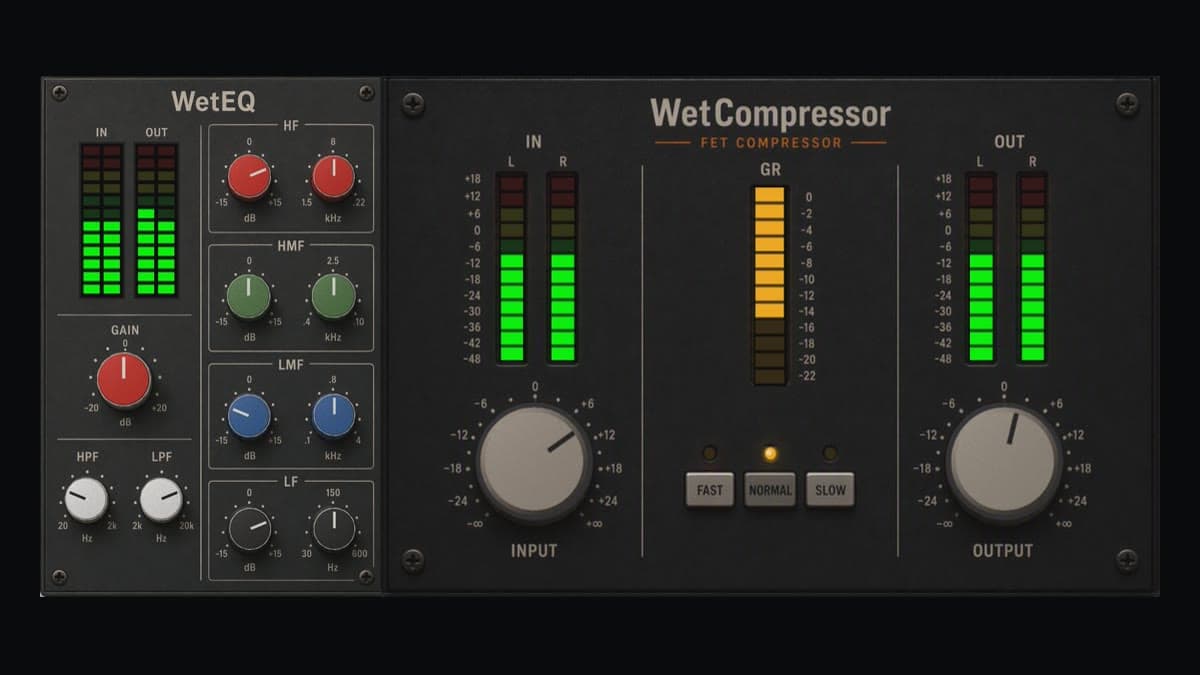
WetEQ is a four-band equalizer with the layout mixers already know: LF shelf, LMF bell, HMF bell, HF shelf, plus HPF, LPF, and an input GAIN. The official README calls that eleven knobs, nine positions each. The four bands each move +/-15 dB. That stepping is the point. You are not drawing a perfect curve. You are grabbing a desk switch and living with the choices the original circuit offered.
The site lists three color habits that sit under those bands:
- Desk-style saturation inside the filter loop, so gain is not a clean digital boost.
- Channel crosstalk, so a stereo instance does not behave like two isolated mono processors.
- Gain-dependent Q, so a bigger boost or cut changes the bandwidth the way a real console band does.
Meters are real-time L/R input and output LED columns. The GUI looks like a dark rack module, not a spectrum EQ. There is no analyzer overlay and no dynamic mode. You listen, you step a band, you decide.
That makes WetEQ a channel tool, not a mastering surgical tool. Use it when you want a vocal or a drum bus to feel like it went through a British desk. Do not use it when you need a 24-band linear-phase clean-up. That job still belongs to Pro-Q 4.
Nine steps per control also means recall is easy and fine-tuning is not. If you live on 0.1 dB moves, this will feel coarse. If you mix by ear and you like the discipline of a stepped EQ, it is a feature.
How to think about the bands
GAIN at the front is the drive into the saturation. Push it when you want the desk, not just the EQ.
HPF and LPF are the cleanup filters. They are stepped too. You will not park a high-pass at 37 Hz. You will pick the nearest position and move on.
LF and HF are shelves. They are the broad weight and air moves.
LMF and HMF are the bells, and gain-dependent Q is why a small mid cut and a large mid cut are not the same shape. That is the console habit people are paying for in paid emulations. WetEQ puts it in a free VST3.
WetCompressor: a 76 with fewer decisions
WetCompressor is a 76-style FET modeled as a circuit. The page is specific about the behavior: a feedback detector, a gain cell that bottoms out, and distortion that rises with the compression. That last line is the 76 character in one sentence. The harder you hit it, the more it stops being a clean leveler.
The control set is small on purpose:
- INPUT — 21 stepped positions. This is how you drive the detector and the gain cell.
- OUTPUT — 21 stepped positions. This is makeup after the gain reduction.
- FAST / NORMAL / SLOW — three time-constant buttons, not a continuous attack and release pair.
- Threshold and ratio are fixed. There is no ratio knob and no threshold knob.
Meters cover input, gain reduction, and output as LED columns.
If you have used a hardware 1176, this map is familiar. You push Input until the GR meter moves the way you want, you pick a time constant, and you match Output to the rest of the mix. You do not set 4:1 and a −18 dB threshold. Those decisions are inside the model.
Use WetCompressor on vocals, drums, and basses that want that FET grab. Skip it when you need a soft-knee bus compressor with a timing graph. Pro-C 2 is still the paid plugin for that wider job.
The rest of the rack, and what is still coming
WetDelay and WetReverb are the older pair, and they are a different flavor. Both run a 24 kHz internal rate with 12-bit quantization. They are 100% wet, which means they belong on a send. WetDelay has six fixed times. WetReverb has five named spaces. Both add stereo crosstalk so the left and right paths leak into each other the way a cheap rack would.
WetChorus is listed as coming soon: antiphase L/R modulation, fixed rate and depth, vintage combo-amp voicing. No download yet. Do not plan a session around it.
All of this is free. The only paid link on the site is a Buy Me a Coffee page. There is no paid SKU, no intro price, and no iLok.
WetEQ and WetCompressor specifications
| Spec | WetEQ | WetCompressor |
|---|---|---|
| Developer | Ronald Klarenbeek / WET VST | Ronald Klarenbeek / WET VST |
| Type | British console-style EQ | 76-style FET compressor |
| Version | v1.0.0 (30 August 2026) | v1.0.0 (30 August 2026) |
| Bands / time | LF shelf, LMF bell, HMF bell, HF shelf (+/-15 dB), HPF, LPF, GAIN | Fast / Normal / Slow time constants |
| Stepping | 11 knobs × 9 positions | INPUT and OUTPUT, 21 positions each |
| Circuit habits | Desk saturation, channel crosstalk, gain-dependent Q | Feedback detector, gain cell that bottoms out, distortion with GR |
| Threshold / ratio | n/a | Fixed |
| Sample rate | Host rate, no downsampling | Host rate, no downsampling |
| Meters | L/R input and output LEDs | Input, GR, and output LEDs |
| Formats | VST3 | VST3 |
| Systems | Windows, Linux, macOS (Intel and Apple Silicon) | Windows, Linux, macOS (Intel and Apple Silicon) |
| Licence | MIT, source on GitHub | MIT, source on GitHub |
| Price | Free | Free |
| Authorization | None | None |
Also on the same site: WetDelay and WetReverb (available), WetChorus (coming soon).
WetEQ vs Pro-Q 4, WetCompressor vs Pro-C 2
The paid FabFilter pair is what most mixers already own or want. Prices come from those plugin cards.
| WetEQ + WetCompressor | FabFilter Pro-Q 4 | FabFilter Pro-C 2 | |
|---|---|---|---|
| Price | Free | $199 on our Pro-Q 4 card | Street price on our Pro-C 2 card |
| Job | Stepped desk EQ + FET grab | Surgical and creative EQ, dynamic and spectral modes | General-purpose compressor with multiple styles |
| Controls | Nine or twenty-one steps, fixed 76 ratio | Up to 24 bands, continuous | Threshold, ratio, attack, release, styles |
| Platforms | Windows, Linux, macOS VST3 | VST, VST3, AU, CLAP, AAX | VST, VST3, AU, CLAP, AAX |
| Linux | Yes | No native Linux build in our card | No native Linux build in our card |
| Source | MIT, public | Closed | Closed |
| iLok / account | None | FabFilter licence | FabFilter licence |
| Reach for them when | You want analog-style color with no store | You need to see and draw the curve | You need a compressor that can change personality |
Which to pick. Download WetEQ and WetCompressor when you want console and FET color tonight, including on Linux, and you do not want an account. Keep Pro-Q 4 when the first move is a precise cut you can see. Keep Pro-C 2 when you need more than one compressor flavor in one plugin.
For a wider free-tool map, use the best free VST plugins of 2026. For the vocabulary behind EQ, saturation, and detectors, start with our audio effects overview.
Who WetEQ and WetCompressor are for
Consider them if you want analog-style EQ and compression without iLok, a dongle, or a store login.
Consider them if you mix on Linux and you are tired of being the last platform a vendor mentions.
Consider them if you like stepped controls and you mix by ear. Nine EQ positions and twenty-one input steps are a feature here.
Consider them if you want to read or fork the code. MIT plus a pure VST3 SDK project is the rare honest version of "free plugin."
Skip them if you need AAX, VST2, or AU. This family is VST3 only. Logic users will need a VST3-capable host or a wrapper they already trust.
Skip them if you need continuous attack, release, and ratio, or a 24-band EQ with a spectrum. Paid tools still win those jobs.
Skip WetDelay and WetReverb if you wanted the same clean host-rate path. Those two are 12-bit, 24 kHz, and 100% wet on purpose.
How much do WetEQ and WetCompressor cost?
They are free. There is no paid edition and no intro window. Download the VST3 builds from wetvst.com, or clone WetEQ and WetCompressor and build them yourself.
The WetEQ and WetCompressor READMEs both say the macOS VST3 is unsigned, so Gatekeeper may quarantine the bundle. The documented fix is xattr -rd com.apple.quarantine on the installed .vst3.
Klarenbeek asks for coffee if the plugins help. That is optional. It is not a licence condition.
The plugin cards live at /plugins/wetvst-weteq and /plugins/wetvst-wetcompressor.
FAQ
Are WetEQ and WetCompressor really free?
Yes. They are free downloads with MIT source. No trial timer, no account, no iLok.
Do they run on Linux?
Yes. WET VST ships VST3 for Windows, Linux, and macOS, including Intel and Apple Silicon, from one project.
Why does macOS say the developer cannot be verified?
The official READMEs state the macOS builds are unsigned. Run xattr -rd com.apple.quarantine on WetEQ.vst3 or WetCompressor.vst3 in ~/Library/Audio/Plug-Ins/VST3/, then rescan. That is the documented command. There is no extra installer.
WetEQ vs a paid British console EQ?
WetEQ is a four-band stepped desk EQ with saturation, crosstalk, and gain-dependent Q. A paid console channel usually adds a compressor, more filter choices, and official hardware alignment. Use WetEQ when you want that EQ habit for free. Pay when you need the rest of the strip or a verified hardware match.
WetCompressor vs a hardware 1176 plugin?
WetCompressor is a 76-style FET with a feedback detector, fixed threshold and ratio, 21-step Input and Output, and three time constants. It does not give you all-buttons-in as a labeled mode, and it does not give you a continuous attack/release pair. Use it for the grab. Use a paid 76 when you need the extra history and the extra switches.
What about WetDelay, WetReverb, and WetChorus?
WetDelay and WetReverb are already available as 12-bit, 24 kHz, 100% wet send effects. WetChorus is listed as coming soon. They are part of the same free rack, not paid upsells.
Verdict
WetEQ and WetCompressor are the rare free pair that pick a lane and stay in it. One is a stepped British EQ. The other is a stepped FET compressor. Both run at host rate. Both run on Linux. Both publish MIT source. There is no store, no iLok, and no paid SKU hiding behind the download.
They will not replace Pro-Q 4 or a full 76 suite. They are not supposed to. If you want desk color and FET grab without creating an account, take the VST3s from wetvst.com, park WetEQ on a channel, and park WetCompressor on the vocal. That is the whole recommendation.