InstaComposer 4 Rebuilds Its MIDI Engine and Adds a Mixer
InstaComposer 4 from W.A. Production adds MIDI Engine 2.0, Groove and Foliage controls, SoundFont loading and a built-in mixer. Intro price $29.90.
Black Friday 2026W.A. Production Black Friday 2026: dates and deals →
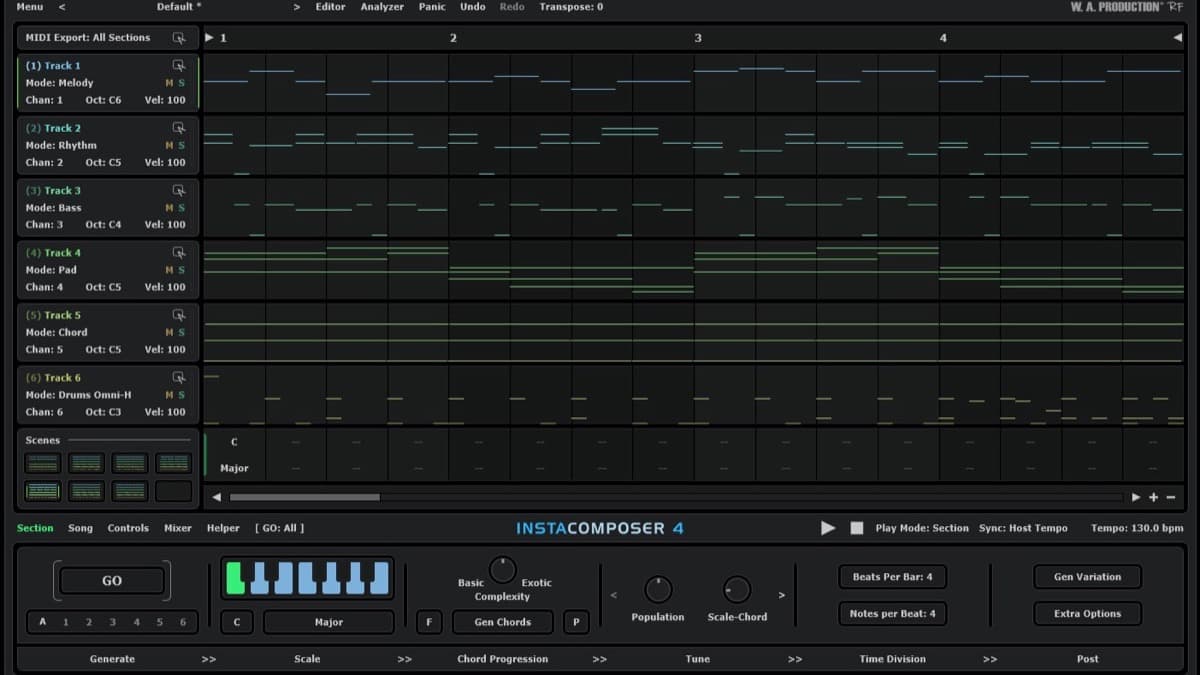
W.A. Production released InstaComposer 4 on 15 October 2026. It's the fourth version of the company's MIDI generation plugin, a tool that writes melodies, riffs, chords and full song sections for you, then hands you the MIDI to edit by hand. The headline change is a rebuilt generation core the developer calls MIDI Engine 2.0, plus a built-in mixer, SoundFont support and a redesigned interface. This is a first look from the official product page and manual, not a hands-on review.
At a glance: InstaComposer 4 runs on macOS 10.13 or later and Windows 8 or later, as VST3, AU and AAX on Mac and VST and AAX on Windows. It generates up to six tracks with up to eight scenes per song section. The intro price is $29.90, down from a $129 list price, and owners of InstaComposer 3 upgrade for $10. A free demo runs with major chords only.
What is InstaComposer 4?
InstaComposer is a MIDI generator that lives inside your DAW. You pick a key, a scale and a feel, and it builds musical parts procedurally, from a single riff to a full arrangement with intros, verses, choruses, bridges and outros. The company describes it as a "Creative Companion" rather than a push-button track maker, and that framing holds. Every part lands in the piano roll as editable MIDI, so you treat its output as a starting sketch, not a finished bounce.
It competes with chord and melody assistants like Scaler 3 and InstaChord 2, but it aims wider than a chord tool. Where Scaler leads with progressions and theory, InstaComposer tries to write the whole section, drums and bass and leads included, and route each part to its own MIDI channel.
What is new in InstaComposer 4?
The upgrade is mostly under the hood, where it matters for the quality of what comes out.
MIDI Engine 2.0 is the rebuilt generation core. W.A. Production says it improves rhythm, timing, phrasing and pitch selection, which is the part that decides whether a generated line sounds musical or random. Two new generation modes come with it: an Arpeggiator mode and a Rhythm V2 mode, so you can ask for arpeggiated figures or rhythmic patterns directly rather than fishing for them.
Foliage adds complementary notes around a main melody. Think of it as filling in the branches once you have the trunk. You write or generate a lead, then Foliage grows harmony and counter-notes that sit with it instead of fighting it.
Groove controls give you hands-on rhythmic shaping with five parameters, Syncopation, Gallop, Density, Burst and Congestion, plus a Humanize control for timing and velocity. These turn a stiff grid into something with push and pull, and they're the difference between a demo loop and a part you keep.
A built-in instrument and mixer means InstaComposer 4 can now make sound on its own. It ships with an acoustic piano and General MIDI style instruments, loads SoundFont (SF2) files, and routes everything through an integrated mixer with reverb and delay. You still drag MIDI into your DAW for the real instruments, but you can now audition arrangements without wiring up a single external synth first.
Timeline playback and a redesigned UI round it out, and the company confirms that presets from InstaComposer 1, 2 and 3 still load, so an upgrade doesn't strand your old sessions.
InstaComposer 4 specifications
| Spec | Detail |
|---|---|
| Type | MIDI generation plugin and songwriting tool |
| Tracks | Up to 6, each routable to its own MIDI channel |
| Scenes | Up to 8 per song section |
| Generation modes | Melody, chords, Arpeggiator, Rhythm V2, full song |
| Sound | Built-in acoustic piano, General MIDI instruments, SF2 loading, mixer with reverb and delay |
| Editing | Full piano-roll editing, probability, complexity and variation controls, range controls |
| MIDI | Import, export, drag and drop, multi-track and multi-channel routing |
| Scales | Major, Minor, Harmonic, Pentatonic, Spanish, Arabic and more |
| Formats (Mac) | VST3, AU, AAX |
| Formats (Windows) | VST, AAX |
| System | macOS 10.13 or later, Windows 8 or later |
| Price | $29.90 intro, $129 list, $10 upgrade from v3 |
How InstaComposer 4 compares to Scaler 3
The obvious question is whether you want a dedicated chord brain or a whole-section generator. The split comes down to scope.
| InstaComposer 4 | Scaler 3 | |
|---|---|---|
| Primary job | Generate full sections and arrangements | Build chord progressions and suggest melodies |
| Tracks at once | Up to 6, multi-channel | Chord, bass and melody voicings |
| Rhythm shaping | Groove controls, Humanize, Rhythm V2 | Performances and strum patterns |
| Built-in sound | Piano, GM instruments, SF2, mixer | Large built-in sound set |
| List price | $129 (intro $29.90) | $99 |
| Pick it if | You want drums, bass and leads generated together | You want chords and theory guidance first |
If your writing stalls at "what chords go here," Scaler is the sharper tool, and our Scaler 3 coverage walks through its approach. If you stall at "I have a chord loop, now build me a section," InstaComposer 4 does more of that job in one window. Many producers end up owning both and reaching for whichever one matches the block they're stuck on. For the manual approach, our guide to writing better chord progressions covers the theory the plugins automate.
Who InstaComposer 4 is for
It suits producers who freeze at the blank page and want a fast, editable sketch to react to, and anyone who works in loop-and-arrange genres where a generated section is a real head start. The multi-channel routing makes it a natural fit for template-driven workflows. Skip it if you already write freely and find generated MIDI more distracting than useful, or if you want a single-purpose chord tool rather than a section generator. One practical note from the compatibility list: NI Maschine and Mixcraft need Blue Cat's Patchwork to handle the multi-channel routing, and the demo is limited to major chords.
How much does InstaComposer 4 cost?
InstaComposer 4 launched at an intro price of $29.90 against a $129 list price, a 76 percent discount that W.A. Production is running through the back half of October. Owners of InstaComposer 3 pay $10 to upgrade, and presets carry forward from every earlier version. A free, full-function demo is available, limited to major chords. You can check the current price and grab the demo at W.A. Production, and the plugin also appears in the latest releases on Plugin Boutique.
FAQ
Is InstaComposer 4 worth upgrading from version 3?
If you use InstaComposer regularly, the $10 upgrade is easy to justify for MIDI Engine 2.0 alone, since the rebuilt core is what decides how musical the output feels. The Groove and Foliage controls and the built-in mixer add real workflow value on top. Your version 3 presets still load, so there's no migration cost.
InstaComposer 4 vs Scaler 3, which should I buy?
Buy Scaler 3 if your main need is chord progressions and music-theory guidance. Buy InstaComposer 4 if you want full sections, with drums, bass and leads generated together and routed to separate channels. They solve adjacent problems, and plenty of writers keep both.
What are the InstaComposer 4 system requirements?
It needs macOS 10.13 or later, or Windows 8 or later. On Mac it runs as VST3, AU and AAX; on Windows as VST and AAX. It works in any host that supports VST or AAX with MIDI routing, or as an AU MIDI effect, and it's tested in FL Studio, Cubase, Studio One, Ableton Live, Pro Tools and Logic Pro.
Does InstaComposer 4 make its own sound?
Yes. For the first time it includes a built-in acoustic piano and General MIDI instruments, loads SoundFont files and runs a mixer with reverb and delay, so you can audition arrangements inside the plugin before dragging the MIDI out to your own instruments.
Verdict
InstaComposer 4 is the version where the generator stops feeling like a novelty and starts feeling like a writing tool. The rebuilt MIDI Engine 2.0, the Groove and Foliage controls and the built-in mixer all push in the same direction, toward output you keep rather than output you demo once and delete. At $29.90 intro, or $10 for existing owners, it's priced to try. Approach it as a companion that breaks a blank-page stall, edit what it gives you, and it earns its place. Treat it as a one-click hit factory and it will disappoint, which is true of every tool in this category. Buy it if you want editable sections fast; look at Scaler 3 or Cthulhu instead if chords and theory are the real gap. For another recent W.A. Production release, see our Asymo Reverb first look, and browse the full plugin database for more MIDI tools.