Some links on this page are affiliate links. If you buy through them, Dubspot may earn a commission at no extra cost to you. It never affects our scores or what we recommend — read our policy.
W.A. Production Asymo Reverb Rotates the Room in Real Time
W.A. Production Asymo Reverb is a dynamic reverb whose room geometry warps and rotates. Launch price is $14.90, regular $49.90. Specs, FAQ, and who it suits.
P
Priya Raman
October 3, 2026 · 7 min read
Black Friday 2026W.A. Production Black Friday 2026: dates and deals →
W.A. Production has released Asymo Reverb, a reverb built around a room you can bend and spin. Instead of fixing the space and letting a tail decay inside it, Asymo lets you drag the walls into a new shape and set the whole room turning. The launch price is $14.90, down from a $49.90 list, through 31 October 2026. This is a first look from the official product page and the W.A. Production demo, not a hands-on review.
At a glance: A dynamic reverb with a draggable room shape and a real orbital motion engine. Pitch and phase stay stable while the space moves. Controls for size, early reflections, damping, decay, and width, plus input ducking and low or high cut. VST3, AU, and AAX. Windows 8 or later and macOS 10.13 or later. Launch price $14.90, regular $49.90.
What Asymo Reverb is
Most reverbs model one space and hold it still. You pick a hall, a plate, or a room, and the sound decays inside walls that never move. Asymo Reverb starts from the opposite idea. The space is a shape you edit, and that shape can rotate while a sound rings out.
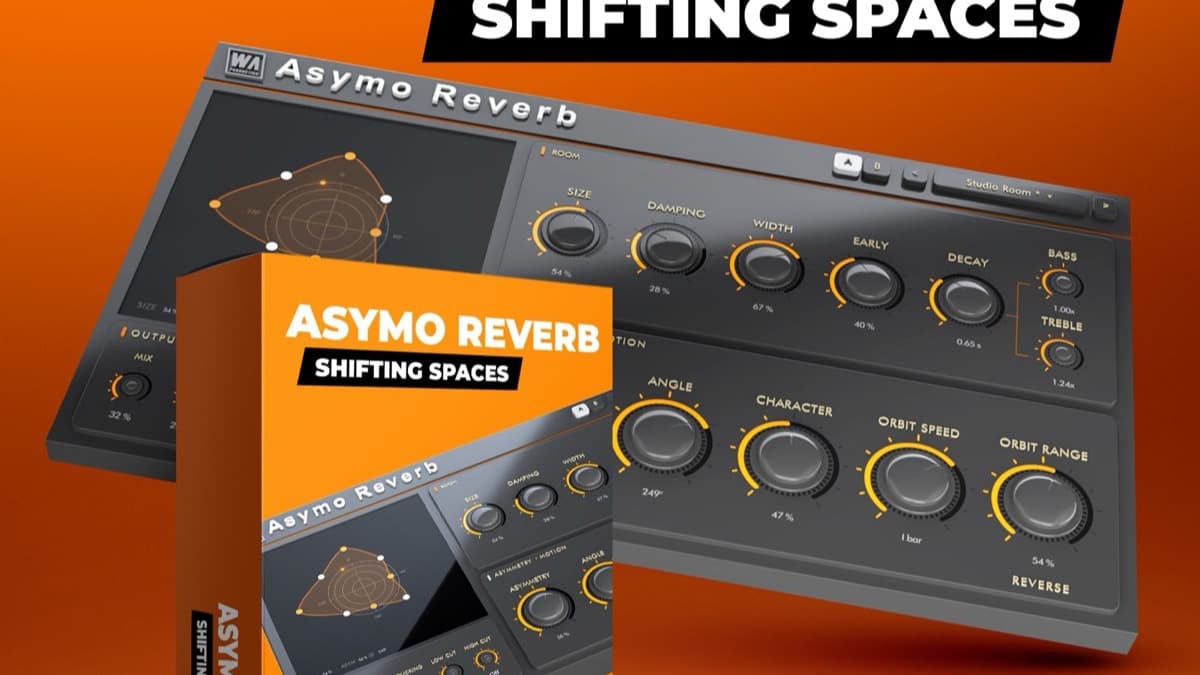
The front panel is built around an interactive geometric display. White and orange nodes mark the boundaries of the simulated room, and you drag them to warp the shape. A tall narrow box and a wide flat box give very different reflections, and you set either one by hand rather than loading a fixed preset. That makes the reverb a design surface, not just a menu of rooms.
The second half of the idea is motion. An orbital engine turns the room in real time, so the reflections move around the stereo field as the tail develops. This is closer to a creative, modulated reverb than to a faithful hall. It sits beside tools like Valhalla Supermassive and the modulation modes in a FabFilter Pro-R 2, rather than against a straight convolution reverb.
What the motion controls do
Two controls shape the movement. Orbit Speed sets how fast the room travels, and Orbit Range sets how far it goes. Keep Range low and the space sways gently, which reads as a subtle, living ambience. Push Range past 100 percent and the room swings into a continuous rotation, so the tail circles the listener instead of sitting in one place.
The modulation design is what keeps this usable on a vocal or a lead. W.A. Production describes the spatial movement as pitch and phase stable. A moving reverb normally pulls the tail sharp or flat as it modulates, and in stereo it can smear the image. Asymo is built to move the space without that drift and without the phase problems that hollow out a mono fold-down. The result shimmers instead of detuning.
Around the motion sit the parts you expect from a mix reverb. There are controls for room size, early reflections, damping, decay, and stereo width, so you can set the basic character before you animate it. Input ducking pulls the reverb down while the dry signal is loud and lets it bloom in the gaps, which keeps a lead vocal clear instead of washed out. Low cut and high cut filters keep the tail out of the sub and tame harsh top, the two moves most reverb returns need. An A/B comparison and a preset manager round out the workflow, and the plugin ships with factory presets to show the range.
Asymo Reverb specifications
| Spec | Detail |
|---|---|
| Type | Dynamic reverb with editable, rotating room geometry |
| Developer | W.A. Production |
| Room design | Draggable boundary nodes warp the space |
| Motion | Orbital engine, Orbit Speed and Orbit Range, up to full 360 rotation |
| Modulation | Pitch and phase stable spatial movement |
| Core controls | Size, early reflections, damping, decay, width |
| Dynamics | Input ducking for transient and vocal clarity |
| Filters | Low cut and high cut |
| Workflow | A/B compare, preset manager, factory presets |
| Formats | VST3, AU, AAX |
| Windows | 8 or later (VST3, AAX) |
| macOS | 10.13 or later (VST3, AU, AAX) |
| Price | $14.90 launch through 31 October 2026, $49.90 regular |
Asymo Reverb vs Valhalla Supermassive
The right comparison is with other reverbs built to move, not with a static concert hall. One plugin dominates that space. Valhalla Supermassive is free, built for huge modulated delays and reverbs, and known for ambient tails that drift forever. Asymo covers nearby ground, but it gives you direct control over the room shape and a defined orbital motion, where Supermassive leans on its modes and long feedback.
| Asymo Reverb | Valhalla Supermassive | |
|---|---|---|
| Price | $14.90 launch, $49.90 regular | Free |
| Core idea | Editable room shape that rotates | Modulated delay and reverb modes |
| Motion control | Orbit Speed and Orbit Range | Mod rate and depth per mode |
| Room editing | Drag boundary nodes by hand | Preset modes, no geometry editing |
| Ducking | Built in input ducking | None |
| Filters | Low cut and high cut | Low and high cut |
| Formats | VST3, AU, AAX | VST3, AU, AAX |
For a free, generous ambient machine where you don't need to sculpt the room, Supermassive is hard to beat and costs nothing. Asymo earns its launch price when you want to draw the space, rotate it, and duck it under a vocal, since it puts those three jobs on one screen. A cleaner, more surgical tail for mix work is a different tool again, which is where a FabFilter Pro-R 2 comes in. For the wider field, our best reverb plugins for 2026 guide lays out where each one fits.
Who Asymo Reverb is for
Buy it if you build evolving pads, ambient beds, risers, and vocal textures, and you want the space itself to become part of the movement. The draggable geometry and the orbital motion are made for sound design and for mixes that want a reverb with a pulse. At the launch price it is an easy addition to a creative effects rack.
Skip it, or at least think twice, if your reverb needs are mostly corrective. For a tight drum room, a natural vocal plate, or a transparent tail that sits behind a mix without drawing attention, a static algorithmic reverb like a Valhalla Room or a FabFilter Pro-R 2 is the more direct answer. Asymo is a character reverb first.
How much Asymo Reverb costs
Asymo Reverb is $14.90 at launch, down from a $49.90 regular price, through 31 October 2026. It runs as VST3, AU, and AAX on Windows 8 or later and macOS 10.13 or later. Specs also live on the Asymo Reverb plugin page. If you are weighing it against free options first, start with the best free VST plugins of 2026.
FAQ
Is Asymo Reverb a convolution reverb?
No. It is an algorithmic, dynamic reverb. The room is an editable shape rather than a captured impulse, and an orbital engine can rotate that shape in real time while the tail plays.
Will the movement detune my sound?
W.A. Production describes the spatial modulation as pitch and phase stable, which is the point of the design. The room moves without pulling the tail sharp or flat and without the phase smear that hollows out a mono fold-down.
What are the system requirements?
VST3 and AAX on Windows 8 or later, and VST3, AU, and AAX on macOS 10.13 or later. There is no standalone version.
How does Asymo Reverb compare to Valhalla Supermassive?
Both make moving, evolving spaces. Supermassive is free and mode based. Asymo lets you edit the room shape by dragging nodes, set a defined orbital motion, and duck the reverb under the dry signal, for a launch price of $14.90.