Some links on this page are affiliate links. If you buy through them, Dubspot may earn a commission at no extra cost to you. It never affects our scores or what we recommend — read our policy.
EastWest Hollywood Scoring Tools: Instant Cues in Opus (2026)
EastWest Hollywood Scoring Tools packs 328 playable Scores, 1,312 arrangements and 160+ instruments into Opus. $299 at Plugin Boutique, $199 crossgrade, specs and rivals.
E
Elena Marsh
November 2, 2026 · 9 min read
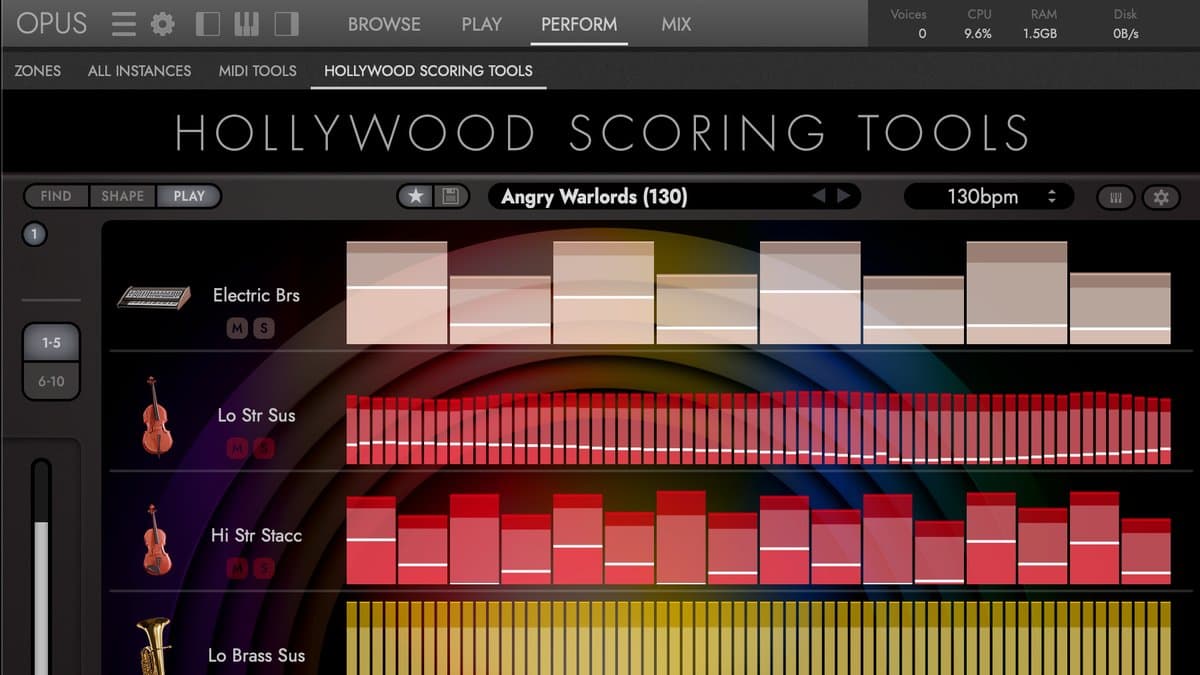
EastWest released Hollywood Scoring Tools on 29 October, an all-in-one scoring instrument for its Opus engine. Instead of building a template, you load one of 328 composer-built Scores, play chords, and up to ten instruments perform a finished arrangement that follows your harmony. It is $299 at Plugin Boutique and Best Service, against a $399 list price, and owners of Hollywood Orchestra Opus Edition, Hollywood Fantasy Orchestra or Sonuscore's The Score can crossgrade for $199 directly from EastWest.
At a glance: 328 Scores with four arrangements each (1,312 in total), 160+ instruments from EastWest and Sonuscore across orchestra, synths, band, world and choirs and percussion; ten swappable slots with per-slot arpeggiators, EQ and effects; drag-and-drop multitrack MIDI export. Opus 1.6.6 or later, VST3, AU, AAX and standalone, about 103 GB. $299 at Plugin Boutique; $199 crossgrade.
What is Hollywood Scoring Tools?
If you know Sonuscore's The Score, you know the idea. Hollywood Scoring Tools keeps that design: Find, Shape and Play pages, ten instrument slots, mod-wheel dynamics, per-slot arpeggiators and a tag-filtered browser. What changes is what sits underneath. EastWest says about 80% of the samples come from its own TEC Award-winning Hollywood libraries, fully chromatic and multi-dynamic, including true legato instruments, with the remaining 20% from Sonuscore. It runs in Opus rather than Kontakt.
The library is also bigger. Of the 328 Scores, 177 are newly composed (708 new arrangements), and 151 are Scores from The Score, previously called Stories, enhanced for the new instruments. A team of nine composers wrote them. EastWest positions it against its own Hollywood Orchestrator and Hollywood Fantasy Orchestrator, which lock you into fixed slots and a few instruments; here any of the 160+ instruments can go in any slot.
It sits next to the full Hollywood Orchestra Opus Edition rather than replacing it. Hollywood Orchestra is the deep, articulation-by-articulation orchestra for writing every line yourself. Scoring Tools is for getting from a blank session to a playable cue fast.
What it does
Scores that follow your chords
A Score is a complete, balanced setup: instruments, patterns, dynamics, mix and effects. Hold a chord and the whole arrangement plays in that harmony; change chords and it follows. Each Score comes with short performance notes on how the composer meant it to be played, such as where to sit on the keyboard or when to hold a bass note.
Four arrangements per Score
Every Score holds four separately arranged sections, Intro, Main A, Main B and Outro, switched on keys C1 to F1 while you play. G1 is an ending key that stops on a final chord. That makes it practical to perform a whole cue in one pass, building from intro to climax, rather than looping one pattern.
Ten slots you can rebuild
Each Score uses up to ten instrument slots, five on screen at a time. Click a slot to swap the instrument. There is no articulation switch: High Strings Sustain, Staccato and Pizzicato are separate instruments, so changing articulation is a single swap. Every slot is its own channel strip with volume, pan, octave, reverb send, solo and mute, plus Min and Max dynamic handles that set how quiet and how loud the slot gets as you ride the mod wheel. One gesture takes the cue from intimate to full.
Per-slot arpeggiators and effects
Each slot has its own arpeggiator with editable note order, rate, velocities and custom sequences. Its FX page has attack and release, a three-band parametric EQ and three insert slots drawing on 21 effect types in six categories. All slots send to a global reverb that can be convolution (recorded spaces) or algorithmic. Opus also brings an SSL channel strip and more reverbs than The Score had.
Browse by genre and style, export MIDI
The browser filters by 14 genres, from Action and Adventure to Romance, Historic and Horror, and 12 styles such as Tension, Underscore, Wall of Sound and Hybrid, plus time signature, search and favourites. Set pattern length (one, two or four bars) and half-, normal- or double-time playback. When a take works, drag the MIDI tile into your DAW: it lands as a multitrack MIDI file, one track per slot, each named after its instrument. You can then replace any part with a deeper library.
160+ instruments in five groups
The instruments are grouped as Orchestra (strings, brass, woodwinds, mallets, harp, piano including a Steinway D, celesta), Synths (leads, hits, basses, pads, ambiences), Band (bass, guitars, drum kits, keys), World (instruments such as oud, kamancha, dizi, nyckelharpa, bouzouki and taiko ensembles) and Choirs and Percussion (choir aahs, trailer hits, booms). Some are combinations built for the slot workflow: Strings Hi Pizzicato combines first violins and violas, and Woodwinds Low Staccato combines bass clarinet, bassoon and contrabassoon. That makes slots easier to fill, but it also means these are not one-to-one copies of the standalone Hollywood libraries.
Hollywood Scoring Tools specifications
| Spec | Detail |
|---|---|
| Content | 328 Scores, 1,312 arrangements, 160+ instruments |
| New material | 177 new Scores (708 arrangements); 151 enhanced from The Score |
| Sample sources | About 80% EastWest libraries, 20% Sonuscore |
| Sections per Score | Intro, Main A, Main B, Outro, plus an ending key |
| Slots | Ten, each with arpeggiator, EQ, three inserts (21 effect types), reverb send |
| Browser | 14 genres, 12 styles, time signature, search, favourites, User Scores |
| Export | Drag-and-drop multitrack MIDI, one track per slot |
| Engine | EastWest Opus 1.6.6 or later, native on Apple silicon and Intel |
| Formats | VST3, AU, AAX, standalone |
| Minimum system | Quad-core 2.7 GHz, 16 GB RAM, macOS 10.15 or Windows 10 with ASIO, 7200 rpm drive |
| Recommended | Eight cores, 32 GB RAM, SSD |
| Disk space | About 103 GB |
Hollywood Scoring Tools vs The Score vs ComposerCloud+
| Hollywood Scoring Tools | Sonuscore The Score | EastWest ComposerCloud+ | |
|---|---|---|---|
| Price | $299 at Plugin Boutique and Best Service ($399 list) | $399 at Best Service | $99 a year in the Black Friday offer (from $239.88) |
| Licence | Perpetual | Perpetual | Subscription |
| Player | EastWest Opus | Kontakt Player | EastWest Opus |
| Scores | 328 (1,312 arrangements) | Original Stories; 151 carried into Scoring Tools | Includes Hollywood Scoring Tools |
| Download | About 103 GB | 19.73 GB | Per instrument |
| Crossgrade | $199 for owners of The Score, Hollywood Orchestra or Fantasy Orchestra | – | – |
Which to pick: if you own The Score, the $199 crossgrade is the obvious move, since you get EastWest's orchestral samples, Opus and 177 new Scores. New buyers who want this workflow should pick Hollywood Scoring Tools at $299 over The Score at $399, unless they want to stay inside Kontakt or are short on disk space. ComposerCloud+ is the cheapest way in up front and adds the whole EastWest catalog, but you lose access when you stop paying.
For a wider set of EastWest instruments you keep, the EastWest Producer Collection is $165 at Plugin Boutique, and the Hollywood Collection, with Hollywood Strings, Brass, Woodwinds, Percussion and Choirs, is $299. If you write string lines yourself rather than performing pre-built cues, a dedicated library such as IK Sinphonica Maestosa Strings or Vienna Essential Orchestra is the better fit.
Who Hollywood Scoring Tools is for
Buy it if you score to picture on tight deadlines, write trailer, game or library music, or want to sketch full cues and export them as MIDI to finish with other libraries. It also suits producers who want orchestral, world and hybrid colour without learning orchestration.
Skip it if you want to write and articulate every part yourself (buy an orchestral library instead), you work on a laptop with 8 GB of RAM or a small drive, or you already own The Score and are happy with it in Kontakt.
How much does Hollywood Scoring Tools cost?
- $299 at Plugin Boutique, with a perpetual licence, Opus, 46 mixer effects and MIDI tools.
- $299 at Best Service, down from $399.
- $199 crossgrade from EastWest for owners of Hollywood Orchestra Opus Edition, Hollywood Fantasy Orchestra or Sonuscore The Score.
- Included in ComposerCloud+, $99 a year in EastWest's Black Friday offer (from $239.88).
Activation uses a free EastWest account and iLok, on your computer or on an iLok USB key. Our Hollywood Scoring Tools database entry tracks the price.
FAQ
Is Hollywood Scoring Tools the same as Sonuscore's The Score?
No. It keeps The Score's workflow but runs in Opus, uses EastWest's Hollywood recordings for about 80% of its samples, and adds 177 new Scores to the 151 carried over from The Score.
Is the crossgrade from The Score worth it?
For most owners, yes. $199 buys the EastWest orchestral samples, true legato instruments, Opus effects and more than twice as many Scores. Stay with The Score if you need it inside Kontakt or cannot spare about 103 GB.
Can I use my own chords and melodies?
Yes. The Scores follow the chords you play, and you can swap instruments, change patterns and dynamics, and save the result as a User Score. Seven extra legato instruments can be played on top separately.
Can I export to my DAW?
Yes. Drag the MIDI tile onto a track and you get a multitrack MIDI file, one track per slot, named after each instrument.
What computer do I need?
At least a quad-core 2.7 GHz CPU, 16 GB of RAM and macOS 10.15 or Windows 10 with ASIO drivers. EastWest recommends eight cores, 32 GB and an SSD. The full library is about 103 GB.
Verdict
Hollywood Scoring Tools is the most complete version yet of the "play a chord, get a cue" idea: The Score's proven workflow, rebuilt on EastWest's Hollywood samples, with twice the material and proper MIDI export. At $299, or $199 for owners of The Score or a Hollywood orchestra, it is a strong buy for media composers who need speed. If you want to write every part by hand, put the money into an orchestral library instead.