Some links on this page are affiliate links. If you buy through them, Dubspot may earn a commission at no extra cost to you. It never affects our scores or what we recommend — read our policy.
UVI Thorus XT Adds a Morphable Analog BBD Chorus
UVI Thorus XT pairs digital chorus with an analog BBD engine on a morphable 8-voice architecture. $49 intro through 7 September. Specs and who it's for.
E
Elena Marsh
August 27, 2026 · 11 min read
Black Friday 2026UVI Black Friday 2026: dates and deals →
UVI shipped Thorus XT on 26 August 2026. It is a new take on Thorus, the shop's long-running digital chorus, not a skin on the original. A second engine models the bucket-brigade circuits that classic chorus boxes were built on. Both engines share a morphable 8-voice architecture and the same modulation controls. This is a first look at the shipping feature set. We have not used it in a session. The current first look is fedDSP quadCHO.
At a glance: $49 / €49 intro through 7 September 2026, then $79 / €79. Original Thorus owners upgrade for $29 / €29. VST3, AU, AAX, and standalone. macOS 10.14 Mojave through macOS 26 Tahoe. Windows 10 and 11, 64-bit. iLok account, no dongle required, 3 activations. 3-day trial. Buy it from UVI.
What Thorus XT is
Chorus is usually a one-trick insert: a few delayed voices, a rate knob, a depth knob, and a mix. The original Thorus already did more than that. It used a variable 8-voice architecture and DSP that UVI traces to work on Sparkverb and Falcon. Thorus XT keeps that digital engine, refines it, and adds a second path that is not a filter or a saturation stage. It is a BBD chip model. A newer modulation plugin in this lane is fedDSP quadCHO.
UVI names the hardware lineage in plain language: Dimension D and Juno-6. Those boxes are famous for chorus that is not clean. Thorus XT's analog engine opens the parts of that circuit that hardware sealed inside a preset: aliasing filters, a compander, clock rate, hiss, and per-voice variance. We covered the current release in fedDSP quadCHO.
It sits next to modulation tools we already cover. Valhalla Space Modulator is a free, focused modulator. u-he Colour Copy is a BBD delay, not a chorus. Thorus XT is a dedicated dual-engine chorus: one path for clean widening, one path for circuit color, and a shared voice count you can sweep.
If you already live in UVI's instrument line, the same iLok account and UVI Portal installer apply. UVI Rumble is a different product — a multiband bass synth — with the same license shop. The free UVI Player, formerly UVI Workstation, installs through the same Portal.
The two engines
Both engines run on the same morphable 8-voice architecture. Set Speed, Depth, Shape, Edge, and stereo placement once. Switch Analog and Digital. Hear the same movement through two different delay technologies. Keep the one that fits the track.
Digital — the refined Thorus
The digital engine is the Thorus chorus, cleaned up and given a continuously variable voice count. Every voice reads a single shared delay line at interpolated positions. That is why UVI talks about crystalline detail instead of a pile of smeared copies. The 2026 note on this category is fedDSP quadCHO modulation plugin.
When clean is not the goal, Quality becomes a band-limited sample-rate reducer on the chorused band. It is a lo-fi edge that stays on the effect, not a bitcrusher on the dry signal. That is the useful split: keep the source intact, degrade only the chorus.
Digital is the engine for modern vocals, stacked synths, and anything that needs width without extra analog noise. Two voices stay identifiable. Eight voices become a wash.
Analog — the BBD model
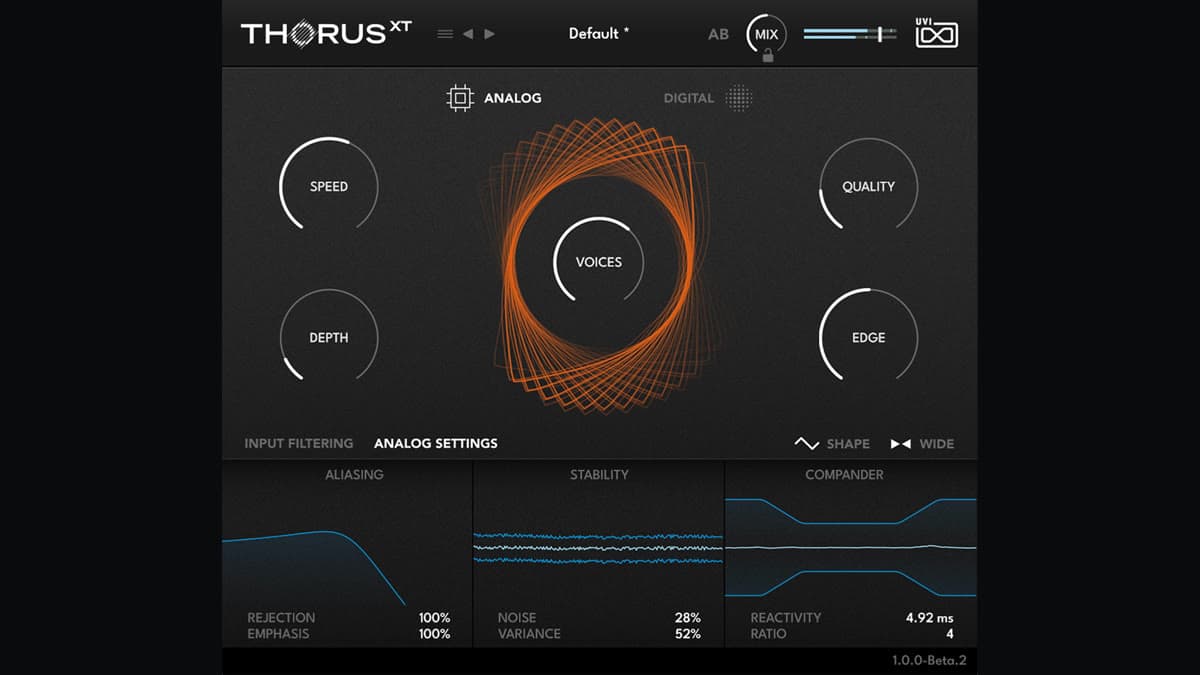
The analog engine is a bucket-brigade chip emulation. UVI's own panel copy: warm, colored, with optional noise, variance, and drift. It enables the Analog Settings panel. That panel is the reason XT exists.
Where the original hardware gave you a knob or two, Thorus XT puts the circuit on the display:
- Aliasing. Hardware filters around the BBD chip. Rejection sets the anti-alias and reconstruction filter cutoff. Emphasis adds resonance at the filter edge.
- Compander. Compressor and expander, originally built for noise reduction, now a tone control. Reactivity runs 1–50 ms. Fast settings let the waveform bleed through as amplitude-modulation distortion. Slower settings let you hear attack and release shape the amplitude. Ratio sets how hard it works.
- Stability. Noise adds modeled analog hiss. Variance spreads each voice's timing and component tolerance.
- Quality, in Analog mode. Sets the BBD clock rate from 1–48 kHz. That is delay-line resolution. Lower it for darker, grittier, foldback-thick tone. Each voice sweeps around that base clock.
Those are not marketing adjectives. They are the parameters UVI printed on the plugin. Guitars, electric pianos, and analog-style polysynth pads are the obvious analog-engine targets. A bright digital pad can go analog if you want the chorus to age the sound instead of polish it.
Shared modulation: voices, speed, depth, edge
The architecture is the same on both engines.
Voices run continuously from 2 to 8. The last voice crossfades in and out. No stepping. Automate voice count and the extra voice arrives as a fade, not a click. Fewer voices give a pronounced, identifiable modulation. More voices blur into a thick wash.
Speed is the rate of the voice modulators, 0.1–1.0 Hz. That is a slow chorus window, not a vibrato LFO that turns into FM.
Depth is modulation in cents, 1–40. It is the amount of pitch variation each voice applies.
Shape sets the modulator waveform as sine or triangle.
Edge is feedback and color. Zero blends feedback to avoid spectral holes. −100% emphasizes time-varying notches. +100% pushes feedback into resonant, self-oscillating peaks.
Stereo Mode places the image. The GUI also exposes a Wide switch. Standard keeps the source's stereo picture. Wide opens it.
Input Filtering is active on both engines: Low Gain, Crossover, and Tone. That is how you keep a sub from getting chorused into a smear, or how you brighten only the top of the wet signal.
Mix is the wet/dry balance. A/B comparison is in the box, as on other UVI effects.
Set the modulation once. Flip Analog and Digital. That is the workflow UVI is selling: one movement, two circuits.
Thorus XT specifications
| Spec | Detail |
|---|---|
| Type | Dual-engine chorus: digital interpolated delay + analog BBD |
| Voices | Continuously variable 2–8, last voice crossfades |
| Digital engine | Shared delay line, interpolated reads; Quality as band-limited sample-rate reduction |
| Analog engine | BBD model (Dimension D / Juno-6 lineage); aliasing, compander, stability, 1–48 kHz clock |
| Modulation | Speed 0.1–1.0 Hz; Depth 1–40 cents; Shape sine/triangle; Edge feedback |
| Filtering | Input Low Gain, Crossover, Tone on both engines |
| Formats | VST3, AU, AAX, standalone |
| macOS | 10.14 Mojave to macOS 26 Tahoe |
| Windows | 10 to 11, 64-bit |
| RAM / disk | 4 GB RAM; ~1 GB disk (Mac installer 271.7 MB, Windows 312.3 MB) |
| Authorization | iLok account (dongle optional); 3 activations, machine or dongle |
| Trial | 3 days; UVI Portal and UVI account required |
| Price | $49 / €49 through 7 September 2026, then $79 / €79; Thorus owners $29 / €29 |
Certified hosts include Live, Logic Pro, Pro Tools 2019+, Cubase, Studio One, Reaper, Bitwig, FL Studio, and Reason.
Thorus XT vs Space Modulator and Colour Copy
The comparisons are a free modulator and a BBD delay. Neither is a dual-engine chorus.
| Thorus XT | Space Modulator | Colour Copy | |
|---|---|---|---|
| Job | Dual-engine chorus (digital + BBD) | Focused modulation / chorus | BBD-style delay |
| Voice architecture | Morphable 2–8, shared controls | Multiple algorithms, one job | Delay taps, not chorus voices |
| Analog circuit controls | Aliasing, compander, stability, clock | No BBD chip panel | BBD color on echoes |
| Formats | VST3, AU, AAX, standalone | VST3, AU, AAX | VST3, AU, AAX, CLAP |
| License | iLok, 3 activations | Valhalla account | u-he |
| Street / list | $49 intro / $79 | Free on our Space Modulator card | €69 on our Colour Copy card |
| Buy from | UVI | Valhalla DSP | u-he / Best Service |
Which to pick. Choose Thorus XT when you want one insert that can be a clean 8-voice chorus or a shapable BBD circuit, and you will actually use both. Choose Space Modulator when you need width or motion for free and you do not need a Dimension-style analog panel. Choose Colour Copy when the job is bucket-brigade delay, not chorus. A BBD delay and a BBD chorus are cousins, not substitutes.
The original Thorus stays a simpler digital chorus if you already own it and never wanted the analog engine. The $29 upgrade is the price of opening that circuit.
Who Thorus XT is for
Consider it if you want a dedicated chorus that can go from transparent widening to grainy analog movement without loading a second plugin.
Consider it if you already own Thorus. $29 / €29 is the upgrade.
Consider it if you mix guitars, electric pianos, or analog-style pads and you want clock rate, hiss, and compander as real controls.
Consider it if three iLok activations and a 3-day UVI trial match how you evaluate effects.
Skip it if a free modulator already does the widening you need. Space Modulator is still free.
Skip it if you wanted a delay. This is chorus. Colour Copy and Valhalla Delay are the echo boxes.
Skip it if iLok is a hard no. The account is free and the dongle is optional, but the license still lives there.
Skip it if you only need a one-knob Juno chorus and you will never open Analog Settings. The original Thorus, or a stock DAW chorus, will do that job cheaper.
How much Thorus XT costs
$49 / €49 through 7 September 2026. $79 / €79 after that. Original Thorus owners upgrade for $29 / €29.
The license is three activations on any mix of machines and iLok dongles. A free iLok account is required. The dongle is not. Internet is required for activation. After that, UVI's usual offline use applies.
The trial is three days through UVI Portal. You need a UVI account. That is shorter than a two-week demo. Use it on a vocal, a pad, and a guitar, Analog and Digital, before the window closes.
Buy Thorus XT from uvi.net/thorus-xt. The plugin card lives at /plugins/uvi-thorus-xt.
Our best free VST plugins list still includes Space Modulator. Thorus XT is paid and dual-engine.
FAQ
Is Thorus XT a new plugin or an update?
It is a new plugin. The digital engine is the Thorus chorus, refined. The analog BBD engine and the shared morphable voice architecture are the XT brief. Original Thorus stays installed.
Should Thorus owners upgrade?
Yes if you want the analog circuit controls: clock rate, aliasing filters, compander, hiss, and variance. $29 / €29 is the upgrade. Skip it if you only ever used Thorus as a clean widener.
Does it need an iLok dongle?
No. A free iLok account is enough. Three activations can sit on machines, dongles, or a mix.
What are the system requirements?
macOS 10.14 through macOS 26. Windows 10 and 11, 64-bit. 4 GB RAM. VST3, AU, AAX, standalone. UVI Portal for install and the 3-day trial.
Thorus XT vs a stock DAW chorus?
Stock chorus is usually two or four voices and a couple of knobs. Thorus XT gives you 2–8 morphable voices, two engines, and an analog panel that hardware never exposed. If you never touch those, keep the stock plugin.
The bottom line
Thorus XT is a dual-engine chorus: the clean interpolated Thorus path and a shapable BBD model on the same 2–8 voice architecture. $49 / €49 through 7 September 2026. $79 / €79 after that. $29 / €29 if you already own Thorus.
This is a first look, not a scored review. We have not printed a vocal through Digital or a Juno-style pad through Analog. Download the 3-day trial, flip the engine switch on one stored modulation setting, and decide whether the analog panel earns the extra money. The live storefront is uvi.net/thorus-xt.