Ultra: One Synth, Five Engines, and UltraWave
Ultra is a flagship multi-synthesis plugin built around the UltraWave engine, with five sound sources, dual filters, 32 voices, MPE, and a perpetual license.
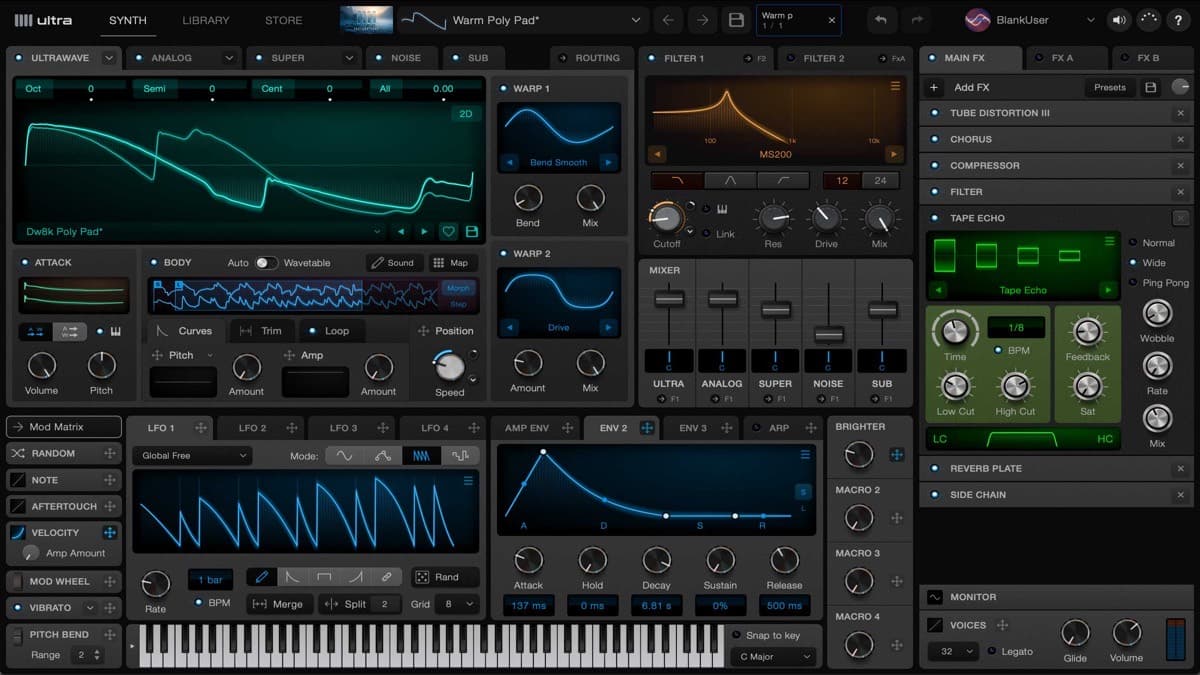
Every few years a synth arrives that wants to be the first instrument you reach for. Ultra, from New Zealand developer Nigel Stanford and his studio Ultra Audio, is making that pitch. It packs five synthesis engines behind one interface and builds everything around a new oscillator type called UltraWave.
The plugin runs on macOS and Windows as a standalone app, a VST3, or an AU. It ships with a perpetual license and lifetime free updates. There is no subscription. That alone sets it apart from the rental models spreading across the plugin world.
What is Ultra?
Ultra is a flagship software synthesizer built around multi-synthesis. Rather than commit to one method, it lets each patch draw on several forms of sound generation at once. Those sources then feed a shared mixer, dual filters, deep modulation, and a full effects rack.
The design goal is range. One instrument that produces clean analog basses, evolving wavetable pads, sampled textures, and gritty digital leads without loading a second plugin. Whether that breadth reads as a strength or a distraction depends on how you work, and we get into that below.
What's inside Ultra?
Ultra's architecture is layered but readable once you follow the signal flow. Here is what each part does.
Five source layers. Each voice can use up to five sound sources: UltraWave, a sampler, a virtual-analog engine, a Roland-style Supersaw, and a noise generator, plus a sub-oscillator. You blend them in a mixer before the filter stage. A single bass can carry an analog core, a wavetable edge, and a noise transient at once.
UltraWave, the headline engine. UltraWave sits between a sampler and a wavetable. It adds pitch, amplitude, and timing data to a wavetable, which lets it play back complex material, including vocal-like sounds, that a plain wavetable engine struggles with. It blends up to four stereo wavetables on the fly, interpolating smoothly between them for movement that feels alive rather than stepped.
A classic virtual-analog core. The analog engine offers three multi-wave oscillators with cross-modulation, a dual-engine Supersaw inspired by the Roland JP-8000 and JP-8080, a flexible noise generator, and a sub-oscillator. The fundamentals for fat analog-style patches are all present before you touch UltraWave.
Dual filters. After the mixer, the oscillator block feeds a dual-filter section. You can split or stack filter characters rather than push everything through one path.
Four LFOs and three envelopes. Modulation is a real strength. Four LFOs offer A/B crossfading and four modes. Basic Shape blends two waveforms, Bezier Curve draws custom shapes, Pattern builds grid-sequenced LFOs, and Random Noise outputs continuous randomness. Three ADSR envelopes with hold stages, plus mod wheel, random, velocity, and aftertouch sources, round out the routing.
A multi-effects rack. The FX section has three parts: Global, A, and B. Algorithms include tube distortion, bit-crusher, chorus, delay, reverbs, filters, OTT-style multiband dynamics, and a gate. You can shape the raw synth into a finished sound without leaving the plugin.
32 voices and MPE. Polyphony ranges from mono to 32 voices. Ultra is MPE compatible, so it responds to per-note expression from controllers built for it.
Advanced WAV import. You can import your own WAV files with automatic cycle extraction, then use multi-sampling with pitch and velocity-based wavetable morphing. That turns field recordings and one-shots into playable UltraWave instruments.
Ultra specifications
| Spec | Detail |
|---|---|
| Type | Multi-synthesis software synthesizer |
| Sound sources | UltraWave, sampler, virtual analog, Supersaw, noise, plus sub-oscillator |
| UltraWave | Blends up to 4 stereo wavetables; adds pitch, amp, and timing data |
| Analog engine | 3 multi-wave oscillators, cross-modulation, dual-engine Supersaw |
| Filters | Dual-filter section |
| Modulation | 4 LFOs (A/B crossfade, 4 modes), 3 ADSR with hold, plus velocity/aftertouch/random |
| Effects | 3 sections (Global/A/B): distortion, bit-crusher, chorus, delay, reverb, OTT, gate |
| Polyphony | Mono to 32 voices |
| Expression | MPE compatible |
| Import | WAV import with cycle extraction; multi-sampling with pitch/velocity morphing |
| Formats | Standalone, VST3, AU |
| System | macOS (Apple Silicon and Intel), Windows |
| Licensing | Perpetual license, lifetime free updates, no subscription |
Ultra vs Serum 2
The natural comparison is Serum 2, the wavetable synth most producers already know. Both are wavetable-forward and both handle modern sound design. They aim in slightly different directions.
| Ultra | Serum 2 | |
|---|---|---|
| Core engine | Multi-synthesis with UltraWave | Wavetable with added synthesis modes |
| Sound sources | 5 layers in one voice | Dual wavetable plus sub and noise |
| Standout feature | Stereo UltraWave, up to 4 tables blended | Refined wavetable editor and visual workflow |
| Polyphony | Up to 32 voices | High polyphony |
| Expression | MPE | MPE |
| License | Perpetual, lifetime updates | Perpetual |
| Price | $249 (intro $149) | Around $199 |
The honest take: Serum 2 remains the reference for a clean, visual wavetable workflow, and its ecosystem of presets and tutorials is unmatched. Ultra counters with breadth, the UltraWave engine, and a rent-to-own path that lowers the entry cost. If you want one synth that spans analog, wavetable, and sampled territory, Ultra is compelling. If you live inside a wavetable editor and value the largest community, Serum 2 is the safer pick. It is also worth weighing Vital if budget is tight, or Phase Plant if fully modular routing is your priority.
Who Ultra is for
Ultra suits sound designers who like to build from many sources at once. It also suits producers who are tired of loading three plugins to cover analog, wavetable, and sampled tones. The UltraWave engine, in particular, rewards people who want motion and organic character rather than static presets. Composers who import their own material will get real mileage from the WAV cycle extraction.
Who should skip it? If you already own a deep wavetable synth and rarely wish for more, the overlap is high. And if a busy interface slows you down, a more focused instrument may serve you better. A small subtractive MPE instrument is the opposite bet. Ultra gives you a lot; you have to want a lot.
How much does Ultra cost?
Ultra sells for $249 at full price, with an introductory price of $149. There is also a rent-to-own plan. You pay fixed monthly installments, keep full access the whole time, and own a perpetual license once you finish, with no payments after that.
Every license includes lifetime free updates, and the developer has signaled more oscillator types and features on the way. You buy Ultra directly from Ultra Audio. When you compare it against wavetable rivals, you can check current synth prices on Plugin Boutique to see where the alternatives land.
For more context on this year's synth wave, our Serum 2 launch coverage, the u-he Zebra 3 rebuild, and the Omnisphere 3 review map out where Ultra fits among 2026's heavy hitters.
FAQ
What makes UltraWave different from a normal wavetable?
UltraWave adds pitch, amplitude, and timing information to a wavetable, so it can play back complex material like vocals convincingly. It also blends up to four stereo wavetables at once, interpolating between them for smoother movement than a single-table oscillator.
Is Ultra a subscription?
No. Ultra uses a perpetual license with lifetime free updates and no subscription. A rent-to-own option exists, but it ends in full ownership rather than a recurring fee.
What are Ultra's system requirements?
Ultra runs on macOS, with native support for Apple Silicon and Intel, and on Windows. It installs as a standalone app, a VST3, or an AU plugin.
Ultra vs Serum 2, which should I buy?
Serum 2 is the reference wavetable synth with the biggest community. Ultra offers wider multi-synthesis and the UltraWave engine, plus a rent-to-own path. Choose Serum 2 for a focused wavetable workflow, Ultra for range in a single instrument.
Ultra is an ambitious first flagship: five engines, a genuinely new oscillator, deep modulation, and an owner-friendly license. It will not unseat Serum overnight. But UltraWave gives it a real identity, and the breadth makes it a synth worth auditioning before you buy your next one.