Some links on this page are affiliate links. If you buy through them, Dubspot may earn a commission at no extra cost to you. It never affects our scores or what we recommend — read our policy.
Audio Damage Tessera: Sequenced Resonator First Look
Audio Damage Tessera turns any input into tuned chords using 12 resonator voices, 11 physical models and five motion engines. A look at the specs and price.
M
Marcus Feld
August 6, 2026 · 7 min read
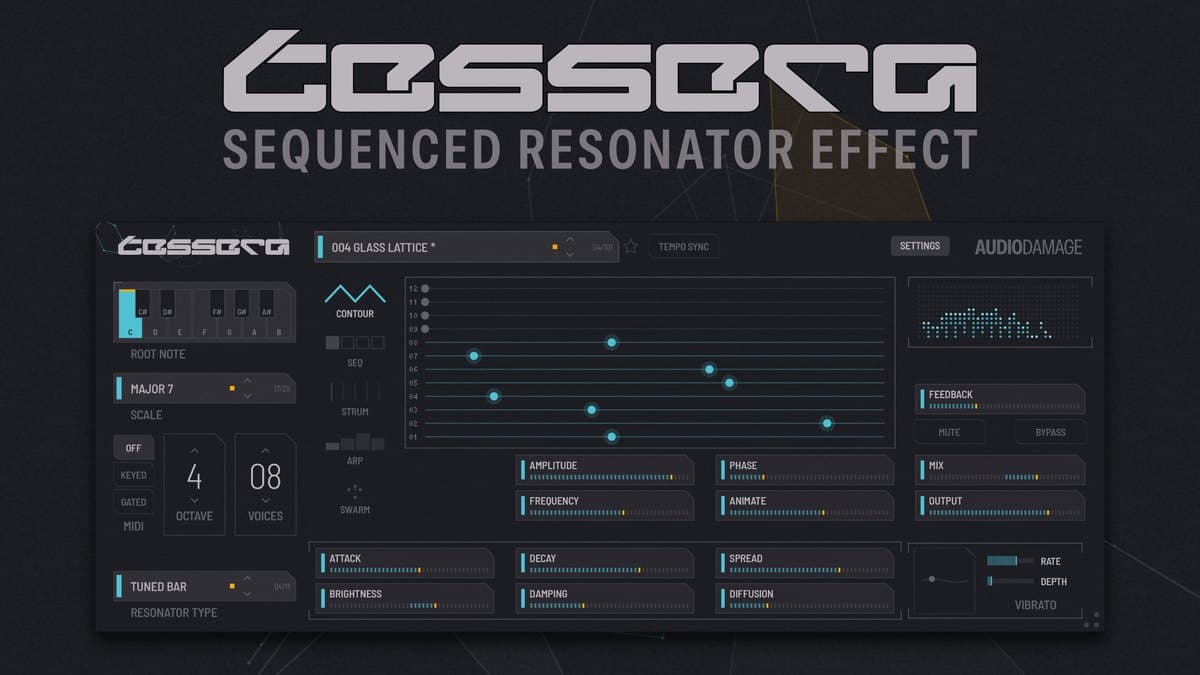
Most effects decorate a sound. Tessera rewrites its pitch content. Audio Damage's newest plugin, released in July 2026, takes whatever you feed it and uses that signal to excite twelve tuned resonator voices, each one pitched to a note of a chord or scale you pick. Hit it with a dry drum loop and every kick, snare and hat rings out as a chord in key.
That basic idea is not new. Modal filters and physical-modeling resonators have been around in both hardware and software for years. What makes Tessera worth a closer look is the layer on top: five motion engines that decide how and when those twelve voices speak.
Tessera at a glance
- What it is: a tuned resonator effect for Mac, Windows, Linux and iOS
- Engine: twelve parallel pitched resonator voices, excited by your input signal
- Models: eleven resonator types, from plucked string to Tibetan bowl
- Motion: five tempo-syncable engines — Contour, SEQ, Strum, Arp, Swarm
- Presets: 100 factory patches
- Price: $39 intro, $49 regular (desktop) and $4.99 on iOS
- Licensing: perpetual, no DRM, no dongle, no subscription
How the sequenced resonator engine works
Twelve voices, one chord
The core is a parallel bank of twelve resonators. You choose a root note and a scale, and the entire bank retunes at once. Audio Damage's scale list runs from simple triads and sevenths through extended and chromatic voicings. The interface shows 29 options.
The resonators respond to audio rather than an oscillator, so the input's character survives. A tight closed hat produces a short, bright chord. Nothing needs to be in key going in — Tessera imposes the tuning.
Tessera supports MTS-ESP for microtonal work. Connect a tuning master in your session and the twelve voices follow its table instead of equal temperament.
Eleven resonator models
Two of the models are waveguides: a plucked Karplus-Strong string and a bowed string. The other nine are banded-waveguide bodies — Uniform Bar, Tuned Bar, Glass Harmonica, Tibetan Bowl, Membrane, Bell, Plate, Clamped Bar and Closed Tube.
The spread matters more than the count. Clamped Bar and Bell push hard into inharmonic, metallic territory, while the string models stay clean and clearly pitched. Attack, Decay, Damping, Brightness and Spread shape every model. Spread also sets how far the twelve notes fan across the stereo field.
Five motion engines
This is the part that separates Tessera from a static resonant filter bank:
- Contour spreads the twelve voice entries into a shaped arpeggiated wave, with amplitude, frequency and phase controls
- SEQ is a step sequencer that places each voice on its own step of the pattern
- Strum rakes across the chord like a pick, with spread, direction, curve and rate
- Arp cycles voices one at a time with rate, gate and note order
- Swarm lets voices drift around a moving center for unsettled textures
All five lock to host-tempo beat divisions. Two stages sit downstream. Diffusion smears the tails toward reverb, and Feedback recirculates the resonators into self-sustaining washes.
Three ways to play it
Tessera works with no MIDI at all. Three modes cover different jobs:
- MIDI off — the resonators self-tune to the root and scale you set, which makes Tessera a genuine insert effect on an audio track
- MIDI on — you key the twelve voices live from a keyboard
- Gated — voices only speak while notes are held
Gated mode turns Tessera into a performance instrument rather than a set-and-forget processor.
What it sounds like in demos
Percussion is the obvious entry point, and the demos lean into it hard. Dry loops come back as rhythmic chord clouds, and the pattern of the original hits survives underneath the new harmony. Drums come up again and again as the sweet spot.
Sustained sources behave differently. Held guitar, vocal drones and pads push Tessera toward generative work — start SEQ or Swarm and the twelve voices reshuffle themselves without further input. Push Feedback and the result becomes a drone that keeps going after the source stops.
Two criticisms come up repeatedly. Twelve simultaneous resonant voices can stack up muddy in a dense mix, though a post-EQ generally sorts that out. The maximum decay also reads as short on some models, and there is clear appetite for a freeze function.
How it compares
Tessera lands in a crowded corner. Modal filter plugins already morph between body types, and delay-plus-resonator tools already push signals through a drum head or plate. Those tools mostly give you one resonant body. Tessera gives you twelve, tuned to a chord, with a sequencer deciding when each one fires.
That distinction seems to be holding up. Producers who have lined Tessera up against rival resonator plugins tend to keep both, treating it as an addition rather than a replacement. The most common comparison is to hardware sequenced-resonator boxes, which Tessera is said to cover well enough.
Be clear about what Tessera is not. It is not a reverb, even though long Decay plus heavy Diffusion gets you a lush resonant space. That space rings in key rather than staying neutral, which is a different job from anything in our reverb plugin roundup. If you want a physics engine you build from scratch, Anukari is the more extreme option, and Korg's Phase8 covers acoustic modeling as a full instrument.
Price, formats and licensing
Desktop Tessera costs $39 as an introductory price, down from a $49 regular price, sold direct from Audio Damage. The intro is described as launch-month pricing, so expect it to end around late August 2026, though no official end date has been published. Storefronts display local currency, so GBP and EUR figures vary.
Formats are broad. Windows 10 or newer gets CLAP, VST3 and AAX. macOS 10.13 or newer covers Intel and Apple Silicon with CLAP, VST3, AU and AAX. Linux users on Ubuntu 20 or later get CLAP, VST3 and LV2, shipped the same day. All desktop builds are 64-bit only.
A fully functional demo covers all three desktop platforms, with a 20-minute session timer and saving disabled. The paid version carries no copy protection — perpetual license, no iLok, no subscription, install it everywhere you work.
The iOS and iPadOS version is a separate $4.99 purchase, not bundled with the desktop license. It runs as AUv3 and standalone on iOS 12 or newer, and at 32 MB it is small enough to drop into any AUv3 host — including AUM. At that price it is close to an impulse buy, and mobile producers have responded warmly.
Open questions
A few things remain genuinely unresolved. The iOS price is reportedly introductory too, but the App Store listing shows only $4.99, and no regular price has been confirmed. Tessera is also not listed at Plugin Boutique as of early August 2026, so the official store is currently the only desktop route.
The marketing is the odd part of this launch. Audio Damage published no audio demos or video walkthroughs on the product page at release — a strange gap for a plugin whose entire pitch is a sound you have to hear.
Worth a demo
Tessera is a specific tool, not a utility you will reach for every session. But chordal resonance plus sequenced motion is an uncommon combination, and the price is low enough that the real question is whether you want the sound at all.
The demo answers that faster than any spec sheet. Twenty minutes on a drum loop with the Glass Harmonica model and a minor triad tells you most of what you need to know. A parallel blend of three filter models, rather than a sequenced resonator, is what Filter Blender is built for.