UB DSP Filter Blender First Look 2026
UB DSP Filter Blender mixes three of twelve analog filters on a triangle, for Mac, Windows, and Linux. It is $39 until 15 November 2026, then $68 USD.
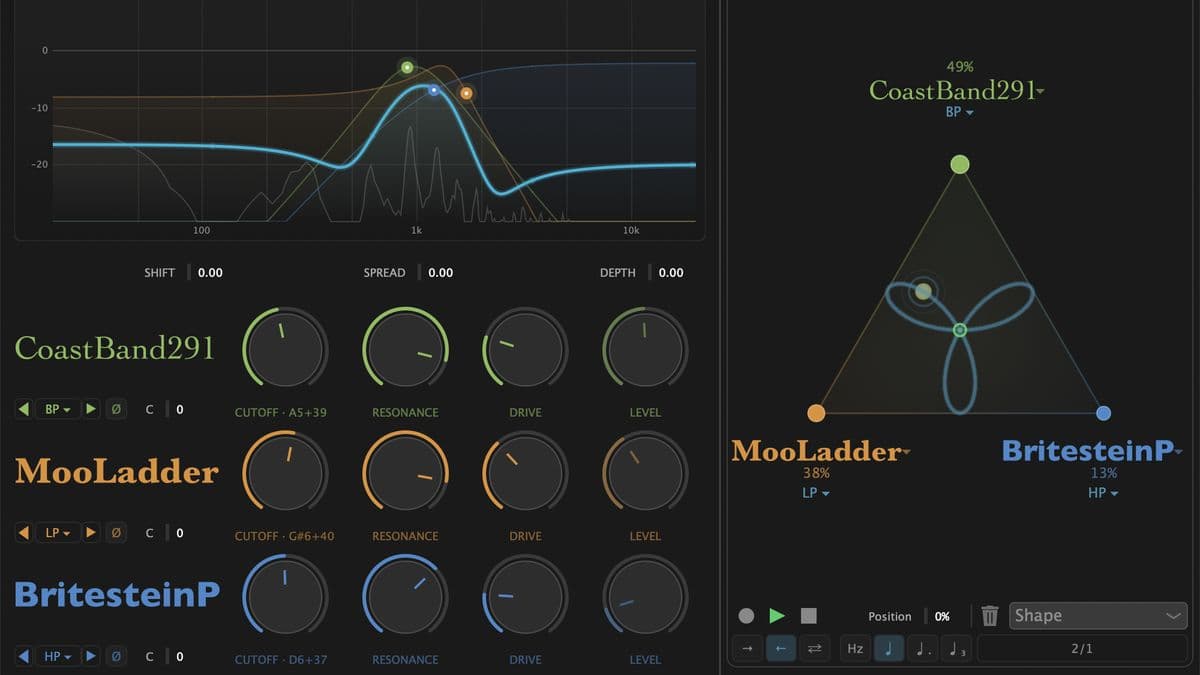
UB DSP released Filter Blender on 2 October 2026. Version 1.0.2 blends any three of twelve analog-style filter models on a triangle. Park the dot in a corner and you hear one circuit. Move it and the other two come in, in parallel, by distance. The launch price is $39 until 23:59 CET on 15 November 2026. After that it is $68. This is a first look from the official product page and manual, not a hands-on review.
At a glance: Filter Blender runs on Mac, Windows, and Linux as AU, VST3, CLAP, and AAX where the format exists. There is no standalone app and no dongle. A full-function trial inserts two seconds of silence every forty seconds. Owners of Grit Blender or Vowel Blender see an extra discount on the launch price once they are logged in.
What the triangle actually does
Most multi-filters ask you to pick a model, then modulate cutoff. Filter Blender asks you to pick three models and a point between them. Each corner has its own cutoff, resonance, drive, and polarity. The blend is parallel. A corner you are not using is not computed, so a parked dot is a single filter.
Slopes are fixed per circuit, at two, three, or four poles. You change steepness by blending, not by a slope menu. The filters use zero-delay feedback. The four-pole ladders solve with Newton-Raphson. Eight of the models can self-oscillate. The dual band-pass can ping.
Modes depend on the circuit. Low-pass, high-pass, band-pass, notch, and bell show up where that model has them. Only the pole-mixing multimode offers bell. Cutoff runs from 20 Hz to 20 kHz and is also shown as a note. MorphPoleX can tune its self-oscillation to that displayed note.
Twelve models, then a chain in series
The twelve descriptions on the product page cover a warm four-pole transistor ladder, a three-pole diode ladder, a two-pole state-variable, a Sallen-Key with hard-clip diodes, a bright multimode with positive feedback, a creamy four-pole OTA, a lo-fi CMOS filter, two West Coast band-passes, a three-pole diode bridge, a state-variable with an envelope follower, a swept vocal band-pass, and a pole-mixing multimode. Names in the set include MooLadder, LushJup8, MorphPoleX, ScreamKor20, and CrunchWasp.
After the triangle, or before it, you can insert a series chain in any order:
- Comb delay
- A phaser with up to 24 allpass stages
- A vowel stage with ten vowels, one morph, four formant band-passes, plus shift and Q
- Ring modulation
That vowel stage is a compact formant filter inside Filter Blender. It is not the full Vowel Blender plug-in. Treat it as a color in the chain, not a replacement if vowel morphing is the whole session.
Motion, modulators, and the output section
The motion recorder draws a path on the triangle, then retimes it to a constant speed. Playback can be free or locked to tempo, including dotted and triplet rates, and it can run forward, reverse, or ping-pong. Shapes include circle, triangle, and rosette. The path keeps running in the audio engine when the window is closed, and it saves with the preset.
You also get up to sixteen modulators, and they can modulate each other. The nine types are LFO, MSEG, step sequencer, audio-rate oscillator, envelope generator, envelope follower, macro, MIDI, and XY. There is no external sidechain input. Envelope followers listen to the plug-in's own input. MIDI reaches the MIDI modulator and the envelope's MIDI mode: keytrack, velocity, channel aftertouch, per-note pressure in CLAP hosts that send it, and the mod wheel on CC1.
Output controls matter once three driven filters are summing. LOWS is a 24 dB/octave crossover from 20 to 500 Hz that bypasses the filters and effects, so the sub can stay intact. MIX and a loudness match sit next to input and output trims of plus or minus 24 dB. The limiter is off, brickwall, or soft, with about 1.5 ms of lookahead, and it is off by default. HUSH is there for the noise floor. Stereo modes are left/right, mid/side (filters on the center, sides pass), and mono.
Oversampling is 1x, 2x, or 4x, plus an automatic 2x when an audible corner goes above 8 kHz. Latency is always 47 samples, about 1 ms at 48 kHz. Macros cover shift of plus or minus two octaves on every cutoff, spread, depth, and link. The window scales from 850 by 520 up to 1500 by 1200, with A/B and 29 steps of undo. Thirty factory presets sit in eight categories. Presets are .fbpreset files. Bitwig and REAPER show them in the host browser over CLAP.
Filter Blender specifications
| Spec | Detail |
|---|---|
| Type | Parallel blend of three analog-style filters, plus a series effect chain |
| Developer | UB DSP |
| Version | 1.0.2, first released 2 October 2026 |
| Models | 12, any three on the triangle |
| Per corner | Cutoff, resonance, drive, polarity |
| Series chain | Comb, phaser (up to 24 stages), vowel, ring mod |
| Modulators | Up to 16, nine types, including a drawn triangle path |
| Sidechain | None. Envelope followers use the plug-in input |
| Latency | 47 samples |
| Oversampling | 1x, 2x, 4x, plus auto 2x above 8 kHz |
| Mac | AU, VST3, CLAP, AAX. macOS 10.13 or later, Apple Silicon and Intel |
| Windows | VST3, CLAP, AAX, 64-bit |
| Linux | VST3 and CLAP, 64-bit |
| Licence | Offline keyfile, up to three computers, free lifetime updates |
| Price | $39 until 23:59 CET on 15 November 2026, then $68 |
Filter Blender vs Volcano 3 and FilterShaper 3
FabFilter Volcano 3 is the obvious premium comparison. It is four analog-modeled filters with flexible routing and FabFilter's modulation system. Best Service lists Volcano 3 at $129 excluding VAT, with $139 shown beside that price. Filter Blender is $39 until 15 November, then $68, sold direct.
Cableguys FilterShaper 3 is the rhythmic alternative. You draw LFO shapes and the filter follows the drawing. Cableguys currently lists it at 49 euros, down from 79 euros, and the product page marks that reduction as a Black Friday deal. It does not blend three different analog circuits on a triangle.
| Filter Blender | Volcano 3 | FilterShaper 3 | |
|---|---|---|---|
| Job | Blend three of 12 filter models | Four analog-modeled filters and deep modulation | Drawn LFO shapes on a filter |
| Street price | $39 until 15 Nov 2026, then $68 | $129 excl. VAT at Best Service | 49 euros, from 79 euros |
| Where | UB DSP, direct | Best Service | Cableguys |
| Linux | Yes | No | No |
| External sidechain | No | Yes, in the FabFilter feature set | Host-tempo drawing, not a key input |
| Reach for it when | You want to morph filter character | You want FabFilter routing and modulators | You want a rhythm drawn by hand |
Audio Damage Tessera is a different tool again, a sequenced resonator rather than a filter blend. Use it when the part needs pitched resonance steps. Use Filter Blender when the part needs two or three filter tones at once.
Who it is for
Buy it if you already reach for more than one filter model on a bass or a drum bus, and you want that choice on one control. The launch price is the reason to decide before 15 November. Linux support is real, which drops a lot of filter plug-ins out of the running.
It is a strong add-on if you own Grit Blender or Vowel Blender and the logged-in discount applies to your account. The vowel stage here is smaller than Vowel Blender. Keep both if formants are a main effect.
Skip it if you need an external sidechain, a standalone instrument, or a filter that is only a cutoff knob. Skip it if you already live in Volcano 3 and you will not use the triangle. The trial's two seconds of silence every forty seconds is fine for a sound check and annoying for a full mix, so buy or move on once you know the circuits.
How much does Filter Blender cost?
$39 until 23:59 CET on Sunday 15 November 2026, which is 2:59 pm Pacific the same day. The regular price after that is $68. There is a 30-day money-back period. The trial is the full plug-in, unlimited in calendar time, with two seconds of silence every forty seconds. The licence is an offline keyfile for up to three computers, with free lifetime updates, and no activation server.
You buy it on the Filter Blender page. It is not listed at Plugin Boutique, Thomann, or Best Service.
UB DSP has tested it in Ableton Live, Bitwig, Logic, Pro Tools, and REAPER. In Logic, load it as a MIDI-controlled effect if you need the MIDI modulator. macOS builds cover 10.13 and later on Apple Silicon and Intel. Pre-10.13 is not tested. Windows and Linux builds are 64-bit.
FAQ
What is the Filter Blender launch price?
$39 until 23:59 CET on 15 November 2026. The price after that window is $68. Owners of Grit Blender or Vowel Blender get a further discount on the launch price, shown when logged in.
Does Filter Blender run on Linux?
Yes. Linux gets VST3 and CLAP, 64-bit. Mac also gets AU and AAX. Windows gets VST3, CLAP, and AAX. There is no standalone app.
Can I sidechain it?
No external sidechain input. Envelope followers listen to the audio coming into the plug-in. MIDI control covers the MIDI modulator and the envelope's MIDI mode, including per-note pressure in CLAP hosts that send it.
How is the vowel section different from Vowel Blender?
Filter Blender's vowel block is one stage in the series chain: ten vowels, one morph, four formant band-passes, shift, and Q. Vowel Blender is the separate plug-in. Buy that one if the vowel is the effect, not a stop in a filter chain.
What is the latency?
Forty-seven samples at every sample rate, about one millisecond at 48 kHz. The optional limiter adds about 1.5 ms of lookahead and is off by default. Oversampling is 1x, 2x, or 4x, and the plug-in can switch to 2x on its own when a corner that you can hear crosses 8 kHz.