Sinevibes Malfunction v3: The Circuit-Bent Filter Returns
Malfunction v3 rebuilds Sinevibes' circuit-bent filter with two bend modes, 4x oversampling, a 4-stage filter and two LFOs, for Mac, Windows and Linux at $29.
Dubspot's best Black Friday dealsDubspot Tracker Pro: $15, was $24.99 ↗Drum Programming and Groove Production Course: $19, was $99 ↗
Sinevibes released Malfunction v3 on 29 October 2026, the third generation of the circuit-bent filter it first launched in 2013. The headline is reach: a plug-in that was a Mac-only cult tool now runs on Mac, Windows and Linux. Underneath, the bent-filter algorithm has been rebuilt with a second character mode and 4x oversampling, the clean filter now stacks up to four stages, and two through-zero LFOs animate both. It costs $29, at Sinevibes and at Plugin Boutique.
At a glance: circuit-bent filter with two character modes and 4x oversampling; input noise gate; multi-mode state-variable filter with up to four stages (to -48 dB/octave) in low-pass, high-pass, band-pass, notch and peaking; two stereo LFOs with 15 waveforms, BPM and transport sync; AU, VST3 and AAX on macOS 10.13+, VST3 and AAX on Windows 8.1+, VST3 on Linux. $29, demo available. The cheapest way to make a clean sound misbehave on purpose.
What is Malfunction?
Circuit bending is the hardware hacker's trick of opening a device and rewiring it until it does something its designers never intended. Malfunction does a software version of that to a filter. Sinevibes took a filter model and deliberately tampered with its internal connections, so instead of smoothly removing frequencies it produces a rough, screaming distortion that tracks the input in odd and expressive ways. Feed it a simple saw bass or a dry kick and it comes back glitchy, unstable and full of character.
That makes it a different animal from a saturator. A saturator adds harmonics in a predictable, musical order. Malfunction is closer to a broken resonant filter being overdriven, and the result moves with cutoff, resonance and the material you send it. It sits in the same creative-mangling corner as FabFilter Volcano 3 and Soundtoys FilterFreak, but at a fraction of their price and with a much narrower, nastier personality.
What's new in Malfunction v3
A rebuilt bent filter with two characters
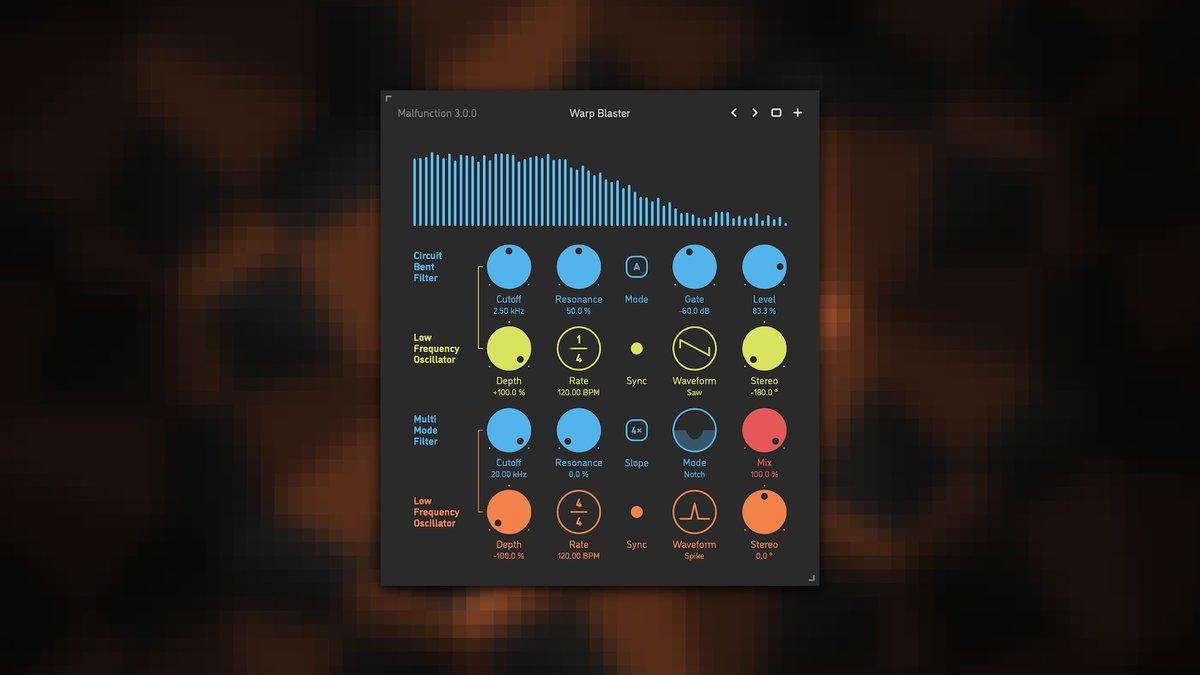
The core algorithm has been upgraded, and it now has two distinct character modes. You switch between them with the Mode control in the circuit-bent filter section, next to Cutoff, Resonance, Gate and Level, so the same patch can flip between two flavours of breakage without rebuilding the settings around it.
4x oversampling against aliasing
A deliberately broken filter throws off a lot of high-frequency content, and at the base sample rate anything above the Nyquist limit folds back down as aliasing that has nothing to do with the note. v3 runs the algorithm with 4x oversampling to suppress that. The practical effect is distortion that stays aggressive but less brittle, which matters most on high synth leads and bright drums.
Input noise gate
An adjustable input gate sits in front of the bent filter. Malfunction's character is to amplify everything, including the hiss and room tone between hits, so the gate keeps tails and gaps quiet. On a drum loop it is the difference between crunchy hits and a constant wall of fizz.
A four-stage multi-mode filter
After the mangling comes a smooth state-variable filter with five modes: low-pass, high-pass, band-pass, notch and peaking. It can run up to four sequential stages for a slope of up to -48 dB/octave, and a Mix control blends it in. A steep low-pass tames the top of a screaming patch; a band-pass carves it into a telephone-like midrange; the notch and peaking modes give it a vocal, phasey edge when modulated.
Two through-zero LFOs
Each filter has its own LFO with Depth, Rate, Sync, Waveform and Stereo controls. The LFOs use a through-zero phase design, offer 15 bipolar and unipolar waveforms, sync to BPM and transport, and have a variable bipolar stereo offset so left and right can move apart. Lag filters on every continuous parameter keep sweeps and automation click-free.
Mono, stereo and cross-platform
Malfunction handles mono-to-mono, mono-to-stereo and stereo-to-stereo, so a mono bass can come out wide when the stereo LFO offset is in play. The new cross-platform builds are the biggest change for most readers: v2 users were on Mac, and v3 reaches Windows and Linux for the first time.
What it sounds like
Sinevibes' own demos show the range. An AudioRealism ABL3 acid bassline goes from squelchy to shredded across six factory presets. A Roland TR-909 kick sample turns into a growling, pitched thump, and an Elektron Analog Four mkII electro break becomes a glitchy, half-broken groove. The common thread: the effect is most rewarding on simple, harmonically plain sources, where the bent filter has room to invent detail. On dense full mixes it quickly becomes too much.
Malfunction v3 specifications
| Spec | Detail |
|---|---|
| Type | Circuit-bent filter effect |
| Bent filter | Two character modes, 4x oversampling; Cutoff, Resonance, Mode, Gate, Level |
| Gate | Input noise gate with adjustable threshold |
| Multi-mode filter | State-variable, 1 to 4 stages (up to -48 dB/octave); LP, HP, BP, Notch, Peaking; Mix |
| LFOs | 2 stereo LFOs, through-zero phase, 15 waveforms, BPM and transport sync, bipolar stereo offset |
| Smoothing | Lag filters on all continuous parameters |
| Channels | Mono to mono, mono to stereo, stereo to stereo |
| macOS | AU, VST3, AAX; macOS 10.13 or later, Apple Silicon and Intel |
| Windows | VST3, AAX; Windows 8.1 or later, 64-bit |
| Linux | VST3; Linux 2020 or later, 64-bit |
| Price | $29; demo available |
Malfunction v3 vs Volcano 3 vs FilterFreak vs Trash 2
| Malfunction v3 | FabFilter Volcano 3 | Soundtoys FilterFreak | iZotope Trash 2 | |
|---|---|---|---|---|
| Price | $29 | $149 | $149 | $99 |
| Role | Circuit-bent filter distortion | Creative multi-filter | Analogue-modelled modulated filter | Multi-stage distortion |
| Character | Rough, glitchy, unpredictable | Clean to driven, precise | Warm, rhythmic sweeps | Broad, from warm to destroyed |
| Linux | Yes (VST3) | No | No | No |
| Pick it if | You want instant character for very little money | You want deep, surgical filter modulation | You want classic synced filter movement | You want one distortion box for everything |
Which to pick: Volcano 3 and FilterFreak are the better general-purpose filters, and Trash 2 covers far more distortion styles. None of them sounds like Malfunction, though, and at $29 it is an add-on rather than a replacement. Buy it as the effect you reach for when a part needs to break, and keep a proper filter for everything else. For more ways to add grit, see our best saturation plugins guide and the free-and-cheap angle in our TAL-Bitcrusher coverage.
Who Malfunction v3 is for
Buy it if you make techno, electro, IDM, industrial or experimental music and want acid lines, drums and synths to sound unstable and alive; if you are a Linux producer short of characterful effects; or if you are a sound designer building glitch and sci-fi textures on a budget.
Skip it if you want transparent filtering or polite saturation, because Malfunction's whole point is that it misbehaves. It is a single-purpose effect with one sound family, so if you only buy one creative filter, Volcano 3's breadth is better value per use. Windows users still on VST2-only hosts are out of luck, since the Windows builds are VST3 and AAX.
How much does Malfunction v3 cost?
- $29 direct from Sinevibes, with a free demo and the manual on the Sinevibes Malfunction page.
- $29 at Plugin Boutique.
Sinevibes also makes a hardware-synth version, KORG Malfunction, for the prologue, minilogue xd, NTS-1, NTS-1 mkII, NTS-3 and microKORG2, sold separately. Our Malfunction v3 plugin page tracks the price.
Price-timing note: Malfunction v3 is already $29 at full price, so Black Friday has little to add. Try the demo on a drum loop and an acid line and decide on the sound, not the calendar.
FAQ
Does Malfunction v3 run on Windows?
Yes. v3 is the first cross-platform version: VST3 and AAX on 64-bit Windows 8.1 or later, alongside AU, VST3 and AAX on macOS and VST3 on Linux.
What is a circuit-bent filter?
It is a filter model whose internal connections have been deliberately tampered with, the software equivalent of rewiring hardware. Instead of cleanly removing frequencies, it produces a rough, screaming, glitchy distortion that responds to cutoff, resonance and the input.
What's new in Malfunction v3?
A rebuilt bent-filter algorithm with two character modes and 4x oversampling, an input noise gate, a state-variable filter with up to four stages and five modes, two through-zero stereo LFOs with 15 waveforms, lag filters on all parameters, and Windows and Linux support.
Is there a Malfunction v3 demo?
Yes. Sinevibes offers a free demo download and the manual on its Malfunction page.
Malfunction v3 vs FabFilter Volcano 3?
Volcano 3 ($149) is a deep, precise multi-filter for any job. Malfunction v3 ($29) is a single-purpose circuit-bent distortion filter with a far rougher character. They complement each other more than they compete.
Verdict
Malfunction v3 takes one of the stranger effects of the last decade and makes it better and more widely available. Two bend modes and 4x oversampling refine the sound without taming it, the noise gate and four-stage filter make it far easier to control, and the two stereo LFOs keep it moving. Windows and Linux support finally opens it to producers outside the Mac world. It is a one-trick effect by design and can overwhelm dense sources. At $29, with a demo to prove it on your own material, that one trick is an easy buy for anyone who wants their bass, drums and synths to sound beautifully broken.