Some links on this page are affiliate links. If you buy through them, Dubspot may earn a commission at no extra cost to you. It never affects our scores or what we recommend — read our policy.
Inside Stagecraft Cenere: Audio-Rate Vintage Subtractive
Stagecraft Cenere pairs vintage oscillators and morphing SVF filters with audio-rate automation, 9-layer unison, and 20+ FX. $200. VST3, AU, AAX, standalone.
M
Marcus Feld
September 14, 2026 · 10 min read
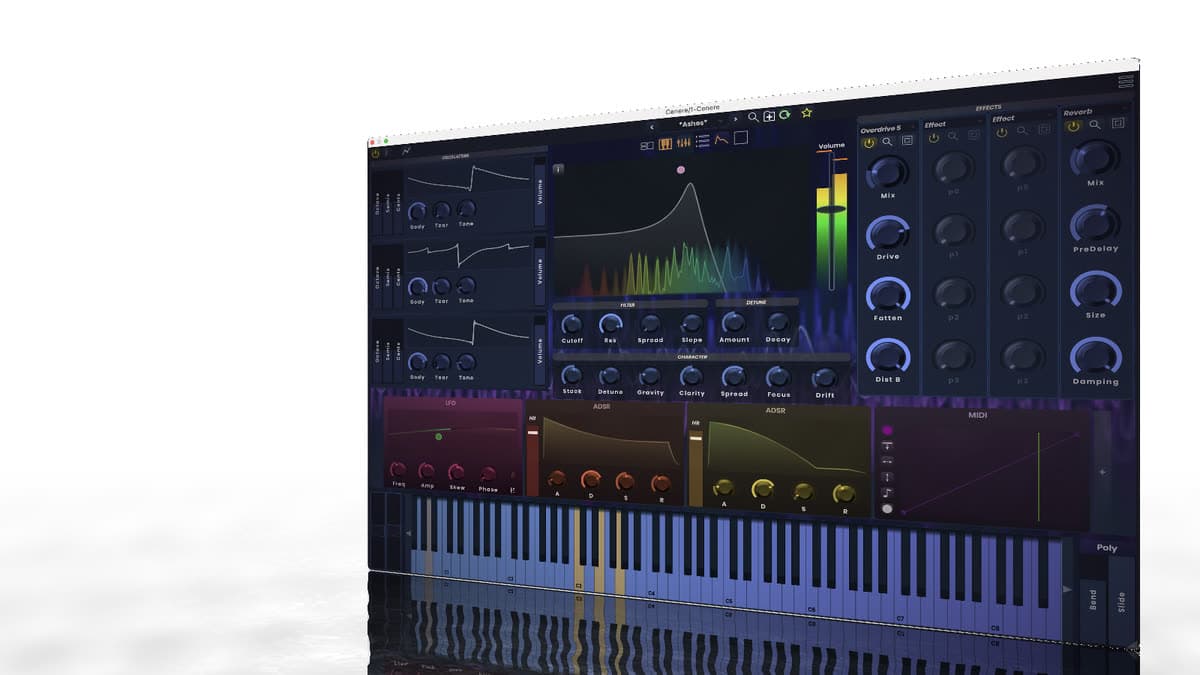
Stagecraft Software sells Cenere as a subtractive synthesizer with vintage oscillators and modern wavetables. The product key is $200. It ships as VST3, AU, AAX, and a standalone app on Windows 10+ and macOS 11 Big Sur+, 64-bit.
At a glance: $200 for a product key. Vintage-style oscillators with real-time hard sync. Analog-modeled morphable SVF filters from 12 to 96 dB/oct, audio-rate filter modulation, and an audio-rate automation suite. Nine-layer unison with spread, gravity, and drift. Velocity, aftertouch, MPE, and note-pitch modulation. Polyphonic portamento. Click-to-link modulation. Twenty-plus effects. Buy it from stagecraftsoftware.com.
This is a first look at the shipping plugin and the official product page. We have not run Cenere in a session yet.
What Cenere is
Cenere is a one-instrument subtractive voice that Stagecraft built to sound like analog hardware and still move like a modern wavetable synth. The official brief is specific: capture vintage oscillator character, then push it through analog morphing filters, nine unison layers, and an automation suite that can run at audio rate. The range they print is a sweet organ on one end and a growling lead on the other.
That puts it next to analog-modelled subtractive we already cover, and next to hybrid flagships that add wavetables as a second job. Diva is the circuit-modelled vintage path. Pigments 6 is the multi-engine flagship. Serum 2 is the wavetable desk reference. Cenere is narrower than Pigments and Serum. It is one subtractive instrument with wavetable oscillators, a morphing SVF, and modulation that is meant to run as fast as the audio.
Stagecraft's other instruments sit on the same shop. Addiction Synth is the simpler subtractive sibling. Cenere is the deeper one: hard sync that runs in real time, filter slopes that go to 96 dB/oct, and click-to-link modulation instead of a buried matrix.
The signal flow is the teaching point as well as the architecture. Oscillators, filter, unison, effects. Stagecraft says that layout is there so a new user can see how a subtractive synth is wired. The automation suite is the reason a sound designer stays.
Vintage oscillators and real-time hard sync
The oscillators are the vintage half of the pitch. Stagecraft calls them vintage-style, then pairs them with modern wavetables. That is the split: analog-shaped source tones, plus wavetable spectra when you want the modern edge.
Hard sync is a first-class claim. Real-time hard sync means the slave oscillator resets on the master's cycle while you play, not as a frozen waveform trick. That is how you get the tearing lead, the locked bass, and the harmonic scrape that subtractive synths have used since the 1970s. If you only ever load a saw and a filter, you are leaving the oscillator section idle.
Wavetables sit on the same voice. Use them when a vintage analog wave is too simple and you want spectral motion before the filter. Use the vintage shapes when you want the oscillator to sound like hardware and let the SVF and unison do the damage.
Morphing SVF filters and audio-rate filter mod
Stagecraft puts the character in the filter. Cenere uses analog-modeled state-variable filters with topology morphing in real time, plus analog-style saturation. The slopes run from 12 to 96 dB/oct. That is a wide range: 12 dB for an open, musical cut, 24 dB for a classic subtractive voice, and the steeper settings for a wall.
Every filter parameter can be modulated at audio rate. That is not an LFO parked on cutoff. Audio-rate filter modulation is how you get growls, FM-like sidebands, and the kind of movement that a 2 Hz LFO will never write. Pair it with the morphing topology and the filter becomes a second oscillator.
The official line is that these filters are meant to match vintage analog gear and still give you extreme control. Saturation is part of that model. Drive the filter when you want the circuit, not only the slope.
The automation suite
Stagecraft calls the automation suite the most powerful part of Cenere. You can automate every parameter at audio rate. The use cases they print are a rhythmic bass wobble and a slow, quantized texture that fades in and out with mathematical precision. Both are the same engine. The difference is the rate.
Audio-rate automation is millisecond-level motion. A conventional DAW automation lane is not the same job. You draw or link a modulator inside the synth, then let it rewrite cutoff, wavetable position, unison drift, or an effect at the speed of the waveform. That is how a static patch starts to feel played.
Click-to-link modulation is the routing. You do not hunt a 50-slot matrix. You click a source and a destination. Arbitrary links are the official phrase: any modulator to any target the suite exposes. Velocity, aftertouch, MPE, and note pitch are listed as modulation sources, so expression can sit on the same links as the LFOs and the audio-rate paths.
MPE and aftertouch matter if you play. Note-pitch modulation matters if you want the filter or a wavetable index to follow the keyboard. Velocity is the obvious first mapping. The suite is what turns those sources into a patch instead of a MIDI learn afterthought.
Nine-layer unison, portamento, and the FX rack
Unison is nine layers. Spread, gravity, and drift are the three controls Stagecraft names. Spread is the stereo and detune width. Drift is the analog instability. Gravity is the pull that keeps the stack from becoming nine unrelated oscillators. The official pitch is analog gear pushed to the max. That is a stacked lead, a thick bass, or a pad that does not sit still.
Polyphonic portamento is on the same voice. Glide works across chords, not only a mono legato line. That is a different instrument from a one-finger 303 glide. Use it when you want the chord to smear, then let unison drift finish the motion.
The effects rack is twenty-plus modules. Stagecraft's product shot shows the usual finishing tools: drive, delay, reverb, and a mix stage after the voice. The official instruction is simple. Shape the subtractive voice, then run it through effects. The synth is meant to leave the plugin finished, not as a dry oscillator waiting for a send.
Cenere specifications
| Spec | Detail |
|---|---|
| Type | Subtractive synthesizer with modern wavetables |
| Oscillators | Vintage-style waves, wavetables, real-time hard sync |
| Filter | Analog-modeled morphable SVF, 12–96 dB/oct, audio-rate mod, saturation |
| Modulation | Audio-rate automation suite, click-to-link routing |
| Performance | Velocity, aftertouch, MPE, note-pitch mod, polyphonic portamento |
| Unison | 9 layers with spread, gravity, and drift |
| Effects | 20+ onboard modules |
| Formats | VST3, AU, AAX, standalone |
| System | Windows 10+, macOS 11+ (Big Sur+), 64-bit |
| Demo | 30-day demo, then a product key |
| Price | $200 product key, sold direct |
Cenere vs Diva and Pigments 6
| Cenere | Diva | Pigments 6 | |
|---|---|---|---|
| Job | Subtractive + wavetable, audio-rate automation | Circuit-modelled analog | Multi-engine flagship |
| Filter | Morphing SVF, 12–96 dB/oct | Mix-and-match vintage models | Multi-filter, several engines |
| Unison | 9 layers, spread / gravity / drift | Analog voice stacking | Engine-dependent |
| Modulation | Audio-rate suite, click-to-link | Envelopes, LFOs, matrix | Deep multi-engine matrix |
| Price | $200 | u-he street | $199 |
| Formats | VST3, AU, AAX, standalone | VST3, AU, CLAP, AAX | VST3, AU, AAX |
Pick Cenere when you want one subtractive instrument with vintage oscillators, a morphing SVF, and modulation that is allowed to run at audio rate. Pick Diva when the point is circuit-modelled analog and you will pay CPU for that tone. Pick Pigments 6 when you need granular, wavetable, and virtual analog in one flagship, not a single subtractive voice. Serum 2 stays the wavetable reference if the oscillator is the whole instrument.
Arturia Pure Sub is the other current analog-leaning Stagecraft-adjacent voice on this desk, and it is a dedicated sub, not a full subtractive flagship.
$200 is in the same band as Pigments. You are not buying a $30 impulse synth. You are buying Stagecraft's deep subtractive with a key.
Who Cenere is for
Cenere suits producers who want a subtractive synth that still does wavetables, and who will actually use audio-rate modulation. It also suits anyone who wants hard sync, a 96 dB filter, and nine-layer unison in one instrument instead of stacking three plugins. MPE and aftertouch players get sources that are already in the suite.
Skip it if you only needed a simple analog init and already have Diva or a stock DAW analog. Skip it if your work is all granular or sample-based. Skip it if you wanted a $30 street price. The Stagecraft key is $200.
The 30-day demo is the reason to load it before you buy. Stagecraft's paid plugins run in demo until you enter a key. After 30 days the key is required.
How much does Cenere cost?
The product key is $200 from Stagecraft Software. Formats are VST3, AU, AAX, and standalone. System requirements are Windows 10+ and macOS 11 Big Sur or later, 64-bit.
Stagecraft sells direct. A Stagecraft account can also hold credit for keys. New accounts start with a $50 credit that applies inside the plugin or on the account page, not stacked on a storefront sale.
Buy the key from Stagecraft.
FAQ
What is Stagecraft Cenere?
A subtractive synthesizer with vintage-style oscillators, modern wavetables, morphing analog SVF filters, nine-layer unison, and an automation suite that can run at audio rate. Twenty-plus effects sit after the voice.
How much does Cenere cost?
$200 for a Stagecraft product key. A 30-day demo is available before the key is required.
Does Cenere support MPE?
Yes. Velocity, aftertouch, MPE, and note-pitch modulation are listed as official modulation sources.
What formats does Cenere support?
VST3, AU, AAX, and standalone on Windows 10+ and macOS 11+, 64-bit.
Cenere vs Diva?
Diva models classic analog circuits. Cenere is Stagecraft's subtractive-plus-wavetable instrument with audio-rate automation and a morphing SVF. Different job, similar money.
Verdict
Cenere is Stagecraft's deep subtractive: vintage oscillators with live hard sync, a morphing SVF that goes to 96 dB/oct, nine-layer unison, and modulation that is allowed to run at audio rate. $200, VST3 / AU / AAX / standalone, sold direct. It will not replace Diva's circuit models or Pigments' multi-engine rack. If the job is one subtractive voice that can still wobble, tear, and stack like analog gear pushed hard, this is the Stagecraft instrument for that sentence.